
A county assessor parcel desk has too few rare positive fraud-flag samples for stable training. What augmentation approach fits?
Select an answer to reveal the explanation.
Short Explanation
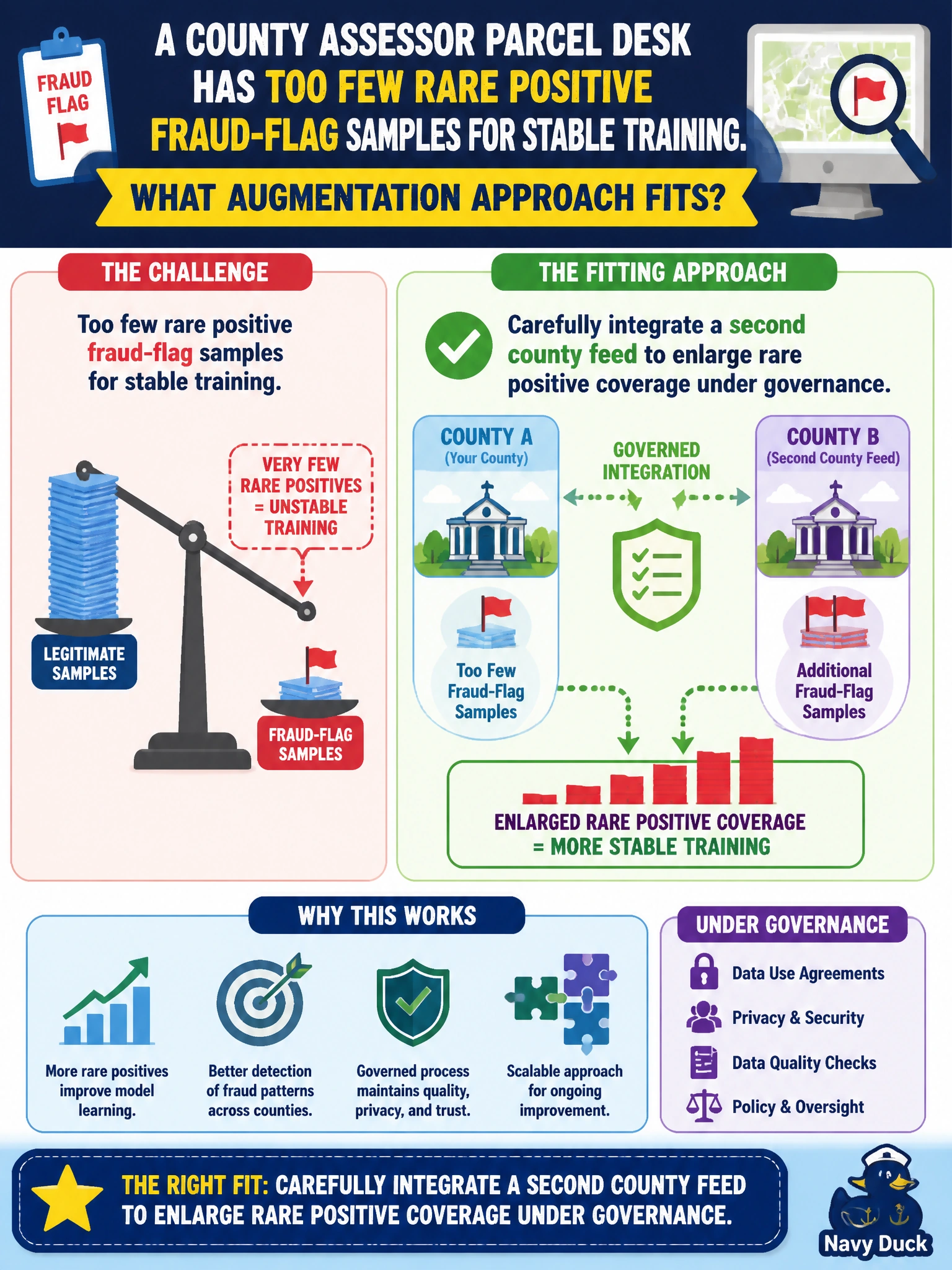
When rare flags are scarce, borrow a carefully governed second county feed—more real examples beat inventing fantasy labels.
Full Explanation
County assessor fraud-flag positives are often scarce. A sound augmentation path is carefully integrating a second county feed to enlarge rare positive coverage under governance—shared schemas, data-sharing agreements, PII controls, and documented provenance—so training sees more real minority examples rather than fantasies. Ignoring scarcity and training only on majority “clean” parcels yields a majority classifier that misses the fraud patterns assessors care about in rare flags. Fabricating random labels without source controls invents false supervision, corrupts evaluation, and can create liability if scores drive audits. Blindly duplicating the same rare row thousands of times without review creates brittle memorization of a tiny template rather than diverse positive coverage across parcel contexts. Exam caveat: scarce positives favor governed external or multi-jurisdiction real-data integration over fake labels or naive duplication. Operational check: negotiate a governed second-county feed, align parcel schemas, deduplicate, label-quality review the rare positives, then retrain and measure minority precision and recall for the assessor fraud model on a held-out real slice. In municipal practice for this NCA-ADS scenario (item q091), document the decision, retain evidence for auditors, and re-validate holdout civic metrics after any change so operational owners can defend the choice under scrutiny.