
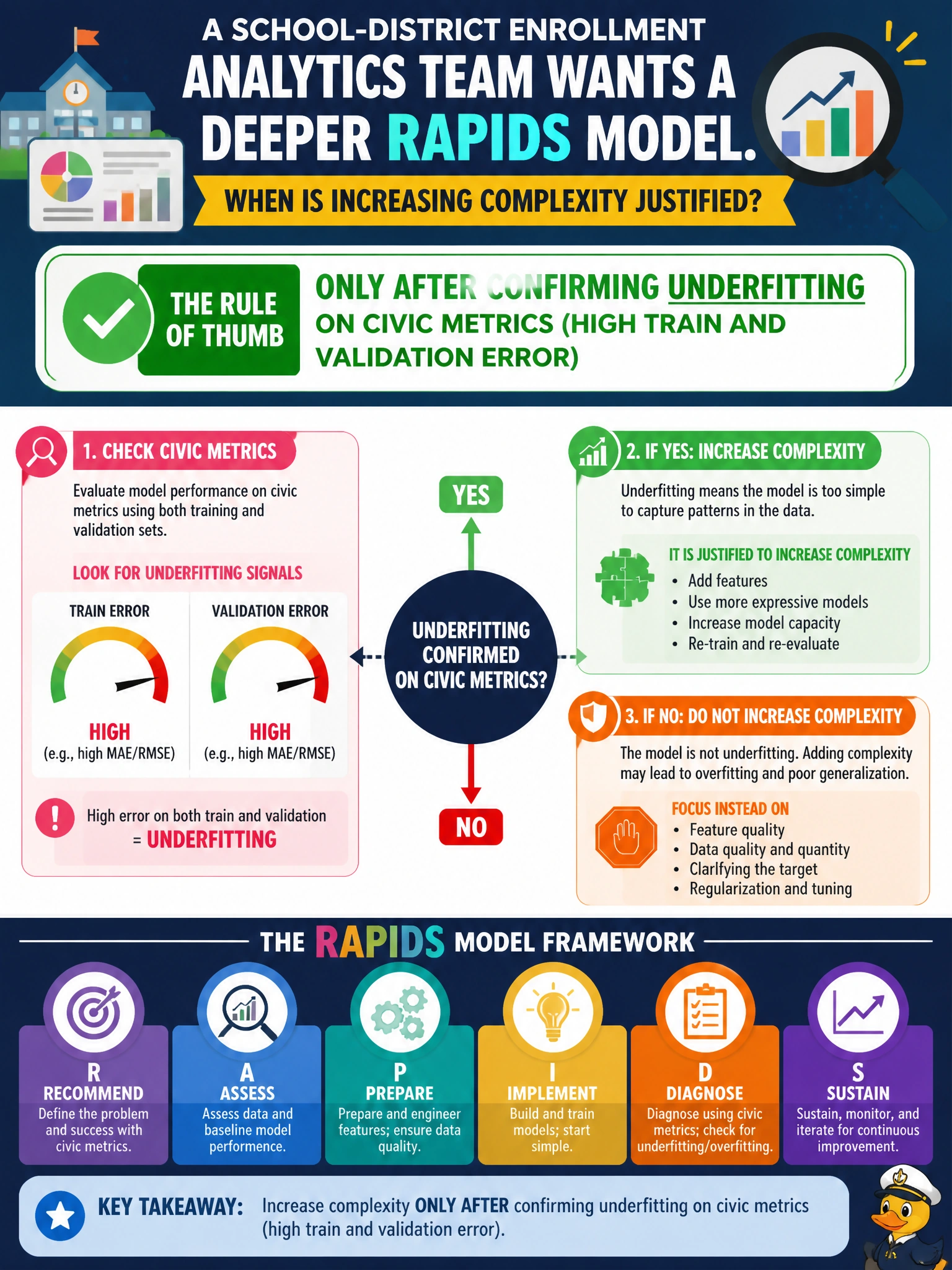
A school-district enrollment analytics team wants a deeper RAPIDS model. When is increasing complexity justified?
Select an answer to reveal the explanation.
Short Explanation
Don’t buy a bigger engine until you’ve proven the little one can’t pull—confirm underfitting on real civic scores first.
Full Explanation
A school-district enrollment analytics team should increase RAPIDS model complexity only after confirming underfitting on civic metrics—specifically high training and validation error showing the current model cannot fit enrollment patterns. Complexity without that diagnosis adds cost, latency, and overfit risk for little educational-operations gain. Increasing complexity whenever a newer library ships confuses tooling fashion with modeling need and can destabilize a pipeline that was already adequate. Reacting immediately after any single weak fold without diagnosing bias versus variance can chase noise instead of a true underfit regime across enrollment cohorts. Building a more “impressive” architecture because leadership asked fails technical governance: enrollment decisions need justified capacity, not theater. Exam caveat: complexity follows diagnosed underfitting (high train and validation error), not library novelty or stakeholder aesthetics. Operational check: document train and validation enrollment errors and residual patterns; only if both errors stay high after a feature review should the district authorize a deeper RAPIDS architecture and re-benchmark against the simpler baseline.