
A parks and recreation demand desk finds a housing-adjacent demand model is memorizing parcel IDs instead of learning transferable patterns. What should they change?
Select an answer to reveal the explanation.
Short Explanation
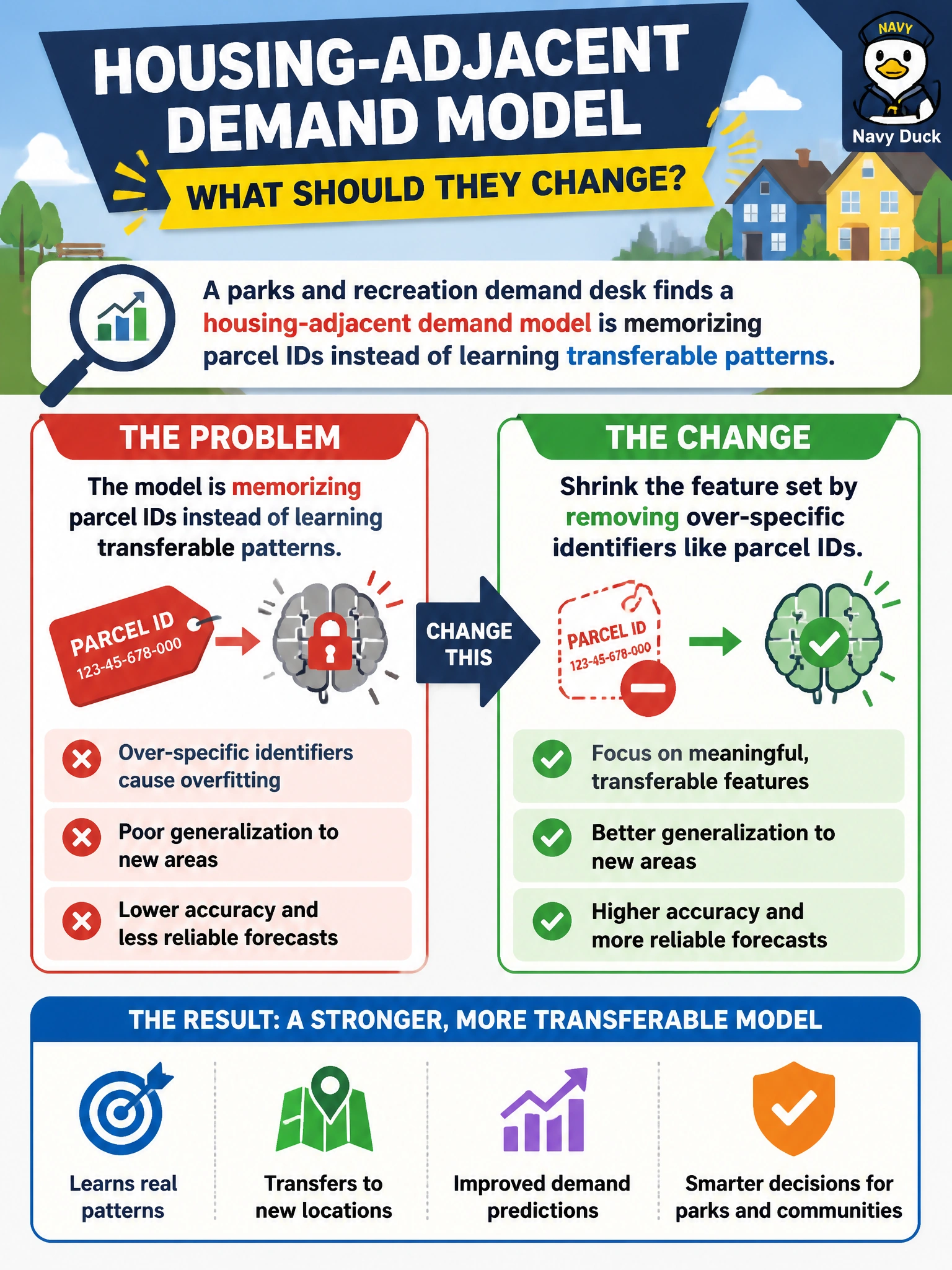
You’re looking for patterns that transfer across neighborhoods, not parcel name tags. Removing over-specific identifiers like parcel IDs helps the model learn generalizable demand signals.
Full Explanation
Parks and recreation demand models that memorize parcel IDs learn name tags instead of transferable neighborhood or amenity patterns that should drive housing-adjacent demand forecasts. Shrinking the feature set by removing over-specific identifiers pushes the model toward generalizable civic signals—distance, land use, seasonality, and program mix—that work on parcels not seen in training. Encoding parcel IDs as high-capacity embeddings and keeping them forever institutionalizes memorization and weakens generalization to new parcels the parks desk must plan for. Duplicating parcel ID columns amplifies the identity signal, worsening overfitting rather than teaching demand structure. Evaluating only on the same parcels seen in training conceals the generalization failure and produces misleadingly good metrics for planning use. Exam caveat: identifier memorization is addressed by removing over-specific IDs; embedding or duplicating them, or restricting evaluation to seen parcels, does not solve it. Practical check: retrain without parcel IDs, validate on geographically held-out parcels, and confirm metrics remain useful where IDs cannot be looked up at scoring time. In municipal practice for this NCA-ADS scenario (item q089), document the decision, retain evidence for auditors, and re-validate holdout civic metrics after any change so operational owners can defend the choice under scrutiny.