
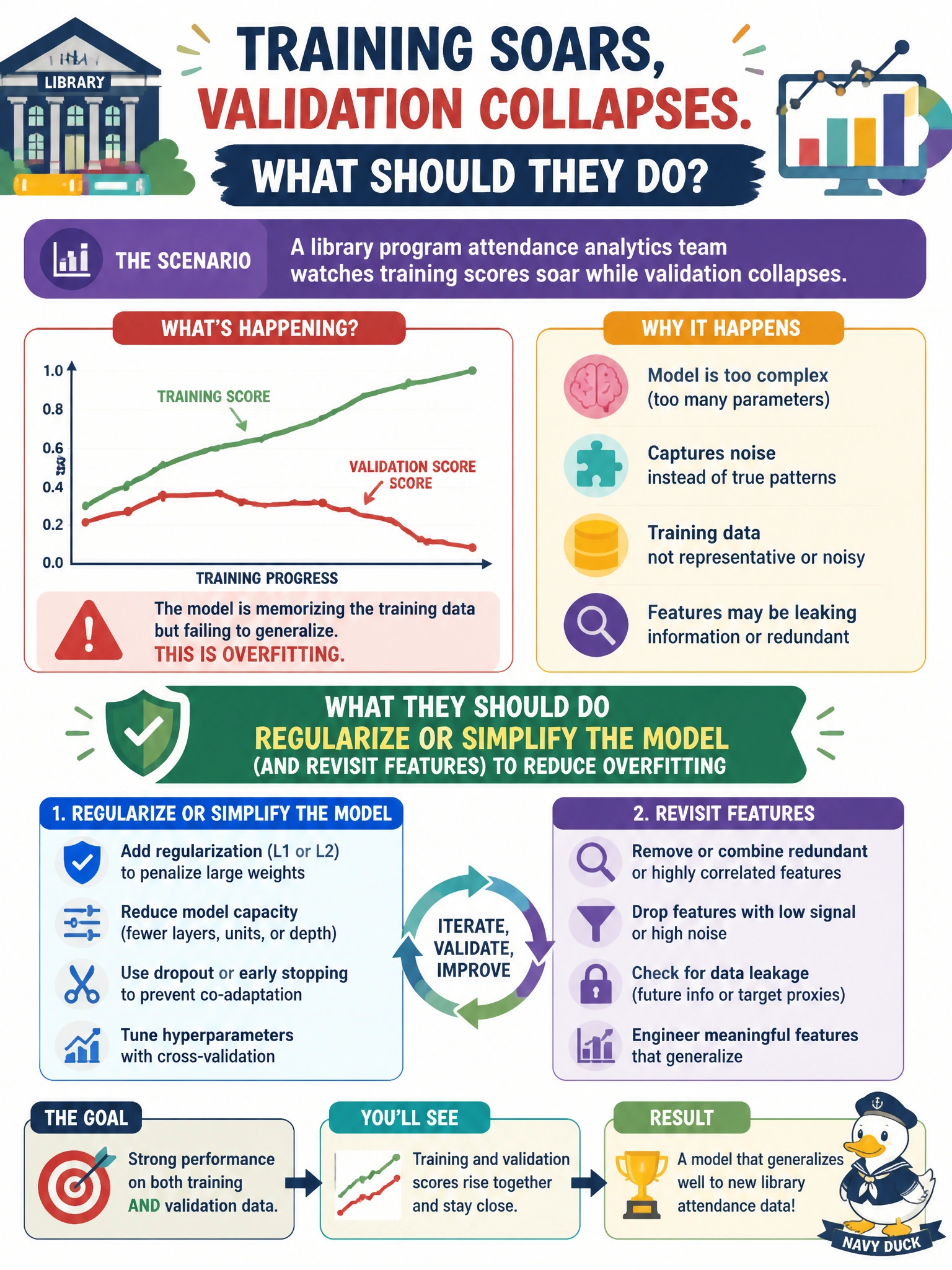
A library program attendance analytics team watches training scores soar while validation collapses. What should they do?
Select an answer to reveal the explanation.
Short Explanation
When homework is perfect but the pop quiz goes badly, you’re seeing overfitting: the model memorized quirks instead of learning patterns that transfer. You can simplify or regularize it and revisit its features, rather than relying on attendance IDs or training scores alone.
Full Explanation
When library attendance scores soar on training data while validation performance collapses, the model is overfitting: it has memorized quirks of the training programs instead of learning transferable attendance drivers, such as schedule, topic, and neighborhood demand. Regularizing or simplifying the model and revisiting its features can reduce this gap by discouraging excessive complexity and reliance on overly specific patterns. Adding raw attendance IDs as memorization features encourages identity lookup rather than learning program-level patterns, so it is unlikely to generalize to new offerings. Reporting only training scores conceals the validation collapse and could lead leadership to approve a model that fails on unseen programs. Increasing depth until training accuracy reaches 100% without checking validation performance moves in the opposite direction, further embedding overfitting. Exam caveat: a large gap between training and validation performance is a warning sign, not evidence that perfect training accuracy means the model is ready. Practical check: remove ID-like features, regularize or reduce model complexity, confirm the library’s validation gap shrinks, and present both training and validation attendance metrics to stakeholders before promoting the model.