
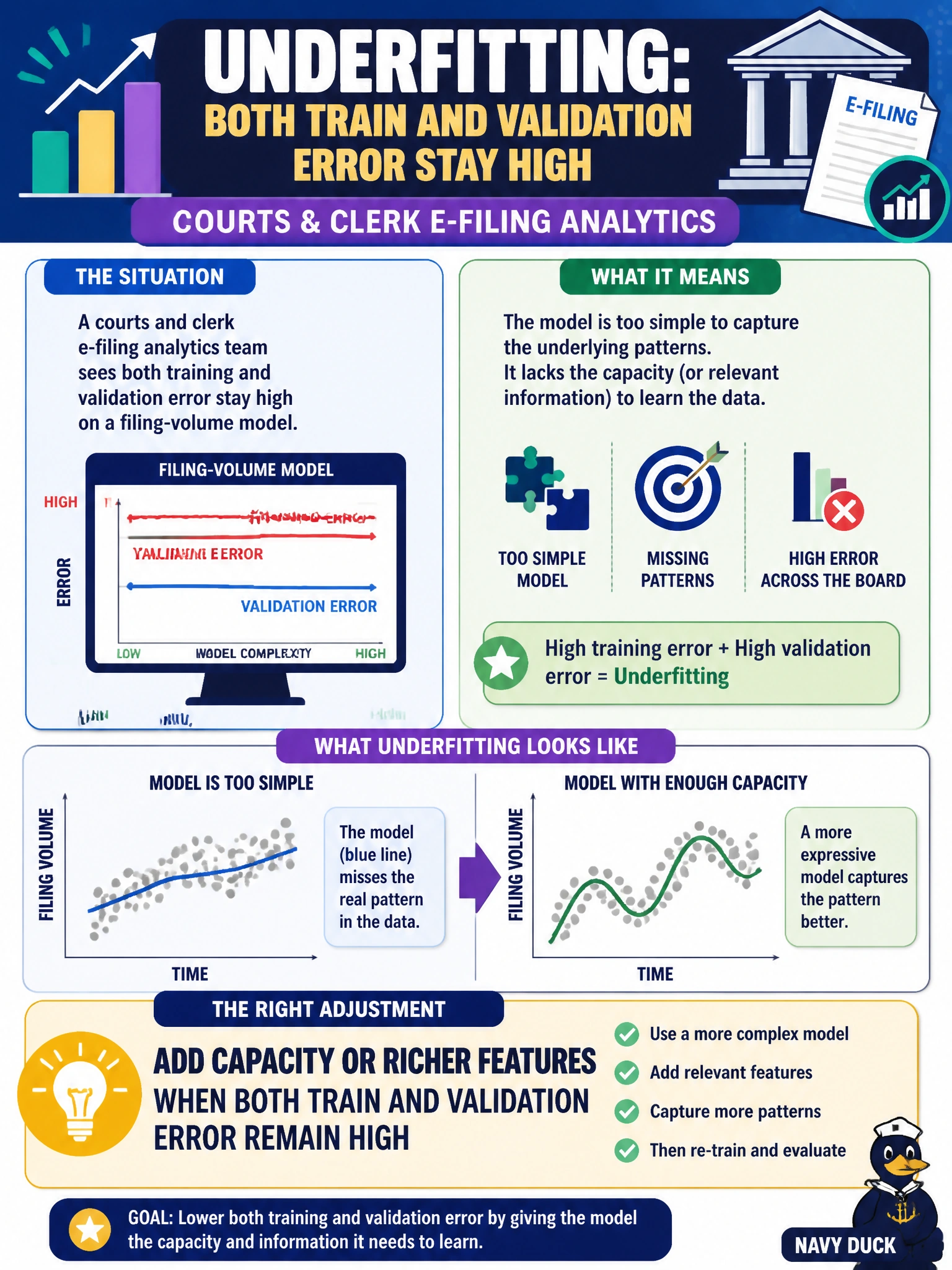
A courts and clerk e-filing analytics team sees both training and validation error stay high on a filing-volume model. What adjustment fits underfitting?
Select an answer to reveal the explanation.
Short Explanation
If the model flunks the practice quiz and the real quiz, it’s underpowered—give it richer features or a bit more capacity, not a tighter muzzle.
Full Explanation
Courts and clerk e-filing volume models that show both training and validation error remaining high are underfitting: the hypothesis class or feature set lacks capacity to capture filing patterns across dockets and seasons. Appropriate adjustments include richer features (calendars, court-type encodings, seasonal civic demand) and/or more model capacity—not immediate heavy regularization that further constrains an already weak fit. Adding heavy regularization and cutting features further when both errors are already high typically worsens underfitting instead of curing it. Assuming overfitting without checking that train error is also high misdiagnoses the regime; overfitting shows a large train–validation gap, not uniformly elevated error on both splits. Stopping data collection because error is high is defeatist and unrelated to the capacity or feature remedy indicated for underfitting on clerk analytics. Exam caveat: high train and high validation error means underfit—add capacity or features; a large train–val gap means overfit—regularize or simplify. Operational check: log train and validation curves for the e-filing model; if both stay high, expand features or capacity, re-evaluate, and only then tune regularization strength for the clerk analytics desk.