
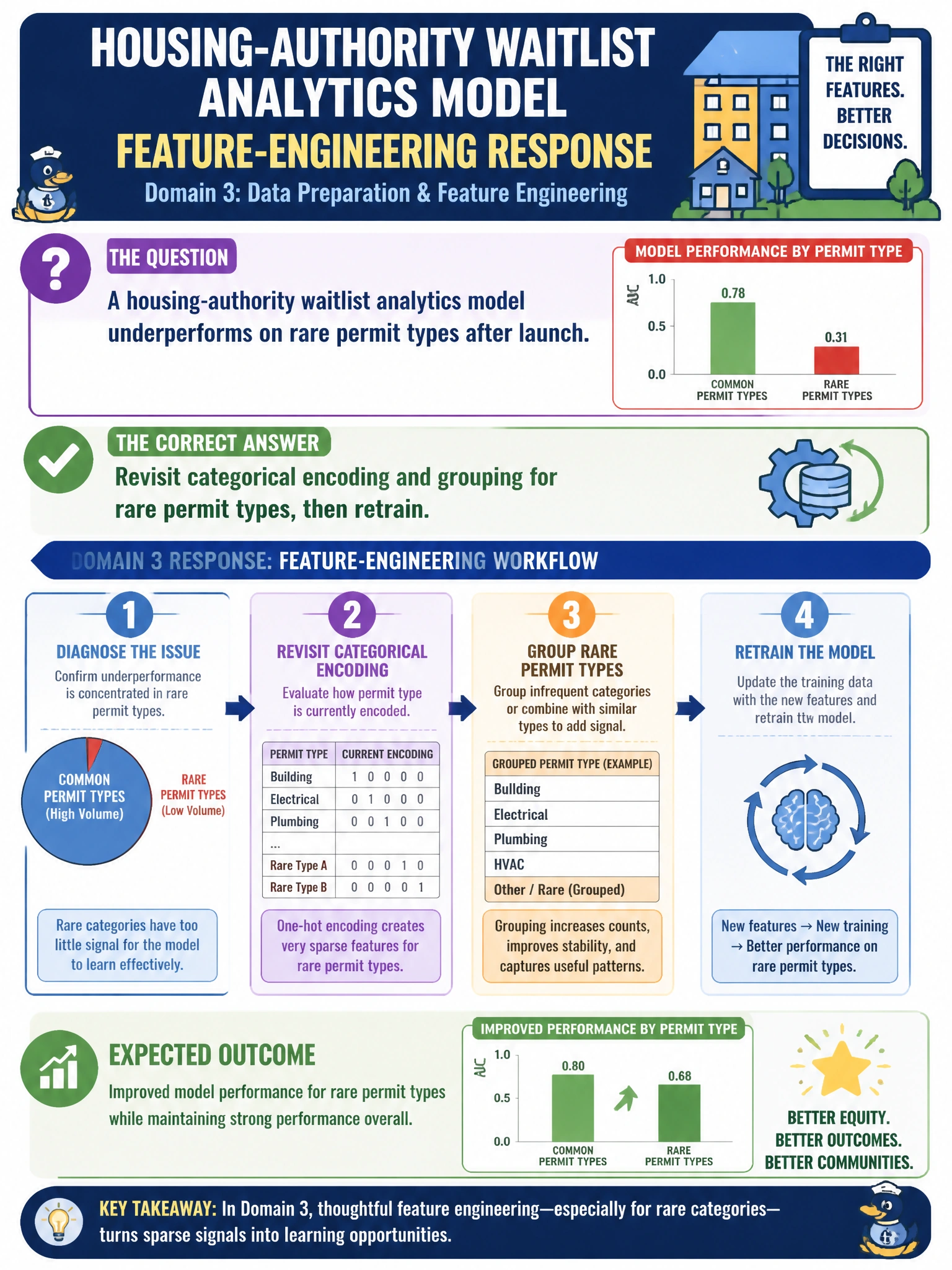
A housing-authority waitlist analytics model underperforms on rare permit types after launch. What feature-engineering response fits Domain 3 practice?
Select an answer to reveal the explanation.
Short Explanation
Rare permit codes are like odd library call numbers—if the encoding mashed them into mush, regroup and re-encode, then try again.
Full Explanation
When a housing-authority waitlist model underperforms on rare permit types after launch, Domain 3 practice is to revisit categorical encoding and rare-level grouping, then retrain. Scarce permit codes often get smashed into unstable one-hots, noisy target encodings, or an undifferentiated “other” bucket; regrouping rare levels, improving encodings, and iterating features targets the actual failure mode residents experience. Freezing the encoding forever and blaming the GPU ignores a fixable feature problem and does not address rare-class errors on the waitlist. Adding duplicate columns of the same weak encoding increases redundancy and dimensionality without injecting new information about scarce permit types. Removing rare classes from evaluation only hides the failure; headline metrics look fine while decisions on scarce permit types remain weak and inequitable. Exam caveat: post-launch rare-category weakness calls for iterating encoding or grouping and retraining—not gaming evaluation by dropping rare classes. Operational check: audit frequency and error rates by permit type, define a rare-level policy (group, hierarchical encode, or targeted sampling), retrain, and re-check minority permit metrics before republishing the housing-authority model.