
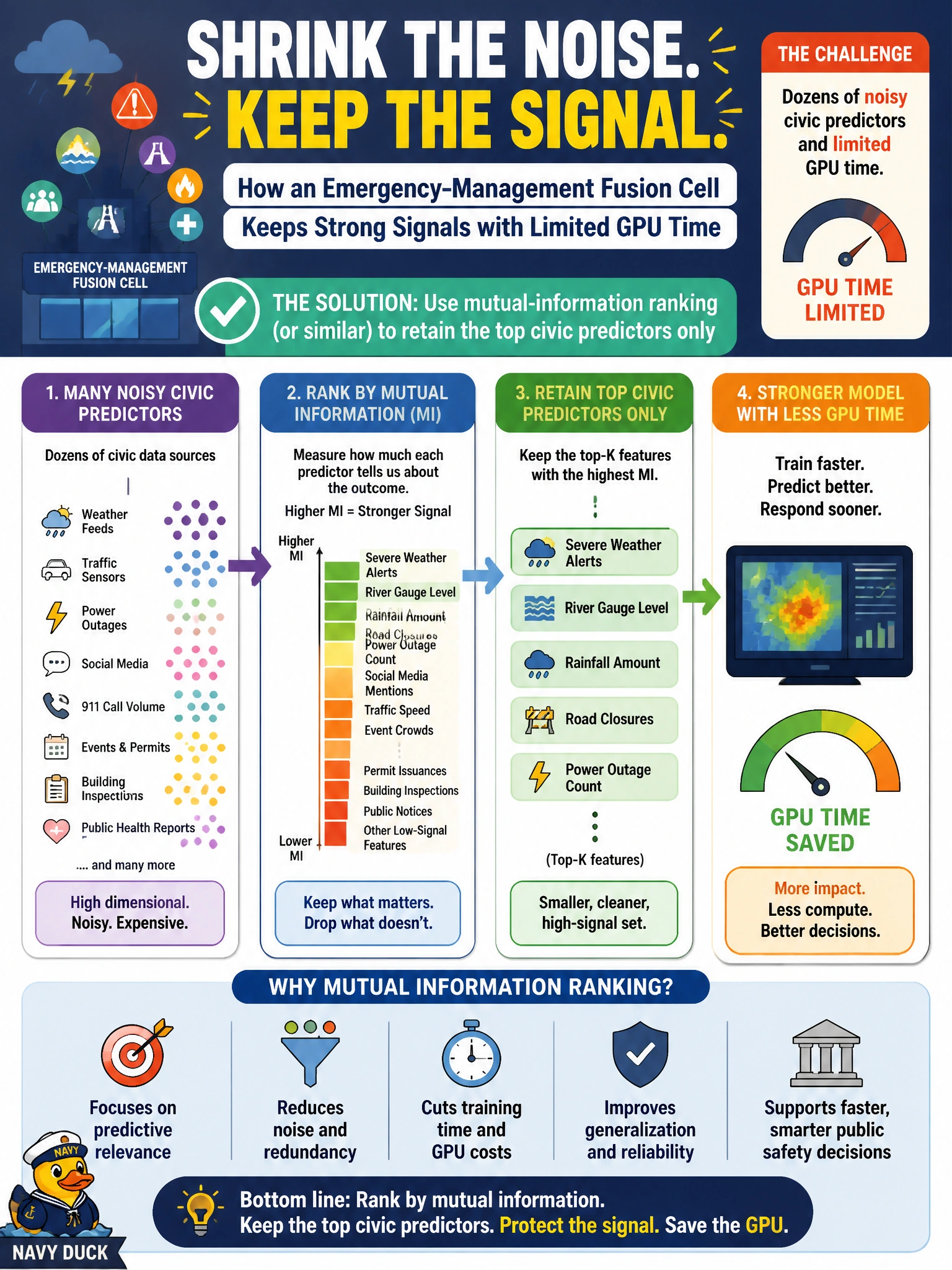
An emergency-management fusion cell has dozens of noisy civic predictors and limited GPU time. How should they shrink the feature set while keeping strong signals?
Select an answer to reveal the explanation.
Short Explanation
Too many sirens drown the real alarm—rank features by mutual information and keep the loudest civic signals for the fusion cell.
Full Explanation
An emergency-management fusion cell with dozens of noisy civic predictors and limited GPU time needs principled feature reduction rather than ad-hoc column dropping. Mutual-information ranking (or a comparable filter/wrapper ranking) scores how much each predictor informs the target, letting the team retain top civic signals and drop noise—saving GPU cycles without alphabetical or identity-column superstition. Keeping every column including pure identifiers fails: IDs add cardinality and memorization risk while consuming memory without transferable emergency-signal value across incidents. Dropping all numeric features for free-text dumps throws away structured predictors that often dominate triage models and may explode tokenize-and-embed compute under GPU limits. Selecting by alphabetical column order is arbitrary and unrelated to predictive value for fusion-cell risk scoring. Exam caveat: limited compute plus many noisy features points to ranking by mutual information (or similar), not keep-all, text-only, or alphabetical selection. Operational check: compute MI (or permutation importance) on a held-out emergency slice, keep a documented top-k civic feature list, retrain under the GPU budget, and verify validation quality does not collapse after the shrink.