
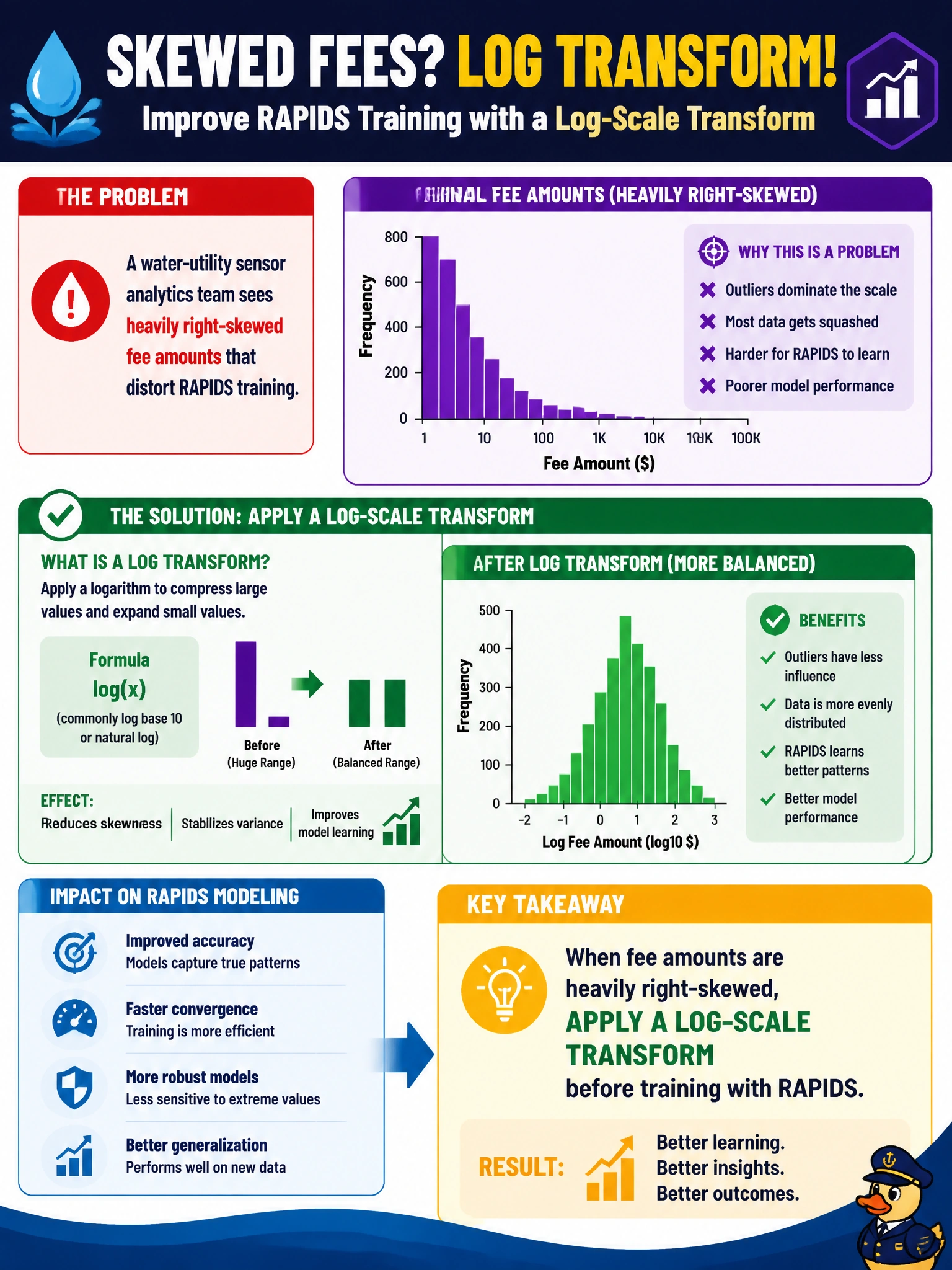
A water-utility sensor analytics team sees heavily right-skewed fee amounts that distort RAPIDS training. Which transformation best improves the feature for modeling?
Select an answer to reveal the explanation.
Short Explanation
Those giant fee spikes can squash the smaller amounts, making it harder for your model to learn from them. A log-scale transform is like zooming the map so both the creek and the reservoir show up.
Full Explanation
Heavily right-skewed water-utility fee amounts compress most observations into a narrow band while a few extreme bills dominate scale-sensitive learning. Applying a log-scale transform before training reduces the skew and can stabilize RAPIDS training for monetary or volume features, while retaining legitimate high fees in the distribution. Replicating the highest-fee records to make the distribution appear balanced invents artificial mass at the extremes and distorts the fee distribution that sensor analytics should learn. Deleting every row with a non-zero fee removes the signal under study and leaves an unrepresentative near-zero slice of the data, which is not useful for billing or anomaly models. Replacing fees with random noise destroys predictive content under the guise of “regularization” and does not treat skew. Exam caveat: for skewed continuous civic amounts, a log-scale transform is appropriate; deleting signal, duplicating extremes, and injecting noise are distractors. Practical check: plot fee histograms before and after the transform, confirm training stability and validation lift for the sensor analytics model, and document the transform so batch and serving paths apply the same feature recipe.