
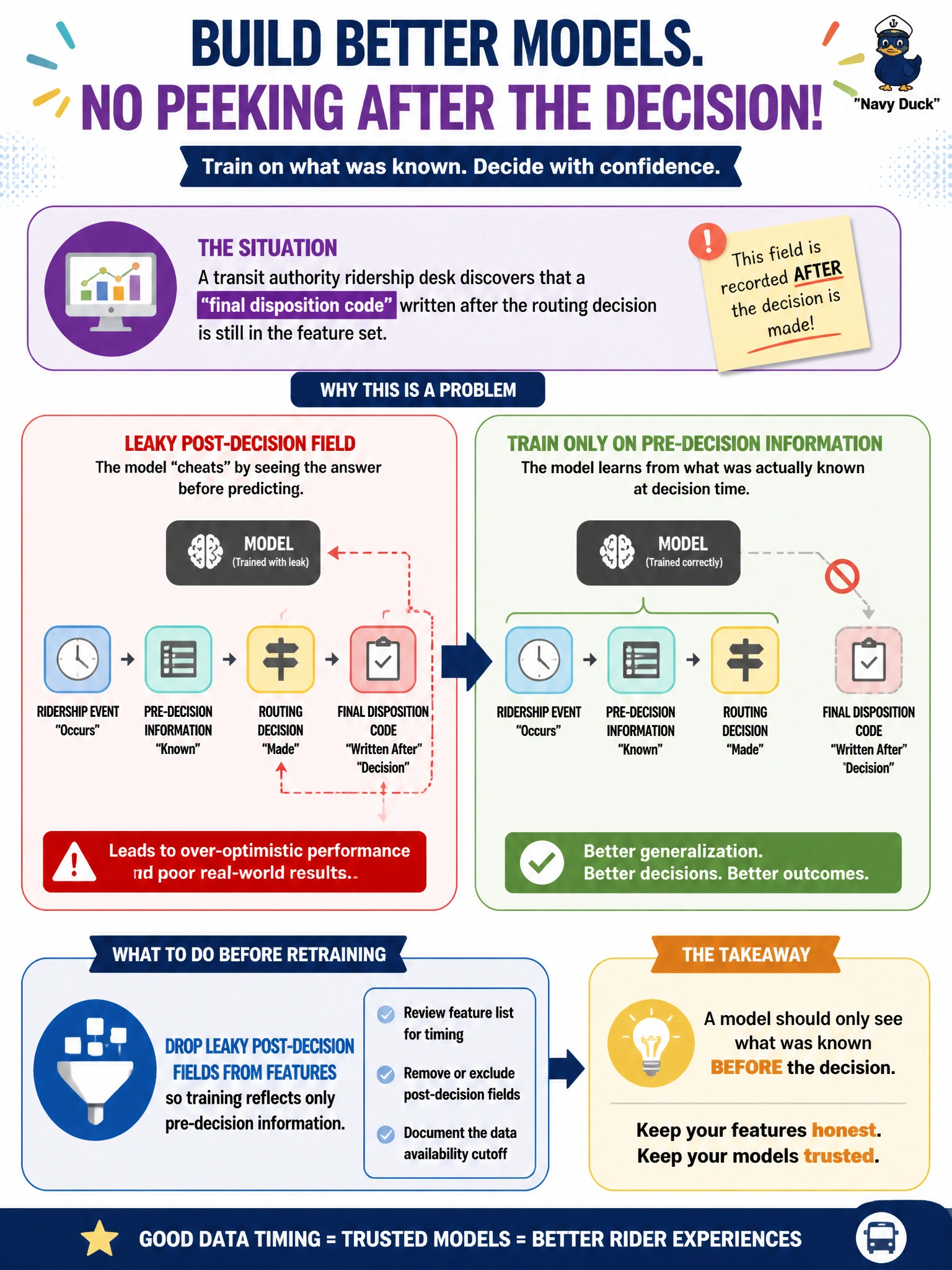
A transit authority ridership desk discovers that a “final disposition code” written after the routing decision is still in the feature set. What should they do before retraining?
Select an answer to reveal the explanation.
Short Explanation
If the answer key was written after the quiz, don’t feed it as a study tip—yank post-decision codes out of the feature bag before you retrain.
Full Explanation
A transit authority ridership desk that finds a “final disposition code” written after the routing decision still in the feature set is facing label leakage. That field encodes post-decision information unavailable at scoring time; keeping it inflates training accuracy while teaching the model something it cannot know in live routing. Before retraining, drop leaky post-decision fields so features reflect only pre-decision ridership and operations signals that a dispatcher could actually observe. Keeping the field because it raises training accuracy fails: the accuracy is contaminated and will not hold when the disposition code is absent in online inference. Encoding the leaky field more aggressively worsens leakage by amplifying a forbidden post-decision signal in importance rankings and splits. Moving it into the label while also keeping it as a feature is incoherent double use and still leaks the outcome into predictors. Exam caveat: any post-event disposition, close code, or after-the-fact outcome in features is leakage—remove it; do not celebrate the accuracy bump on the exam or in production. Operational check: for each candidate feature, ask whether a dispatcher would know its value before the routing decision; if not, exclude it, retrain, and compare honest holdout metrics for the ridership model.