
A county public-health analytics team must design a pipeline auditors can follow from source files to scored risk. What practice best supports that?
Select an answer to reveal the explanation.
Short Explanation
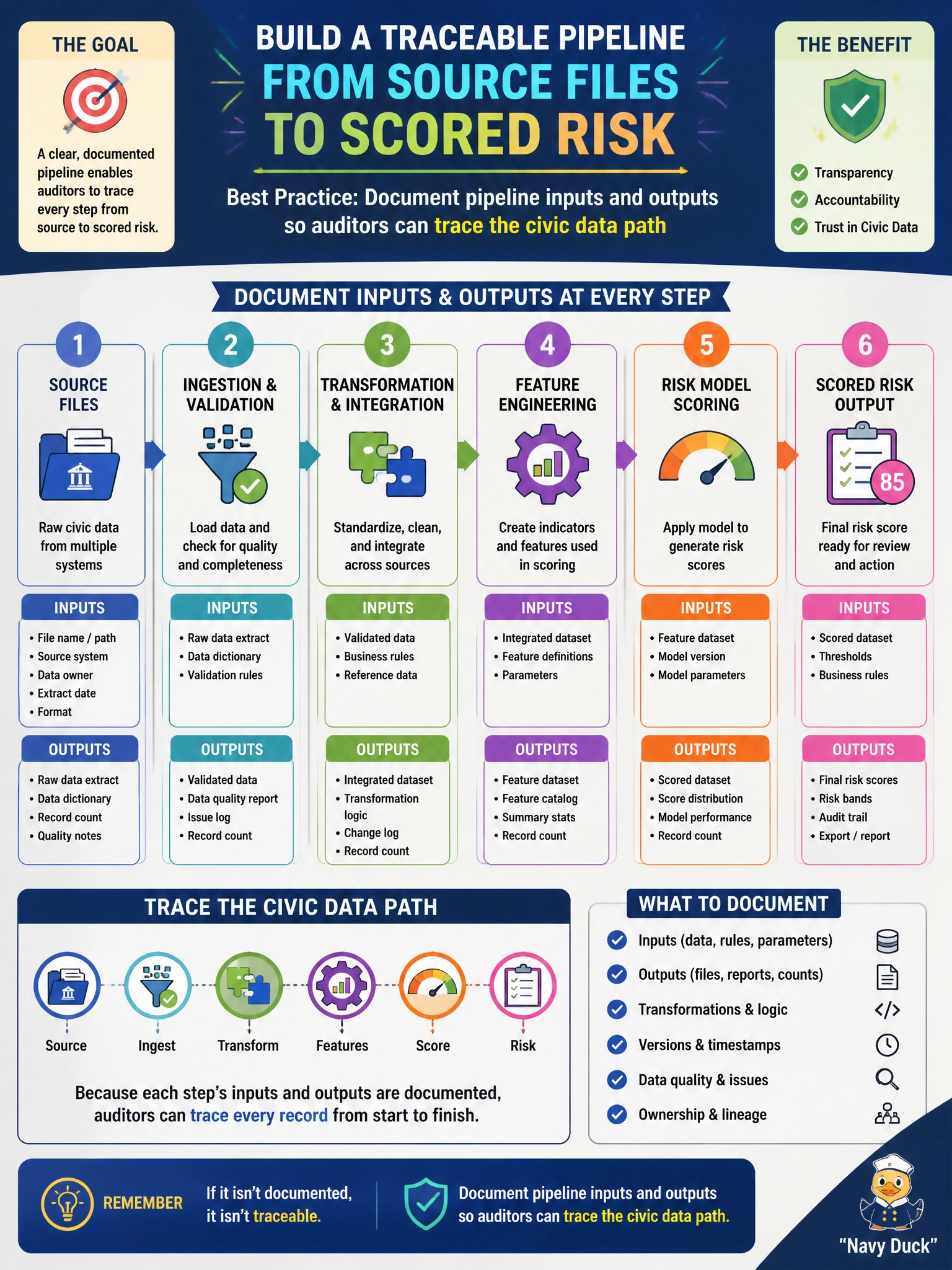
Auditors aren’t mind readers—label what goes in and what comes out so anyone can follow the breadcrumbs from source to score.
Full Explanation
County public-health auditors need to reconstruct how source files become scored risk. Documenting pipeline inputs and outputs—stage contracts, schemas, owners, and lineage—makes the civic data path reviewable and rerunnable by someone other than the author. Transparent end-to-end design is what lets an independent reviewer follow each hop from raw extracts to scored cases without reverse-engineering opaque notebooks. Hiding inputs and outputs so only the author can rerun the job fails auditability and creates bus-factor risk for the health desk when that person is unavailable during an inquiry. Relying on tribal knowledge in chat logs fails because chats are incomplete, mutable, and not an authoritative pipeline record suitable for compliance or public-health review. Changing schemas nightly without recording lineage breaks traceability: auditors cannot know which definition of a risk feature produced last week’s scores or how to reproduce them. Exam caveat: transparency items emphasize documented I/O and lineage over secrecy, chat lore, or silent schema drift in municipal pipelines. Operational check: maintain a short pipeline spec listing each stage’s inputs, outputs, owners, and retention; store it with the public-health job definitions and verify an independent analyst can rerun from documented contracts alone.