
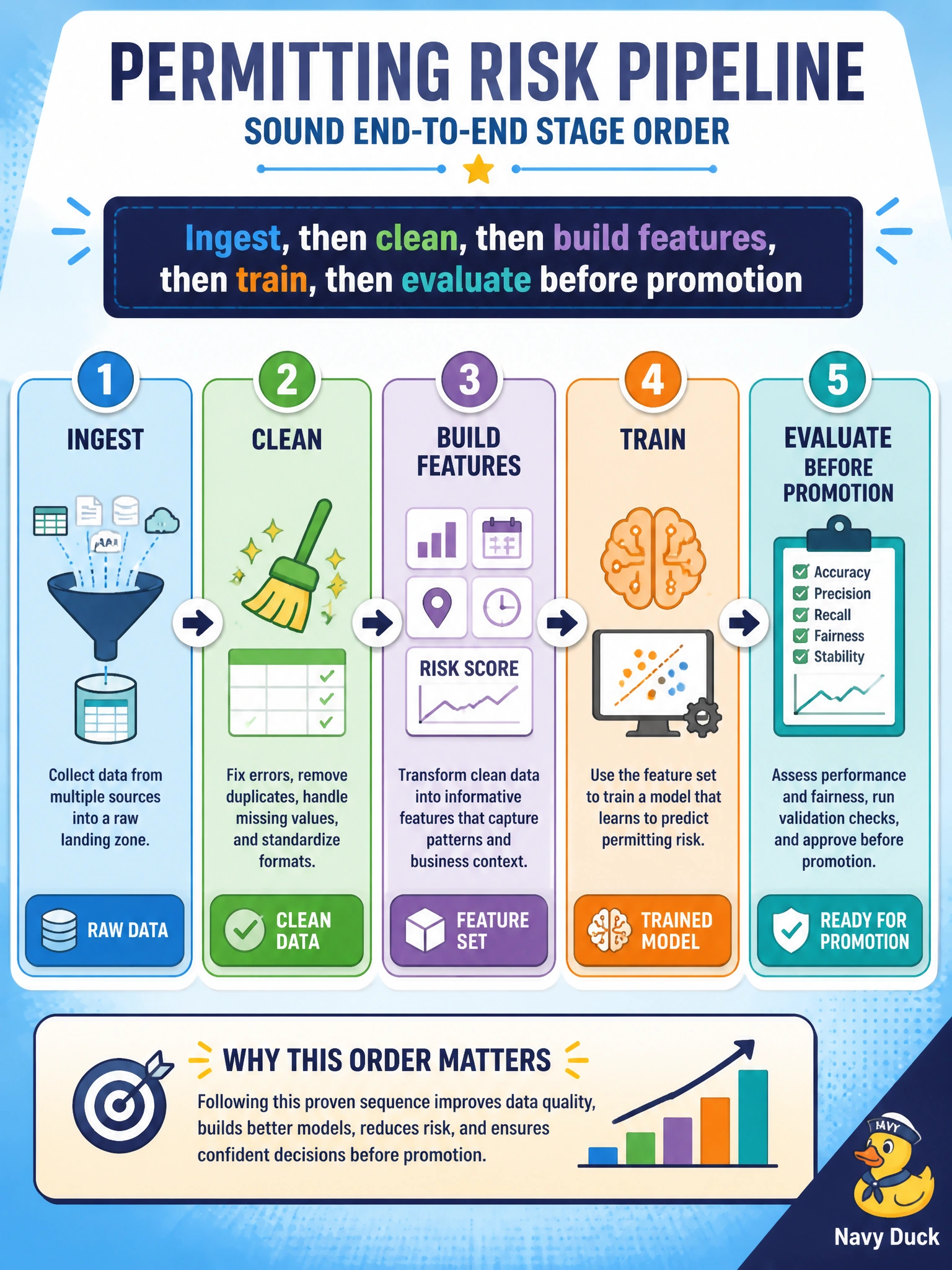
A county social-services case analytics team is designing a new permitting risk pipeline. What is the sound end-to-end stage order?
Select an answer to reveal the explanation.
Short Explanation
Build the assembly line in order: bring the data in, scrub it, shape the features, train, then grade the quiz—don’t grade before you cook.
Full Explanation
A county social-services permitting risk pipeline should follow a disciplined end-to-end order: ingest raw civic sources, clean and validate them, construct features from pre-decision information, train the model, then evaluate against holdout criteria before any promotion. That sequence keeps training honest, prevents label leakage into feature invention, and gives auditors a stage map from files to scored risk. Training first and inventing features from fitted labels reverses causality and invites leakage: features shaped after seeing outcomes overstate permitting-risk quality. Evaluating only in production while skipping cleaning and validation removes quality gates and exposes caseworkers to unvetted scores. Publishing before defining inputs or quality gates fails governance: social-services stakeholders cannot know what the model consumes or when it is safe to trust. Exam caveat: associate-level pipeline items usually reward ingest → clean → features → train → evaluate (then promote); any option that trains or publishes earlier is wrong by stage order. Operational check: encode stage contracts and a promotion gate in the county pipeline so a permitting risk model cannot enter the shared store until cleaning, feature build, training, and evaluation all pass documented criteria.