
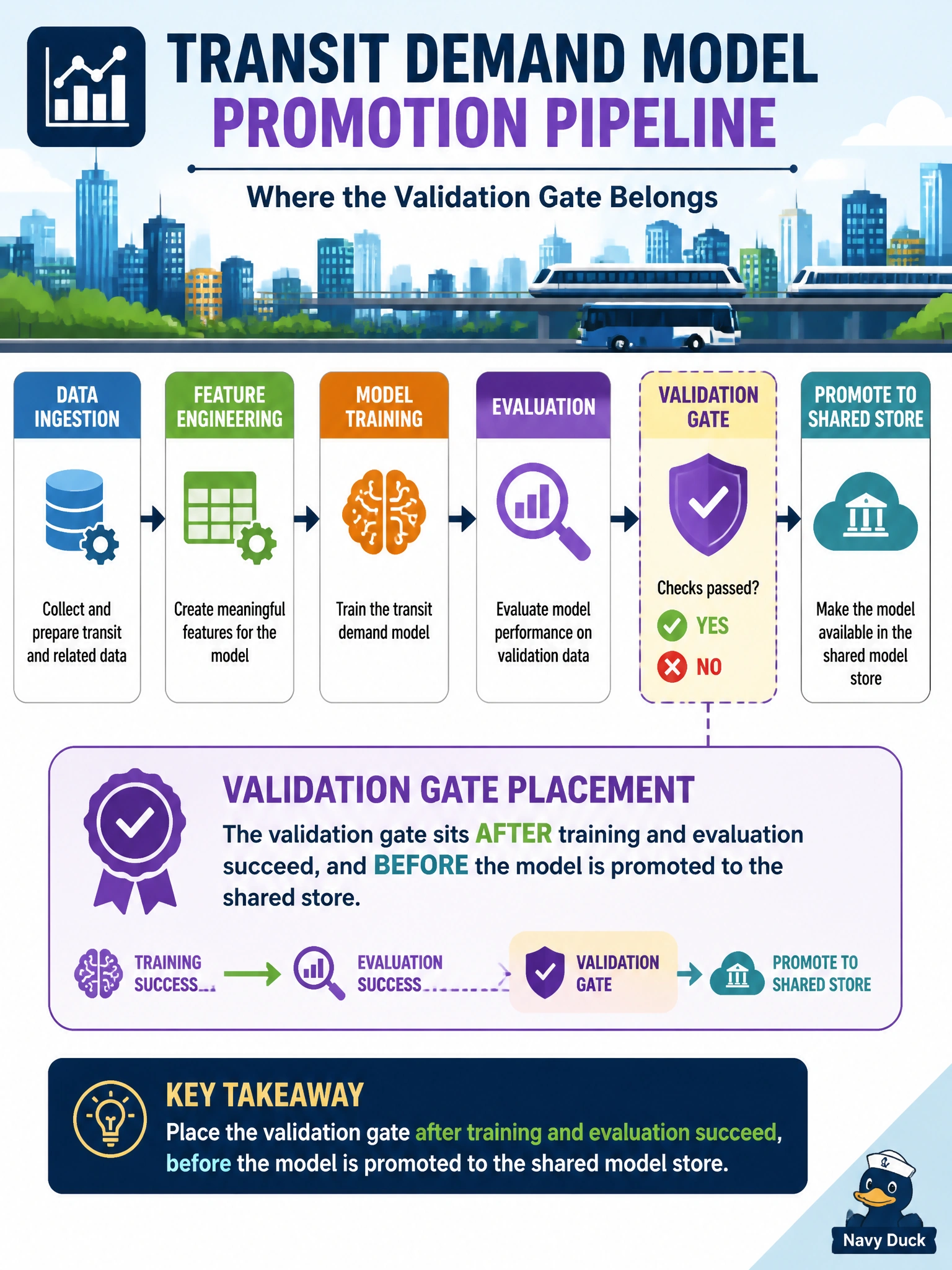
A city planning zoning analytics team wants to promote a transit demand model into the shared model store. Where should a validation gate sit in the pipeline?
Select an answer to reveal the explanation.
Short Explanation
Think of the shared store like a locked supply closet—pass the validation quiz after training before anyone gets the key.
Full Explanation
For a city planning zoning analytics transit demand model, a validation gate belongs after training and evaluation succeed and before promotion into the shared model store. That placement turns metrics into a blocking control: only models that meet civic quality criteria receive a key to the shared store, protecting downstream planners from unchecked artifacts. Placing the gate only after production has already been overwritten fails because the harmful write already happened; validation must precede promotion, not mop up afterward. Putting the gate before any ingest so evaluation never runs is nonsensical: there is nothing trained or scored to validate, and it blocks the legitimate pipeline. Treating validation as an optional slide deck with no blocking criteria fails operational design—the shared store needs enforceable gates, not presentation theater. Exam caveat: promotion-gate questions almost always want “after eval success, before shared/production store,” not before ingest and not after overwrite. Operational check: require signed-off holdout metrics (and schema checks) as a hard dependency in the zoning CI/CD path so transit demand candidates cannot publish to the shared store without a green validation stage.