
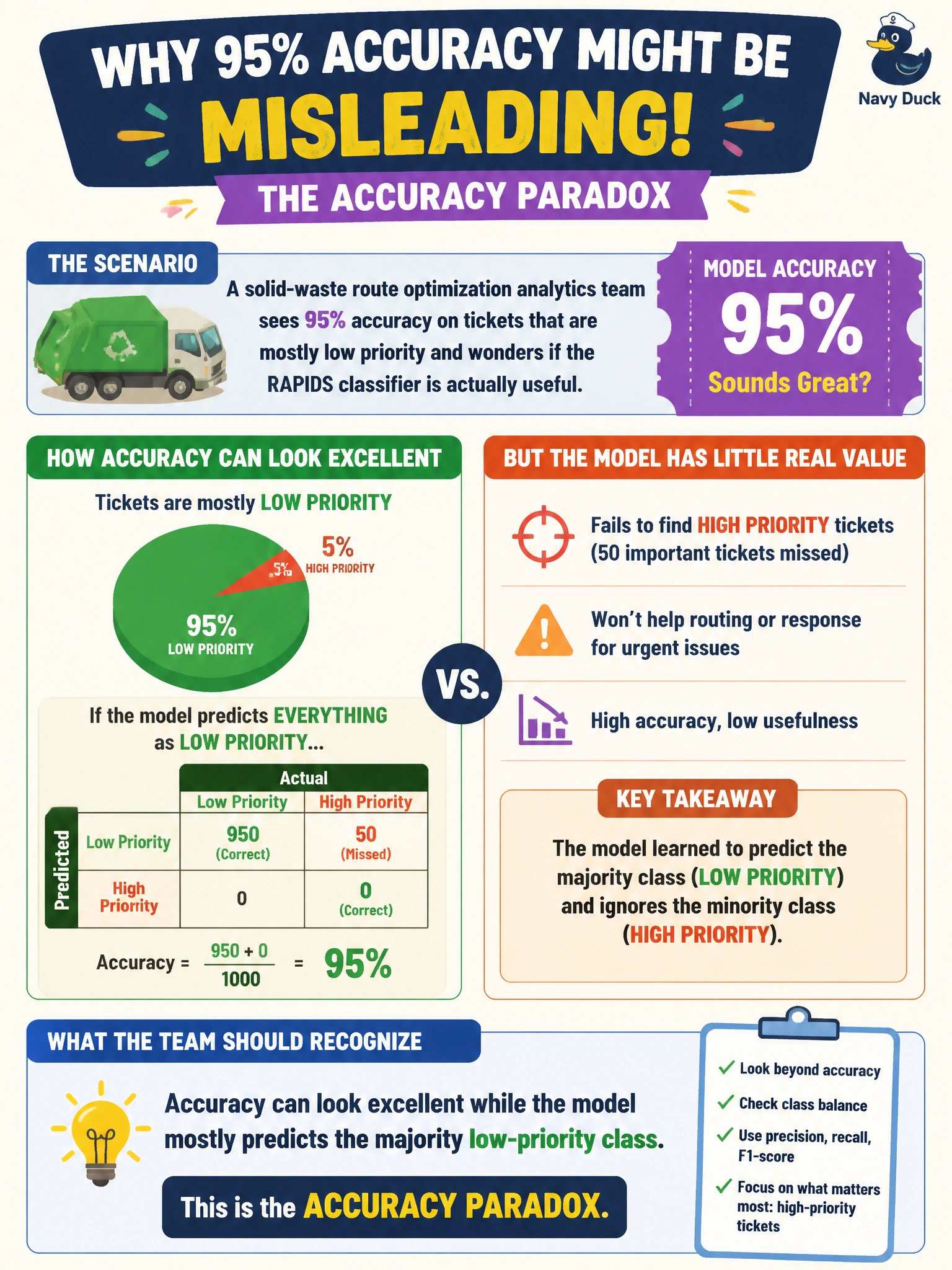
A solid-waste route optimization analytics team sees 95% accuracy on tickets that are mostly low priority and wonders if the RAPIDS classifier is actually useful. What should they recognize?
Select an answer to reveal the explanation.
Short Explanation
If almost every ticket is “low priority,” a lazy model that always says low priority still looks like a genius on accuracy—that’s the accuracy paradox.
Full Explanation
Solid-waste route optimization tickets that are mostly low priority create classic class imbalance. A RAPIDS classifier that almost always predicts the majority low-priority class can still report ~95% accuracy because most rows are majority by definition—this is the accuracy paradox. Usefulness for the municipal analytics team therefore cannot be inferred from accuracy alone; the minority high-priority tickets that actually change routing must be inspected with precision, recall, F1, and a confusion matrix (or PR curves). Claiming 95% accuracy always proves citywide readiness fails because it ignores whether the scarce actionable class is detected at all. Saying accuracy is immune to imbalance fails because accuracy is dominated by majority correctness whenever priors are skewed. Discarding confusion matrices once accuracy exceeds 90% fails because those matrices (and class-wise rates) are exactly how civic teams verify minority performance before promoting a waste-ticket model. Exam caveat: high accuracy on imbalanced municipal tickets is a trap answer; look for the accuracy paradox framing and demand minority-aware metrics. Operational check: compare majority-baseline accuracy to the model; if gains are tiny while high-priority recall is poor, withhold citywide deploy and rebalance thresholds, sampling, or features for the solid-waste priority class.