
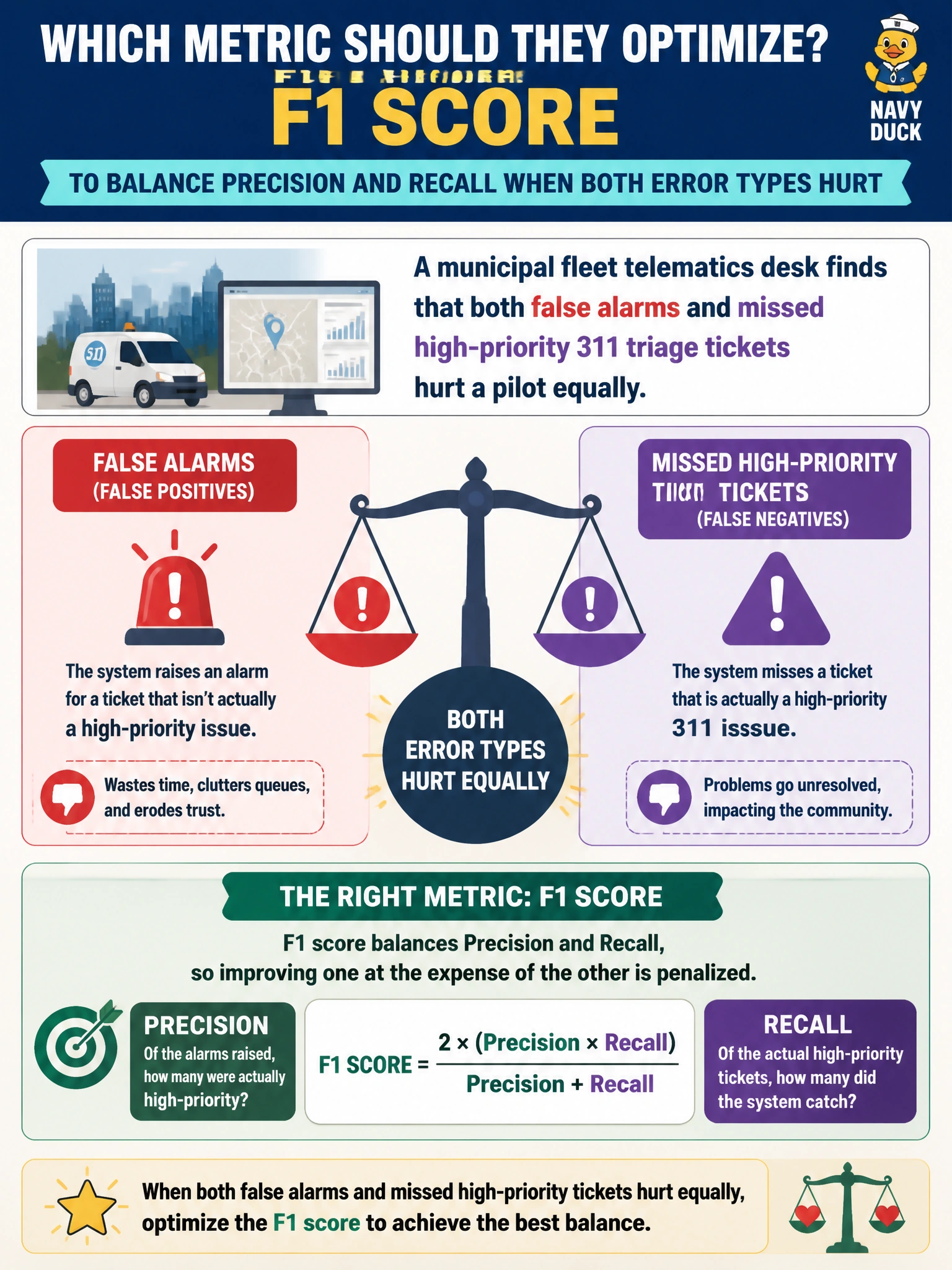
A municipal fleet telematics desk finds that both false alarms and missed high-priority 311 triage tickets hurt a pilot equally. Which metric should they optimize?
Select an answer to reveal the explanation.
Short Explanation
When false alarms and missed high-priority tickets hurt equally, you want a metric that accounts for both. F1 combines precision and recall, so you’re not optimizing for just one side of the problem.
Full Explanation
When false alarms and missed high-priority 311 triage tickets hurt equally, F1 is the appropriate target because it is the harmonic mean of precision and recall. It balances the cost of cry-wolf alerts against the cost of silent misses, rather than rewarding performance on just one side of the confusion matrix. Raw accuracy alone can mislead under class skew typical of 311 triage: a classifier that always predicts the majority low-urgency class may appear strong while missing scarce high-priority tickets that drive fleet response. Training epoch count is a process setting, not a holdout quality metric; choosing a large number of epochs does not show that false positives and false negatives are controlled. Optimizing only false-positive rate ignores misses, so it may quiet the alert queue while leaving high-priority tickets undetected, despite the stated equal harm. Exam caveat: when a question says both error types hurt equally or similarly, favor F1 over raw accuracy or a single-sided rate. Practical check: on a labeled telematics/311 holdout, report precision, recall, and F1 at the chosen threshold, and verify that neither error type is being overlooked before recommending citywide rollout of the triage model.