
An elections operations (non-partisan) data team must explain precision versus recall tradeoffs to a non-technical department head reviewing a ballot-box logistics risk model. What should they emphasize?
Select an answer to reveal the explanation.
Short Explanation
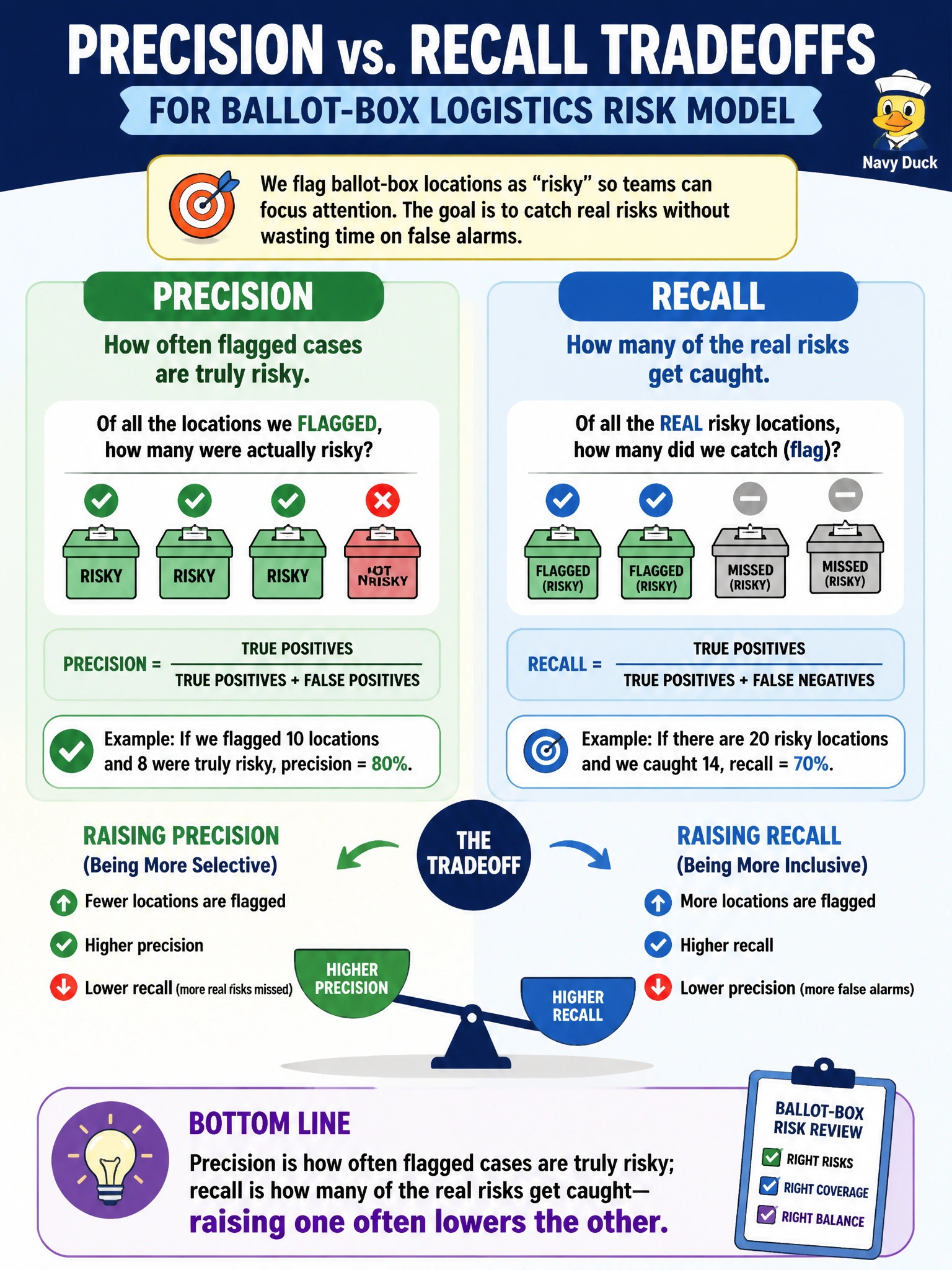
Think of a metal detector at city hall: precision is “when it beeps, is it real?”, recall is “did we catch the risky ones?”—tighten one and the other usually slips.
Full Explanation
In municipal risk scoring—such as an elections operations (non-partisan) ballot-box logistics model—precision and recall answer different operational questions. Precision is the share of flagged cases that are truly risky: when the model raises an alert for a logistics cell, how often that alert is justified. Recall is the share of truly risky cases that the model catches: of all real logistics risks in the civic data, how many did the detector surface. Raising the decision threshold usually improves precision (fewer false alarms to the department head) while lowering recall (more missed risks). Lowering it does the opposite. The correct emphasis therefore teaches the non-technical reviewer that these metrics trade off; they are not interchangeable labels for “how good the model is.” Calling precision and recall synonyms for overall accuracy fails because accuracy mixes all correct predictions and ignores the asymmetric cost of false alarms versus misses in ballot logistics. Treating only training loss as meaningful fails because loss optimizes fitting behavior during training and does not communicate deploy-time civic error types the department head must accept. Claiming recall equals one minus accuracy invents a false identity: accuracy, precision, and recall are defined on different ratios of the confusion matrix, so no such algebraic “no tradeoff” rule exists. Exam caveat: NCA-ADS items often pair a municipal narrative with a classic precision–recall tradeoff; do not equate either metric with accuracy, and do not assume one always dominates. Operational check: before briefing leadership, plot precision–recall (or threshold sweeps) on holdout ballot-logistics tickets, annotate the current operating point, and document which error type the elections desk prefers to absorb under peak volume.