
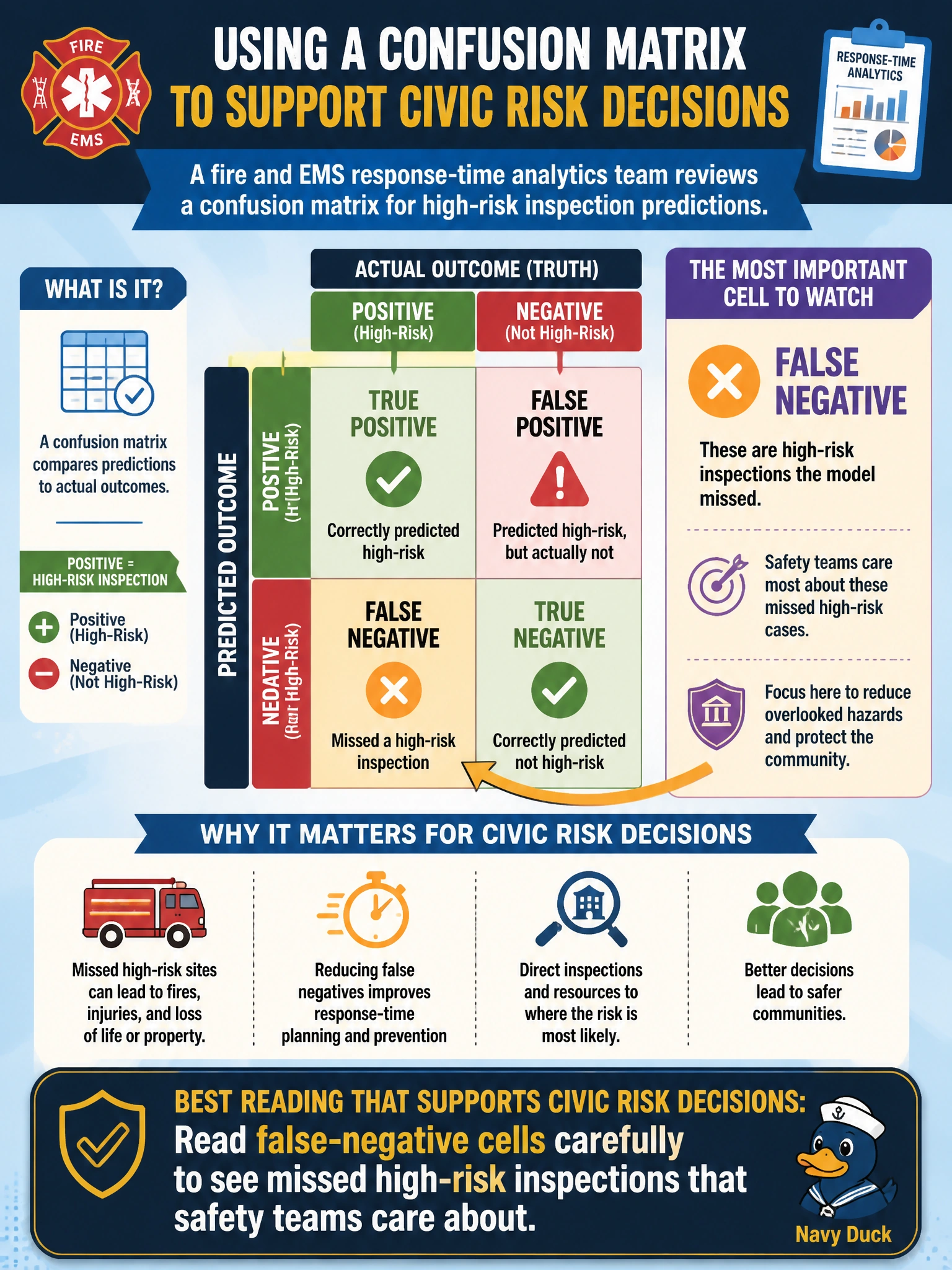
A fire and EMS response-time analytics team reviews a confusion matrix for high-risk inspection predictions. Which reading best supports civic risk decisions?
Select an answer to reveal the explanation.
Short Explanation
A missed high-risk inspection is the quiet empty square that hurts—read the false-negative cell before you celebrate accuracy.
Full Explanation
A fire and EMS response-time analytics team reviewing a confusion matrix for high-risk inspection predictions should read false-negative cells carefully to see missed high-risk inspections that safety teams care about. False negatives are the quiet failures where risk existed but the model said otherwise—exactly the misses that drive civic safety cost. Matrix literacy at associate level means tying cell types to operational harm, not celebrating accuracy alone.
Ignoring false negatives because only overall accuracy matters for safety fails by concept: accuracy can look fine while rare high-risk misses remain. Treating false positives and false negatives as interchangeable with no operational cost difference ignores asymmetric civic costs—extra review versus missed hazard are not equal. Using the matrix only to decorate slides and never count error types abandons its diagnostic purpose.
Exam caveat: class imbalance can make accuracy high while FN rates on the high-risk class remain unacceptable; always pair the matrix with per-class rates and domain cost discussion. Operational check: build the confusion matrix on a validation set with clear high-risk labels, compute false-negative rate for that class, review sample FN cases with fire/EMS inspectors, and set a maximum tolerated miss rate before any automated inspection-priority model goes to pilot.