
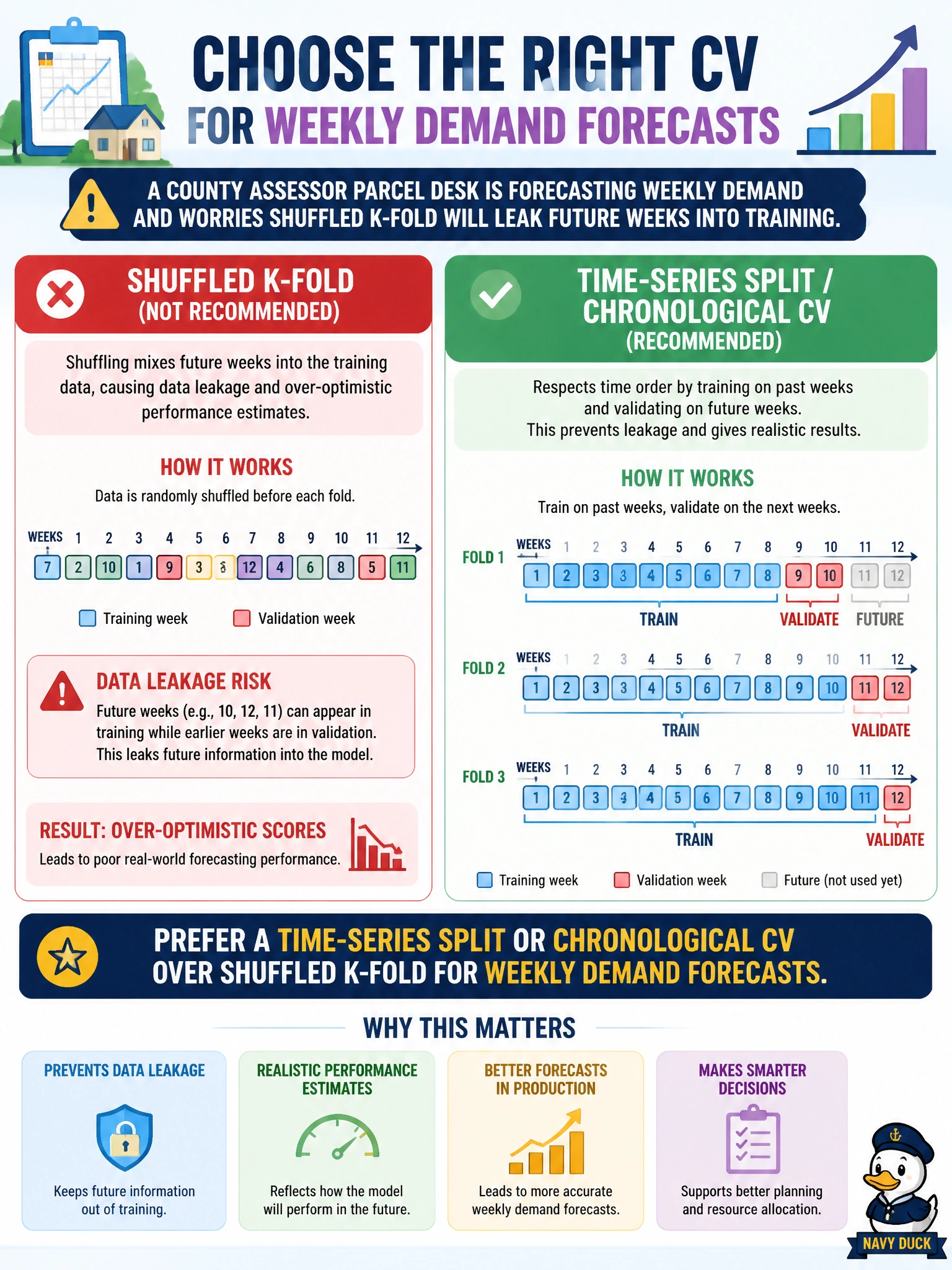
A county assessor parcel desk is forecasting weekly demand and worries shuffled k-fold will leak future weeks into training. Which CV design should they prefer?
Select an answer to reveal the explanation.
Short Explanation
Weekly demand is a timeline, not a shuffled deck—keep earlier weeks for training and later weeks for testing so the future doesn’t leak backward.
Full Explanation
A county assessor parcel desk forecasting weekly demand must avoid shuffled k-fold leakage of future weeks into training. Prefer a time-series split or chronological CV over shuffled k-fold: train on earlier weeks and validate on later weeks so evaluation respects temporal causality. That design matches how weekly demand forecasts will be used—predicting the future from the past—not a randomly mixed calendar.
Fully shuffled k-fold that ignores chronology for the weekly series fails by concept because future information can enter training via neighboring shuffled rows and inflate accuracy. Randomly inserting next month’s labels into earlier training weeks is explicit leakage. Evaluating only on weeks the model already trained on measures fit, not forecast skill.
Exam caveat: chronological splits still need embargo/gaps if features are rolling aggregates that peek across the cut, and abrupt policy changes can make one future block unusually hard—document the cut dates. Operational check: sort weeks ascending, choose expanding or sliding chronological folds, ban shuffled k-fold for this series, score only forward weeks, and compare against a naive seasonal baseline before the assessor desk trusts the weekly demand forecast.