
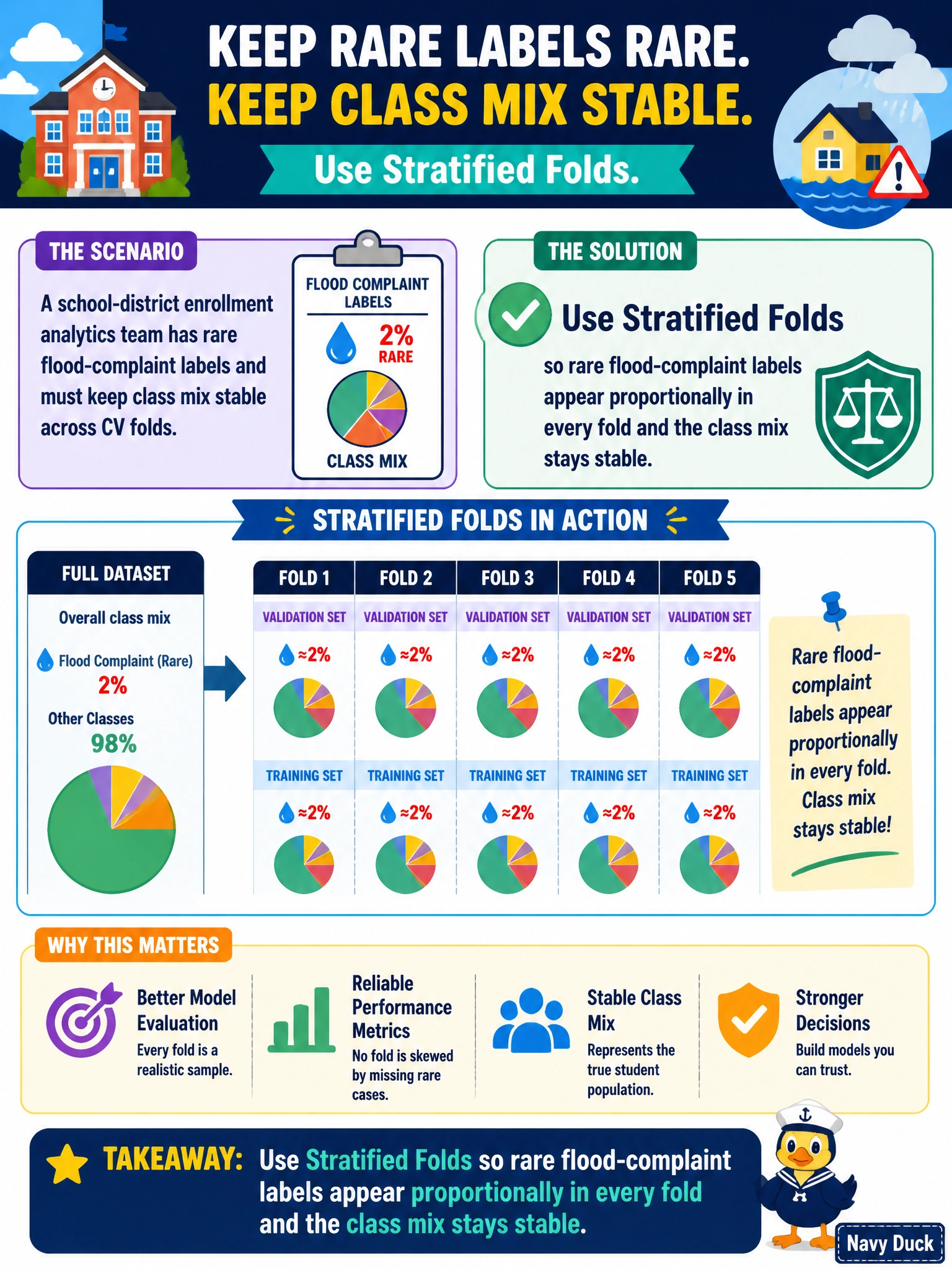
A school-district enrollment analytics team has rare flood-complaint labels and must keep class mix stable across CV folds. What should they use?
Select an answer to reveal the explanation.
Short Explanation
Rare flood flags are like scarce library stamps—stratified folds make sure each quiz pile still gets a few so folds stay honest.
Full Explanation
A school-district enrollment analytics team with rare flood-complaint labels must keep class mix stable across CV folds by using stratified folds so rare labels appear proportionally in every fold. Stratification prevents folds that accidentally contain zero minority examples, which would make validation undefined or misleading for the rare class the district cares about. That design keeps enrollment/complaint evaluation honest under imbalance.
Unstratified shuffles that often drop rare labels from some folds fail by concept—they allow empty or near-empty minority folds and unstable metrics. Discarding all minority-class rows before cross-validation erases the rare signal and cannot evaluate flood-complaint detection. Putting every rare label only in training and never in validation makes it impossible to measure rare-class generalization.
Exam caveat: stratification preserves proportions but does not fix extreme rarity—metrics may still be noisy, and grouped leakage (same school repeated across folds) can remain if you do not also group by entity when required. Operational check: verify each fold’s flood-complaint prevalence matches the global rate within tolerance, refuse folds with zero minority labels, report rare-class recall/precision per fold, and document stratification in the enrollment CV config before pilot decisions.