
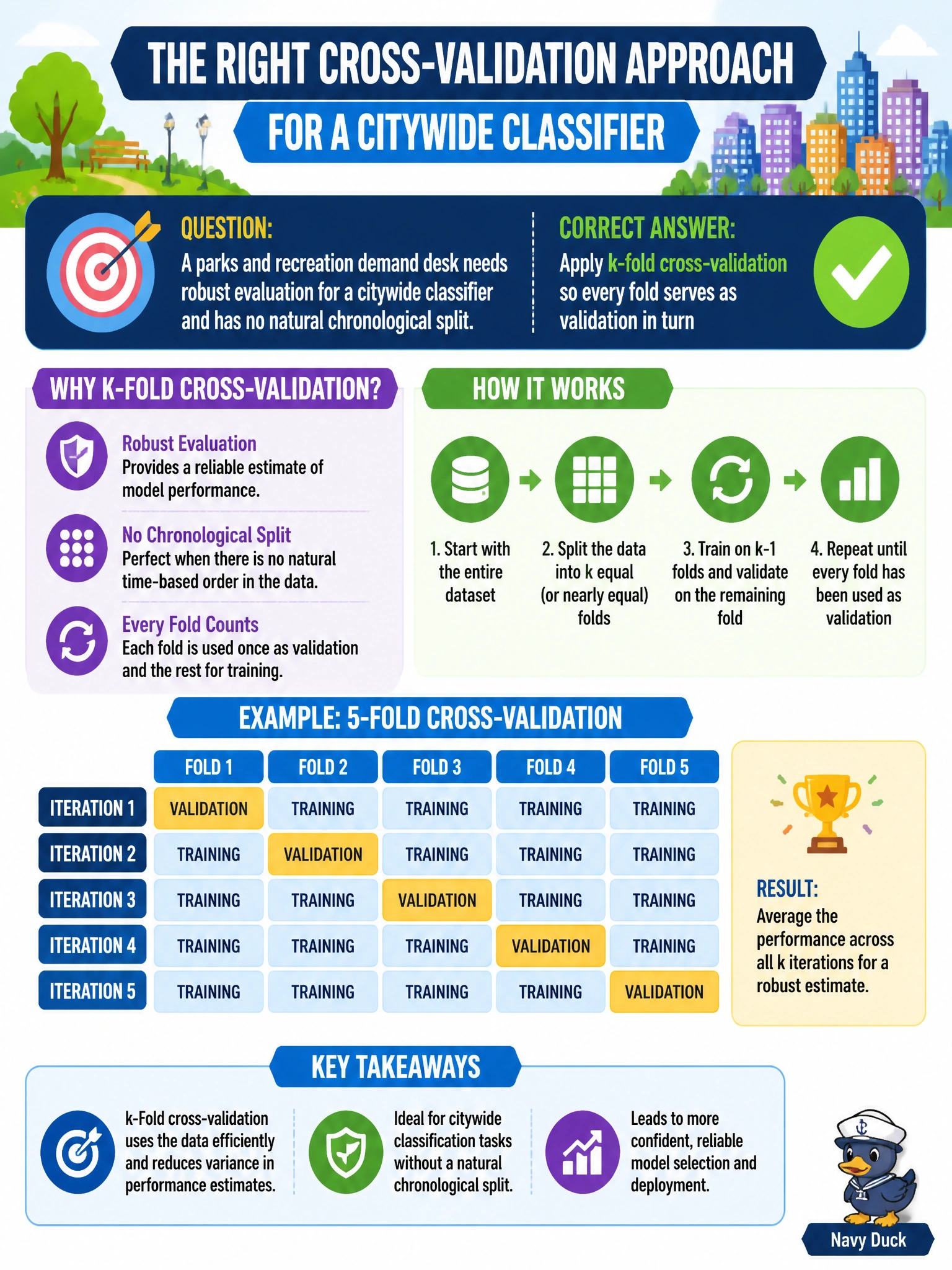
A parks and recreation demand desk needs robust evaluation for a citywide classifier and has no natural chronological split. Which cross-validation approach is appropriate?
Select an answer to reveal the explanation.
Short Explanation
No calendar seam to cut on? K-fold is like rotating who sits out each round so every parks record gets a fair turn as the quiz.
Full Explanation
A parks and recreation demand desk needing robust evaluation for a citywide classifier without a natural chronological split should apply k-fold cross-validation so every fold serves as validation in turn. Rotating holdouts uses all labeled parks records for both training and validation across folds, reducing dependence on one lucky shuffle and giving a stabler estimate for citywide promotion decisions.
Evaluating on a single lucky shuffle once and never rotating folds fails by concept—it can overstate or understate performance based on one draw. Training and testing on the exact same rows for every estimate measures memorization, not generalization. Using only the first ten rows as both train and test forever is an absurdly small, leaky protocol unsuitable for citywide claims.
Exam caveat: standard k-fold assumes exchangeable rows; if hidden geographic clumps or program seasons dominate, consider grouped or stratified folds even without a calendar cut. Operational check: create k stratified or plain folds on the parks classifier labels, train/evaluate rotating validation folds with a fixed metric, report mean and spread across folds, and require the demand desk to review fold variance before calling the citywide model evaluation robust.