
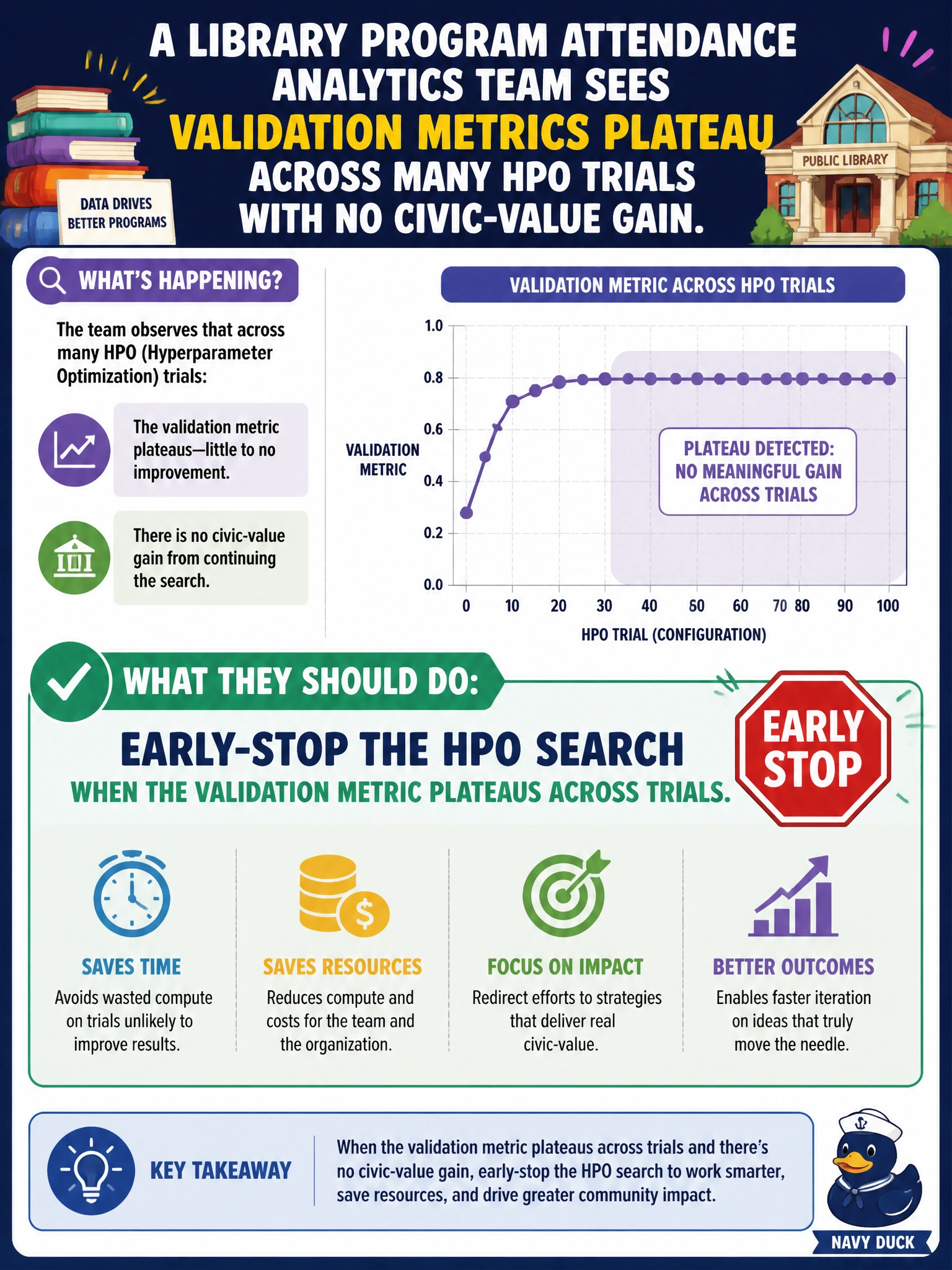
A library program attendance analytics team sees validation metrics plateau across many HPO trials with no civic-value gain. What should they do?
Select an answer to reveal the explanation.
Short Explanation
When the library model’s score stops climbing, close the catalog search—early-stop HPO so you don’t burn GPU time on flatlines.
Full Explanation
A library program attendance analytics team that sees validation metrics plateau across many HPO trials with no civic-value gain should early-stop the HPO search. Once additional trials no longer improve the validation metric in a meaningful way, further GPU burn does not help program planning and delays shipping a good-enough attendance model. Early-stopping on plateau is disciplined resource use under municipal budgets.
Doubling the search forever even after metrics flatten wastes compute and staff time without civic return. Hiding plateaued results and claiming continuous improvement is dishonest reporting. Replacing the metric with a random number generator for excitement abandons evaluation and invents fake progress.
Exam caveat: true plateaus differ from noisy flat stretches—use a patience window and a minimum delta tied to operational meaning (e.g., attendance-count error), not a single unlucky trial. Operational check: plot validation metric versus trial index, define early-stop patience and minimum civic delta with the library stakeholders, halt HPO when the rule fires, retain the best prior config, and record that the stop was plateau-driven so auditors understand why the sweep ended.