
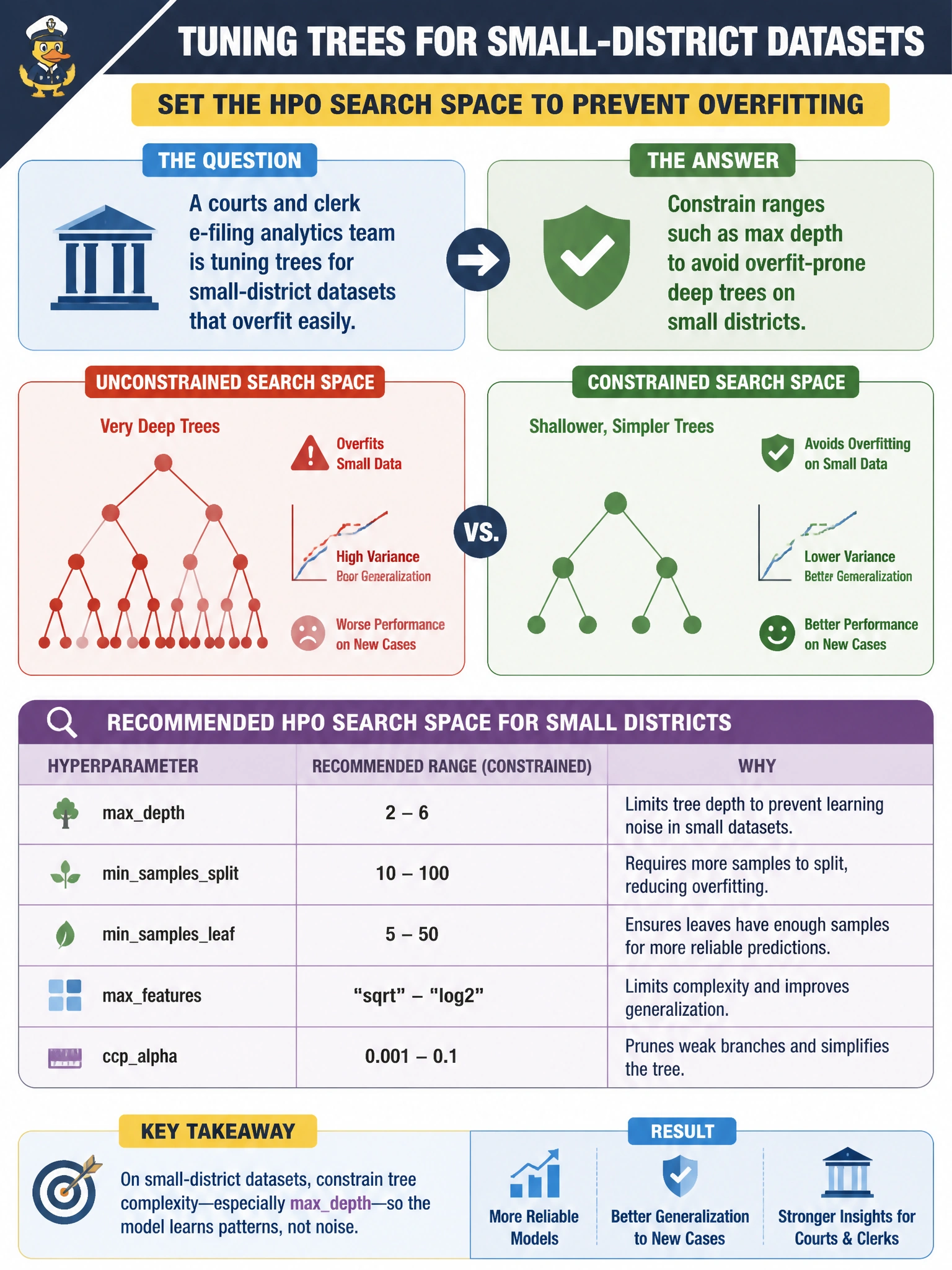
A courts and clerk e-filing analytics team is tuning trees for small-district datasets that overfit easily. How should they set the HPO search space?
Select an answer to reveal the explanation.
Short Explanation
Tiny districts are like short novels—don’t let the search invent hundred-chapter trees. Cap depth so HPO doesn’t overfit the clerk data.
Full Explanation
A courts and clerk e-filing analytics team tuning trees on small-district datasets that overfit easily must constrain the HPO search space. Bounding ranges such as max depth avoids overfit-prone deep trees when row counts are small: the search cannot propose models that memorize tiny district samples too aggressively. That is a deliberate prior for civic datasets where many localities have limited e-filing volume.
Allowing unlimited depth and ignoring validation entirely fails by concept—it maximizes overfit risk on small districts. Forcing every trial to use deeper trees than the number of training rows is an absurd capacity setting that invites pure memorization. Searching only whether the courthouse Wi-Fi SSID is enabled is unrelated to tree capacity and wastes the HPO budget.
Exam caveat: depth caps help but interact with min child weight, subsample, and regularization; a cap that is too tight can underfit some districts, so validate per-district or with stratified folds. Operational check: set max-depth (and related complexity) upper bounds informed by typical small-district sample sizes, require every trial to report validation metrics, reject configs that collapse train error to near-zero with poor validation, and document the constrained space in the clerk analytics experiment record.