
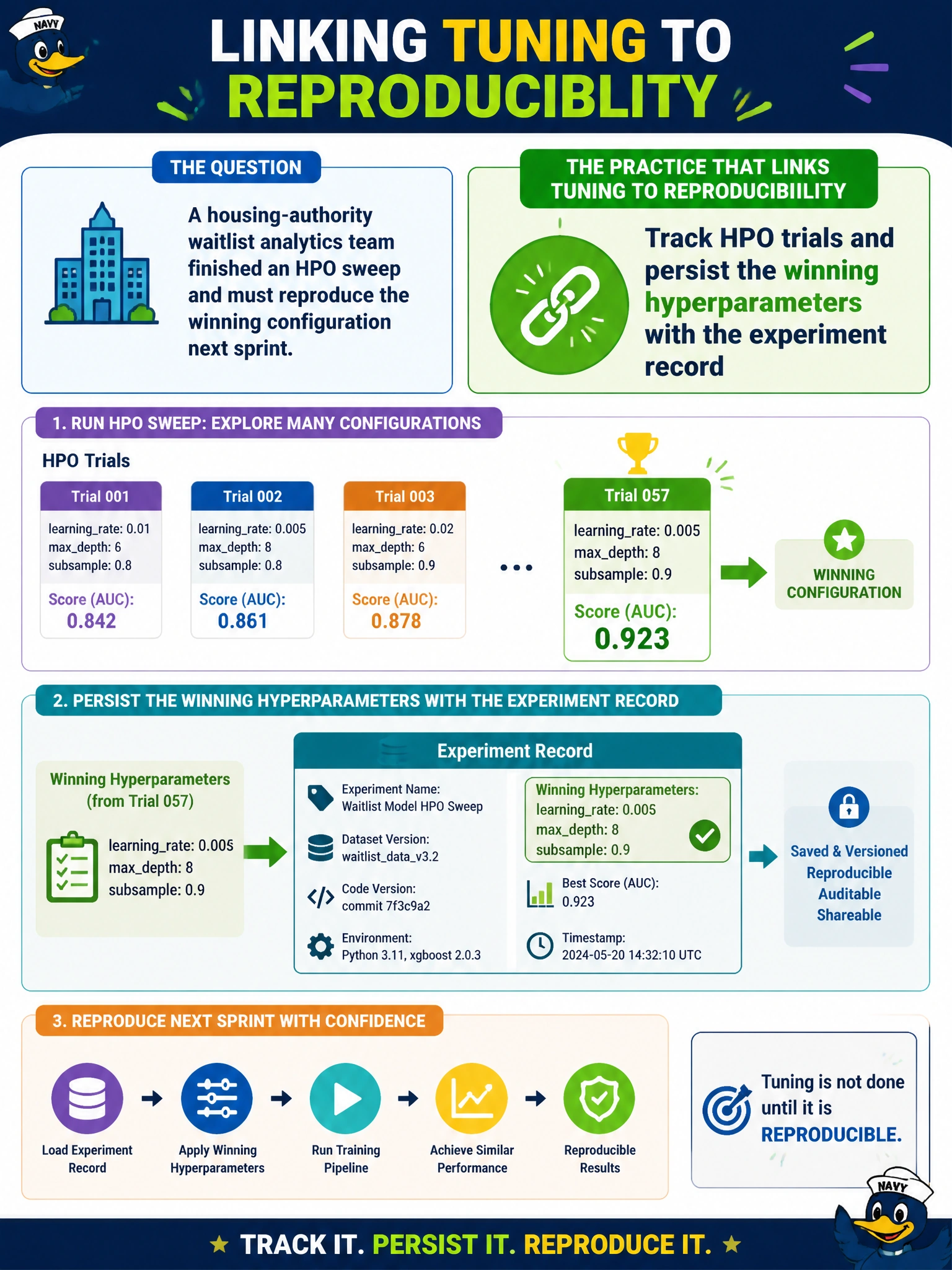
A housing-authority waitlist analytics team finished an HPO sweep and must reproduce the winning configuration next sprint. What practice links tuning to reproducibility?
Select an answer to reveal the explanation.
Short Explanation
Winning recipes belong in the cookbook, not on a sticky note—log the HPO trials so next sprint can bake the same housing model.
Full Explanation
A housing-authority waitlist analytics team that finished an HPO sweep must connect tuning to reproducibility by tracking trials and persisting the winning hyperparameters with the experiment record. Logged configs, metrics, and the chosen winner let next sprint rebuild the same waitlist model, audit decisions, and compare future sweeps against a known baseline. That is how municipal ML avoids “it worked on one laptop” failure.
Deleting all trial logs immediately after picking a winner destroys the evidence trail and blocks reproduction. Remembering the best settings only on a sticky note on one monitor is fragile tribal knowledge that fails staffing changes and audits. Changing undocumented settings each redeploy so nobody can match prior runs actively sabotages reproducibility and confounds production incidents.
Exam caveat: persisting hyperparameters is necessary but incomplete—also version data snapshots, code, and library builds, or the same knobs can still yield different fits. Operational check: store each HPO trial’s parameter dict and score in the experiment store, write the winner into the model card/config used by the waitlist training job, re-run training from that config on a clean agent, and verify metric parity within tolerance before calling the sweep reproducible.