
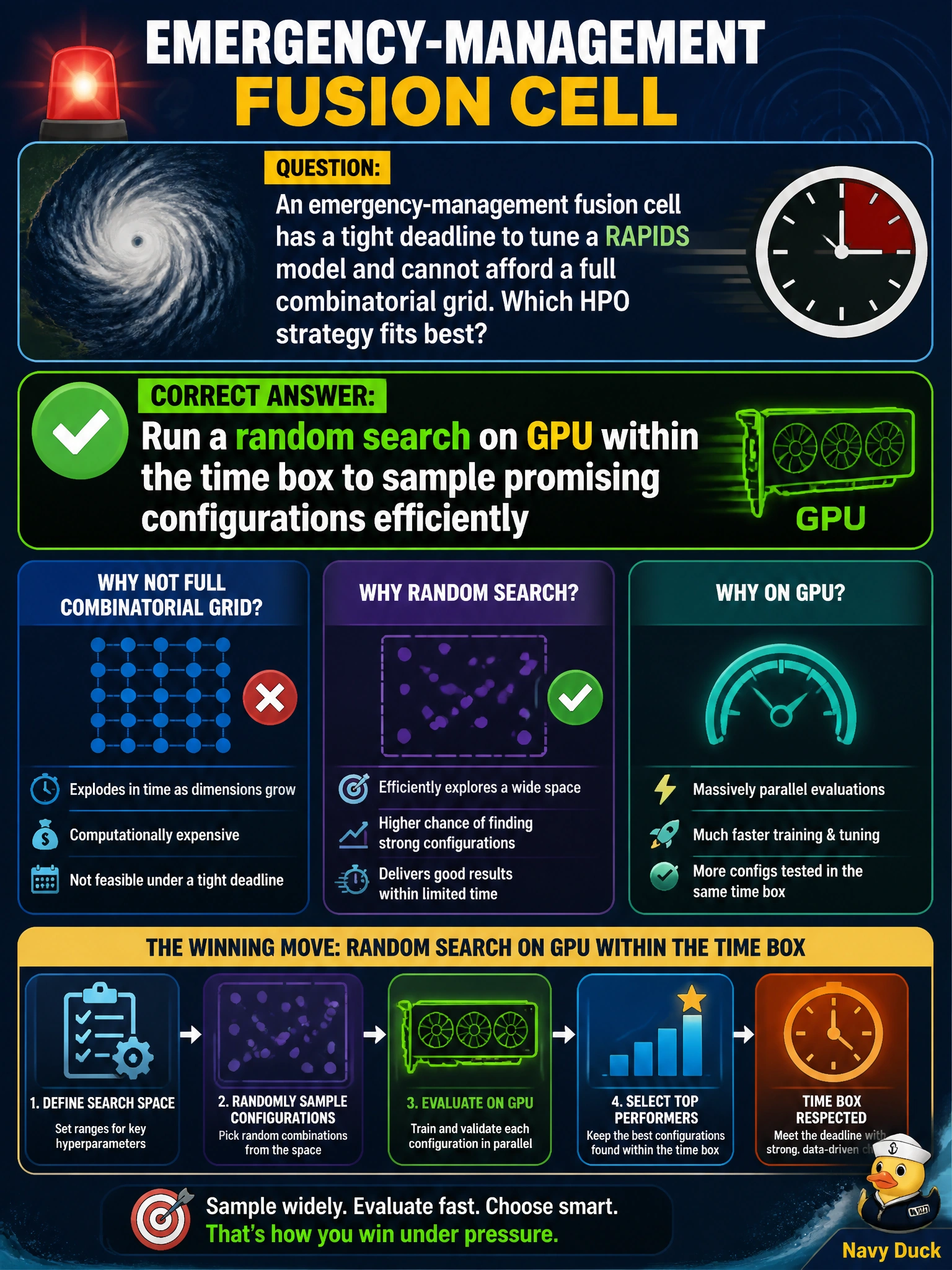
An emergency-management fusion cell has a tight deadline to tune a RAPIDS model and cannot afford a full combinatorial grid. Which HPO strategy fits best?
Select an answer to reveal the explanation.
Short Explanation
When the siren clock is ticking, random search is like sampling food trucks instead of eating at every restaurant on the map—you still find good options before curfew.
Full Explanation
An emergency-management fusion cell with a tight deadline to tune a RAPIDS model cannot afford a full combinatorial grid. Random search on GPU within the time box best fits: it samples configurations efficiently, often finds competitive settings faster than exhaustive grids, and respects the siren-clock constraint. That strategy trades guaranteed full coverage for timely, validated improvement under operational urgency.
Exhaustively enumerating every grid cell even if the deadline is missed fails the stem’s time-box requirement and can leave the fusion cell with no tuned model when the window closes. Skipping tuning and hard-coding the first defaults forever without review abandons HPO and may leave large metric gaps on the table. Tuning by flipping a coin once per month with no validation metric is not search—it is random policy without evidence.
Exam caveat: random search still needs a sensible bounded search space and a fixed validation metric; unbounded ranges or leaking validation into every trial waste the GPU time box. Operational check: set a wall-clock budget, draw random RAPIDS hyperparameter trials, score each on a frozen fusion-cell validation set, keep a running best, stop when the budget ends, and package the winner with trial logs so after-action review can see what the emergency window actually explored.