
A water-utility sensor analytics team is tuning GPU XGBoost for a transit-delay tabular model. Which hyperparameters are most directly meaningful to search first for tree boosters?
Select an answer to reveal the explanation.
Short Explanation
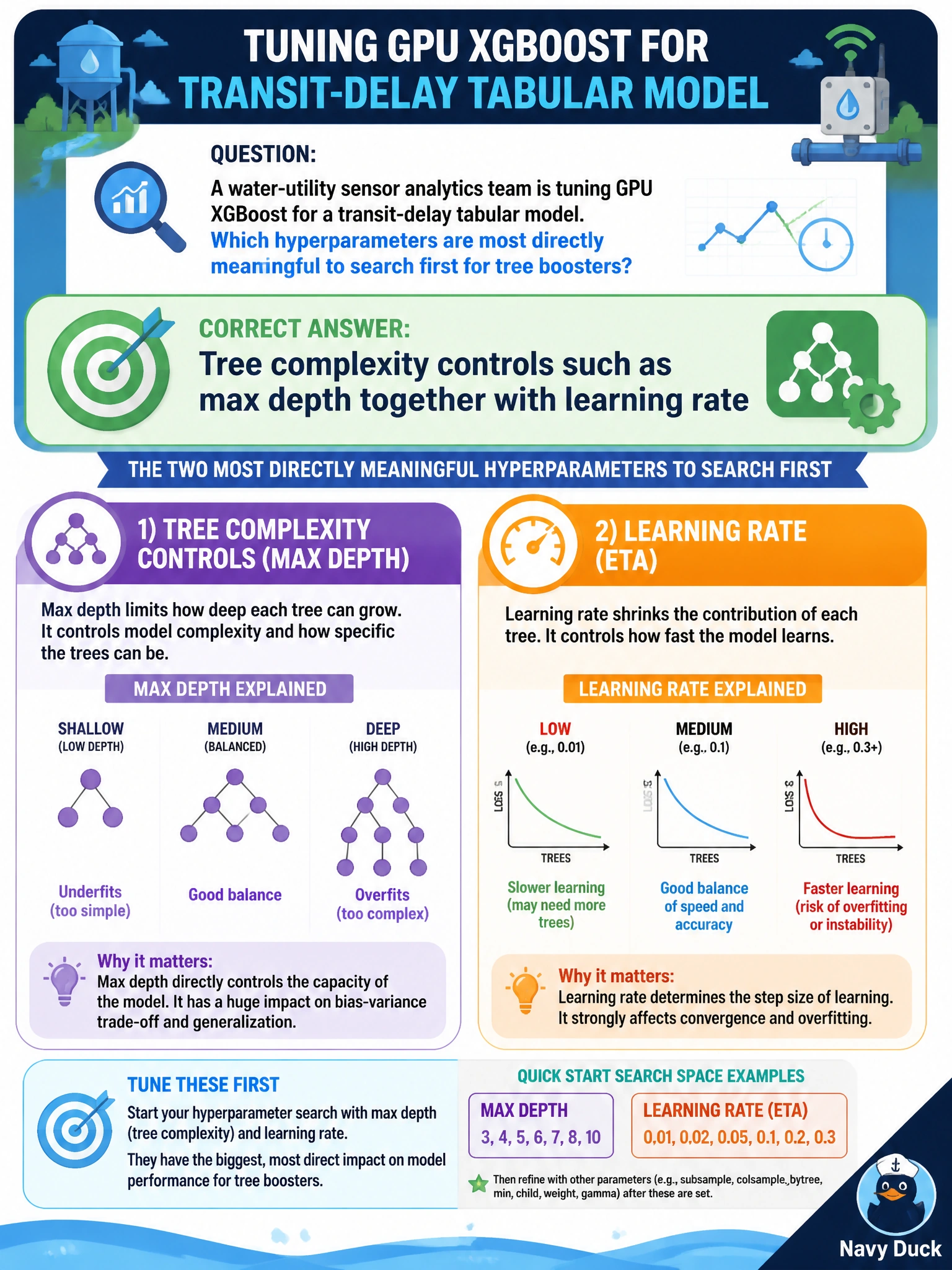
For boosted trees, you can start with the knobs that shape tree growth and learning speed: max depth and learning rate. These hyperparameters directly affect how your model fits the transit-delay data.
Full Explanation
For GPU XGBoost on the transit-delay tabular model, begin by searching tree-complexity controls such as max depth together with learning rate. Max depth and related complexity limits govern how boosted trees grow, while learning rate controls how aggressively each round corrects residuals; these are everyday hyperparameters that can change fit quality on municipal tabular problems. Starting with them keeps your search focused on settings that affect booster behavior. The branding palette’s RGB channel values, maintained by communications for agency graphics, are not model hyperparameters and cannot tune tree boosters. The analyst laptop’s hostname is environmental metadata, not a training control. Randomly renaming columns each trial without tracking configs undermines reproducibility and confuses feature identity with hyperparameter search, so it is not a meaningful search axis. Exam caveat: depth and learning rate interact with the number of boosting rounds, subsampling, and regularization, so searching either knob in isolation can miss stable configurations; GPU defaults may also differ from CPU expectations. Practical check: define a small search space over max depth and learning rate with a bounded round count, log every trial configuration, evaluate on a fixed transit-delay validation split, and confirm that any metric lift holds across a second seed or fold summary for the water/transit feature set before promoting the winning pair.