
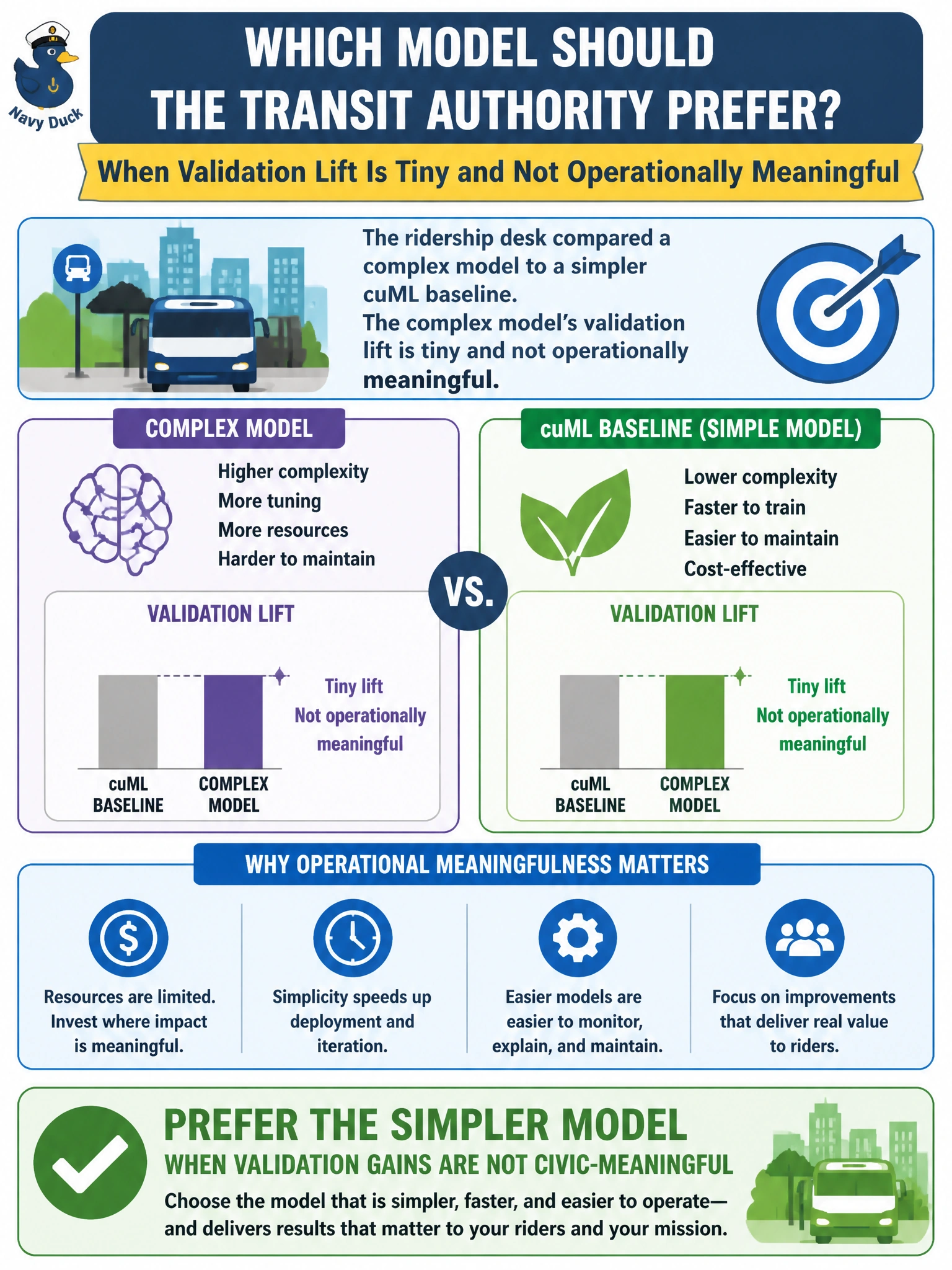
A transit authority ridership desk finds a complex model’s validation lift is tiny and not operationally meaningful versus a simpler cuML baseline. What should they prefer?
Select an answer to reveal the explanation.
Short Explanation
If the fancy bus model only saves a few riders’ worth of error, stick with the simpler cuML baseline—ops teams live with models they can explain.
Full Explanation
A transit authority ridership desk that finds only tiny, not operationally meaningful validation lift from a complex model versus a simpler cuML baseline should prefer the simpler model. When civic impact is negligible, complexity adds maintenance, explainability, and failure-mode cost without helping riders or schedulers. Preferring the simpler baseline when validation gains are not civic-meaningful is the associate-appropriate bias toward operable models.
Always deploying the most complex model regardless of civic impact fails by concept—it optimizes sophistication instead of validated operational value. Discarding validation and choosing models by training loss only invites overfitting and ignores the ridership desk’s real selection signal. Adding random unused features until the complex model looks larger is theater: feature count is not performance, and unused noise features harm generalization.
Exam caveat: “not civic-meaningful” depends on the KPI scale (boardings, delay minutes, cost); a small metric delta might still matter at citywide volume—define a minimum detectable operational effect with stakeholders before declaring lift meaningless. Operational check: compare complex versus simple cuML on the same validation split with the ridership KPI, quantify expected operational change (e.g., trips correctly forecast), review interpretability with scheduling staff, and promote the simpler model when the complex lift fails that effect threshold.