
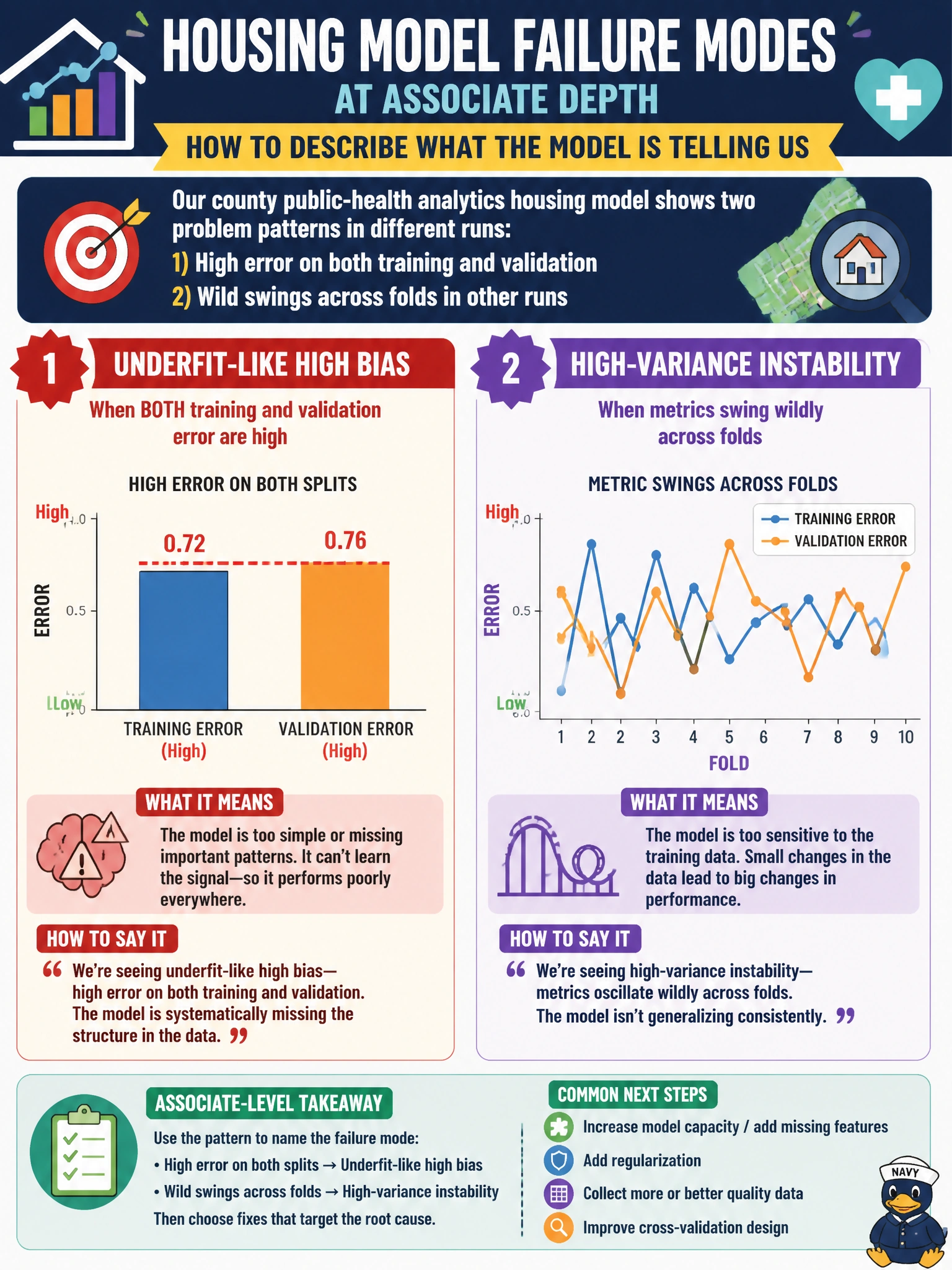
A county public-health analytics housing model shows high error on both training and validation in some runs, then wild swings across folds in others. How should the team describe the failure modes at associate depth?
Select an answer to reveal the explanation.
Short Explanation
High error everywhere feels like a too-simple sketch (bias); wild fold swings feel like a jumpy sketch (variance)—name both so the housing model can be fixed thoughtfully.
Full Explanation
At associate depth, a county public-health analytics housing model that sometimes shows high error on both training and validation, and other times wild swings across folds, should be described with the classic bias–variance language. High error on both splits indicates underfit-like high bias: the hypothesis is too inflexible or features are too weak for the housing signal. Wild oscillation of metrics across folds indicates high-variance instability: the fit is overly sensitive to which slice of data it sees. Naming both failure modes guides different remedies (richer features / more flexible model versus regularization, more data, or stabler CV).
Ignoring diagnostics and redeploying the same unchecked model nightly fails by concept—it refuses to use the evidence the runs already provide. Claiming the GPU driver alone determines all bias and variance behavior misattributes statistical fitting behavior to a driver and is not an associate-level diagnosis. Assuming any error means the dataset must be deleted permanently is an extreme non-sequitur that discards usable public-health data instead of diagnosing bias versus variance.
Exam caveat: high bias and high variance can co-occur in messy civic data; fold swings can also reflect label noise or leakage rather than pure variance—inspect residuals and fold composition before only turning complexity knobs. Operational check: plot train versus validation error across model capacities, tabulate fold metrics with spread, flag runs where both splits are high versus runs where folds diverge sharply, and document which remediation (feature work, regularization, sample size) you apply for each named failure mode before the next housing-model release.