
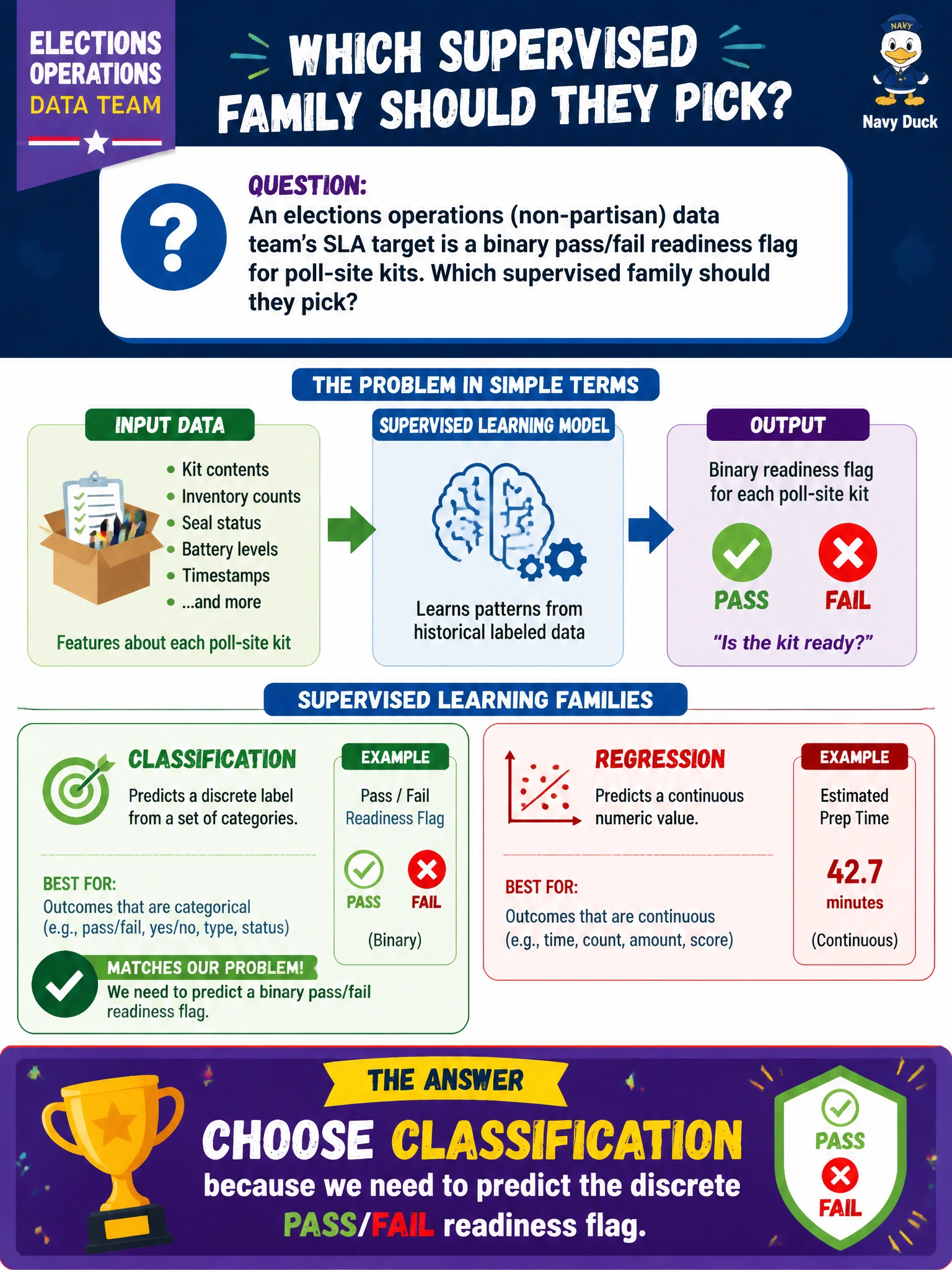
An elections operations (non-partisan) data team’s SLA target is a binary pass/fail readiness flag for poll-site kits. Which supervised family should they pick?
Select an answer to reveal the explanation.
Short Explanation
Pass/fail is a coin flip label, not a tape-measure reading—classification is the matching supervised family for that SLA flag.
Full Explanation
An elections operations (non-partisan) data team whose SLA target is a binary pass/fail readiness flag for poll-site kits needs supervised classification. Classification predicts the discrete readiness flag from kit and site features so operations can prioritize remediation before Election Day. That aligns the learning family with a binary civic SLA outcome rather than an unrelated continuous or unsupervised task.
Regression that predicts an unrelated continuous latitude value only fails by concept: latitude is not the pass/fail readiness target, so the model answers the wrong question. Clustering that ignores the pass/fail labels entirely discards the supervised signal the SLA provides and cannot directly output readiness. Always predicting pass so validation looks perfect on majority days is a degenerate policy that hides failed kits and invents misleading metrics instead of learning readiness.
Exam caveat: elections readiness models must stay non-partisan and operational—label leakage from post-open outcomes, unstable kit definitions across cycles, or class imbalance toward “pass” can inflate accuracy while missing failed sites. Operational check: train a classifier on historically labeled kit readiness, evaluate precision/recall for the fail class on a held-out election cycle or site set, review false “pass” cases with elections logistics, and document feature sources so auditors can reproduce the readiness score without partisan inputs.