
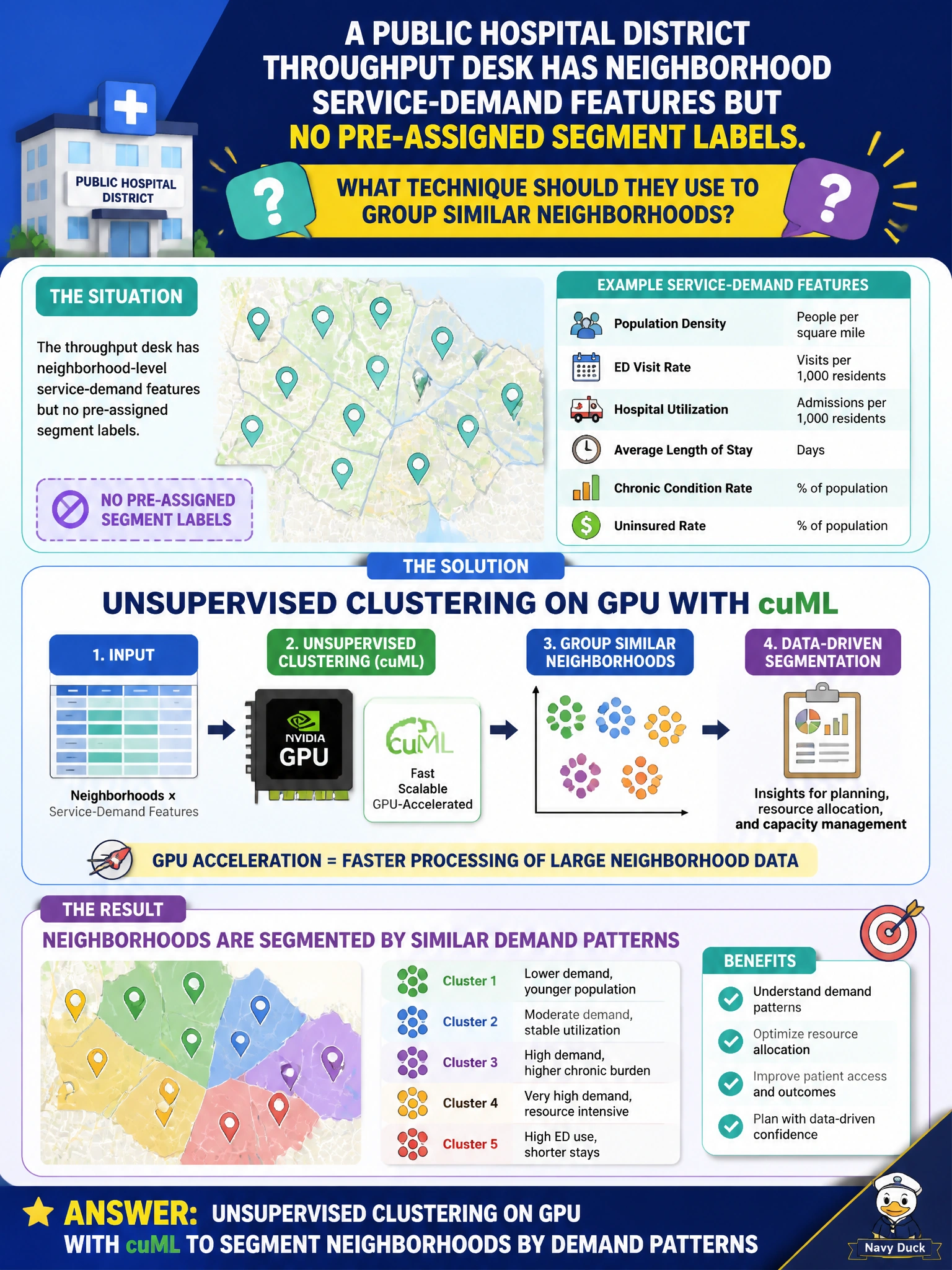
A public hospital district throughput desk has neighborhood service-demand features but no pre-assigned segment labels. What technique should they use to group similar neighborhoods?
Select an answer to reveal the explanation.
Short Explanation
No name tags on the neighborhoods yet? Clustering is like sorting mail into piles by shape when nobody wrote the ZIP codes down.
Full Explanation
A public hospital district throughput desk that has neighborhood service-demand features but no pre-assigned segment labels needs structure discovery, not supervised fitting. Unsupervised clustering on GPU with cuML segments neighborhoods by demand patterns without requiring labels: similar feature profiles group together so planners can study capacity, outreach, and staffing by discovered segment. That matches the stem’s “no labels yet” constraint while staying in the RAPIDS/cuML toolkit.
Supervised logistic regression that requires the missing segment labels to train fails by concept—without labels there is no supervised target to fit. A confusion matrix computed before any model exists fails because confusion matrices evaluate predicted versus true classes; they are not a grouping technique and presuppose labeled predictions. Manual random assignment of neighborhoods to colors with no feature basis invents segments without using demand features, so groups have no analytic meaning for throughput planning.
Exam caveat: clusters are operational hypotheses, not official service boundaries—k, scaling, and feature choice change membership, and hospital planners must validate segments against domain knowledge before policy use. Operational check: run cuML clustering on standardized neighborhood demand features, review segment profiles (visit volume, acuity mix, travel time), stability across seeds, and a planner walkthrough that confirms each cluster corresponds to a usable throughput narrative before publishing segments to the district dashboard.