
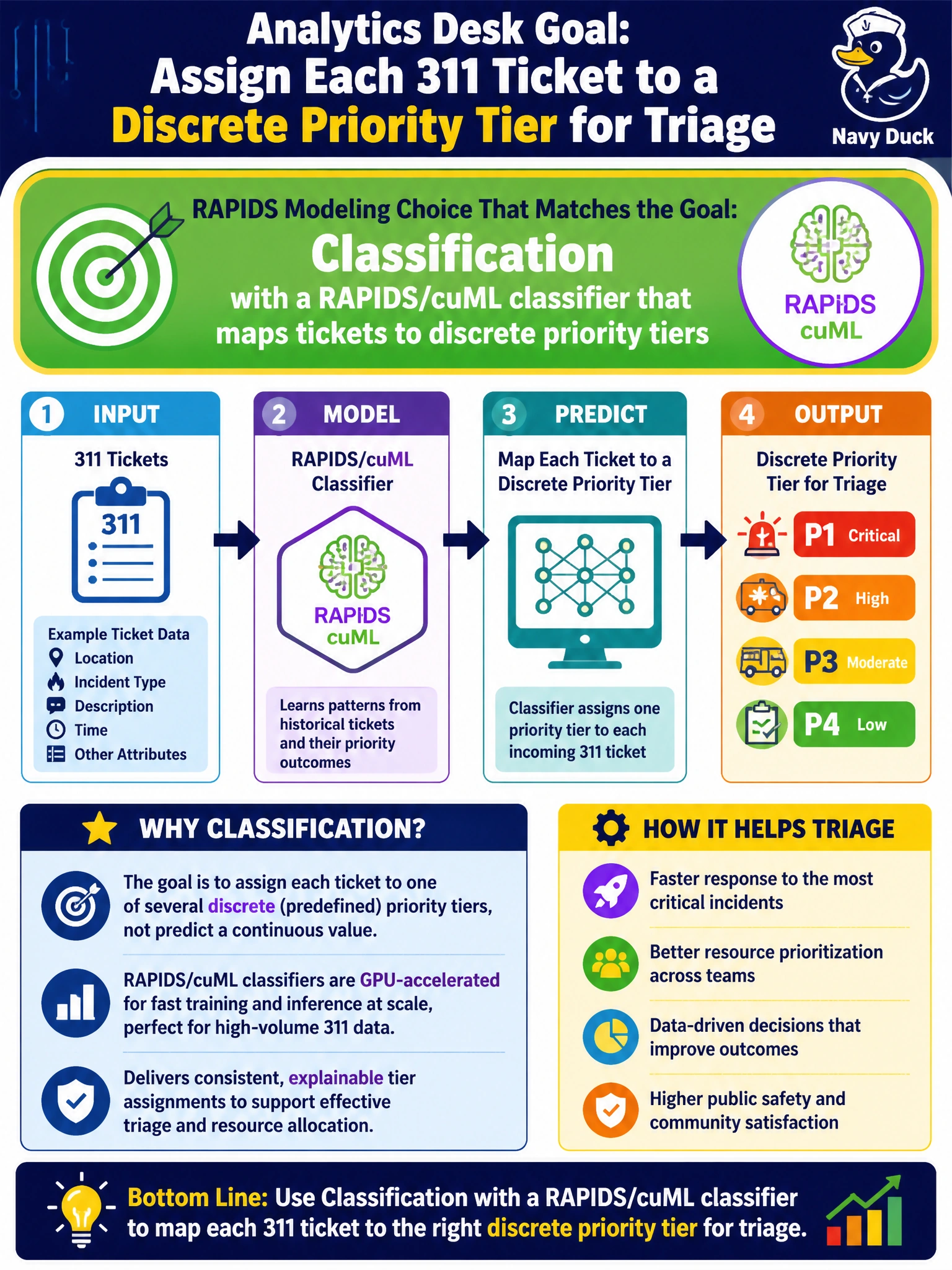
A fire and EMS analytics desk must assign each 311 ticket to a discrete priority tier for triage. Which RAPIDS modeling choice matches that goal?
Select an answer to reveal the explanation.
Short Explanation
Priority tiers are buckets on a shelf—classification drops each ticket into the right bucket instead of inventing a continuous dollar guess.
Full Explanation
A fire and EMS analytics desk assigning each 311 ticket to a discrete priority tier is performing multi-class (or ordinal-class) labeling, not continuous cost estimation. Classification with a RAPIDS/cuML classifier that maps tickets to discrete priority tiers matches that goal: the model outputs a tier label suitable for triage queues, routing rules, and SLA dashboards. GPU-accelerated cuML keeps iterative training and scoring practical on municipal ticket volumes.
Regression that outputs only an unbounded dollar cost with no tier label fails by concept—it predicts a continuous amount instead of the discrete priority classes operations need. Dimensionality reduction that compresses tickets but never assigns a priority class is unsupervised compression; it may aid exploration but does not perform triage assignment. Sorting tickets alphabetically by street name as the priority policy is an arbitrary non-learned rule that ignores severity signals and cannot represent priority tiers.
Exam caveat: classification into tiers still requires careful label definitions and cost-sensitive evaluation—confusing adjacent tiers or ignoring rare high-priority classes can look accurate while harming emergency triage. Operational check: train the cuML classifier on labeled 311 tickets, inspect the confusion matrix with emphasis on high-priority misses, validate tier prevalence against operations policy, and gate promotion on priority-class metrics—not overall accuracy alone—before the fire/EMS desk relies on automated tiers.