
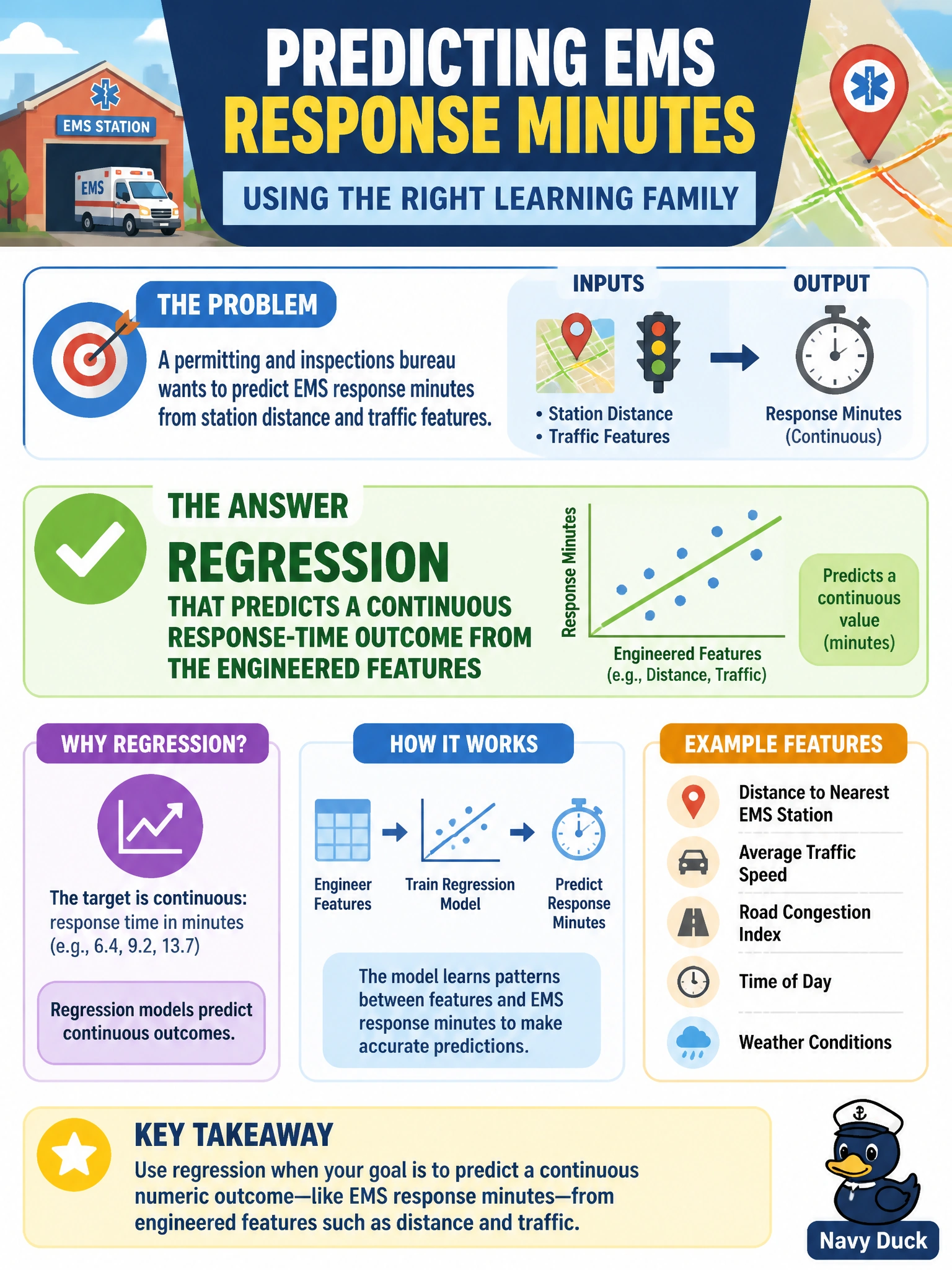
A permitting and inspections bureau wants to predict EMS response minutes from station distance and traffic features. Which learning family should the team choose?
Select an answer to reveal the explanation.
Short Explanation
Minutes are a dial, not a yes/no light switch—regression is the tool that predicts continuous civic outcomes like response time.
Full Explanation
A permitting and inspections bureau predicting EMS response minutes from station distance and traffic features needs a continuous numeric outcome. Regression is the matching supervised family: it maps engineered predictors to a real-valued minute estimate that planners can compare against SLA targets and station coverage gaps. That choice aligns model type with the civic KPI—minutes—rather than forcing an unrelated task shape.
Unsupervised clustering of stations with no minute target fails by concept because clustering discovers groups without predicting the continuous response-time outcome the bureau asked for. Binary classification that only outputs pass versus fail with no minute estimate collapses a continuous operational quantity into a coarse label and cannot answer “how many minutes.” Random shuffling of historical minutes as the production forecast is not learning at all; it provides no feature-conditioned prediction and cannot improve with better distance or traffic signals.
Exam caveat: choosing regression is necessary but not sufficient—leaky features (for example, post-dispatch outcomes), poor residuals in peak traffic hours, or unvalidated geographic shift can still make minute forecasts unsafe for staffing. Operational check: train a RAPIDS/cuML (or GPU XGBoost) regressor on station-distance and traffic features, score holdout mean absolute or RMSE in minutes, stratify errors by peak versus off-peak windows, and require residual review before any permitting desk uses the estimates for coverage decisions.