
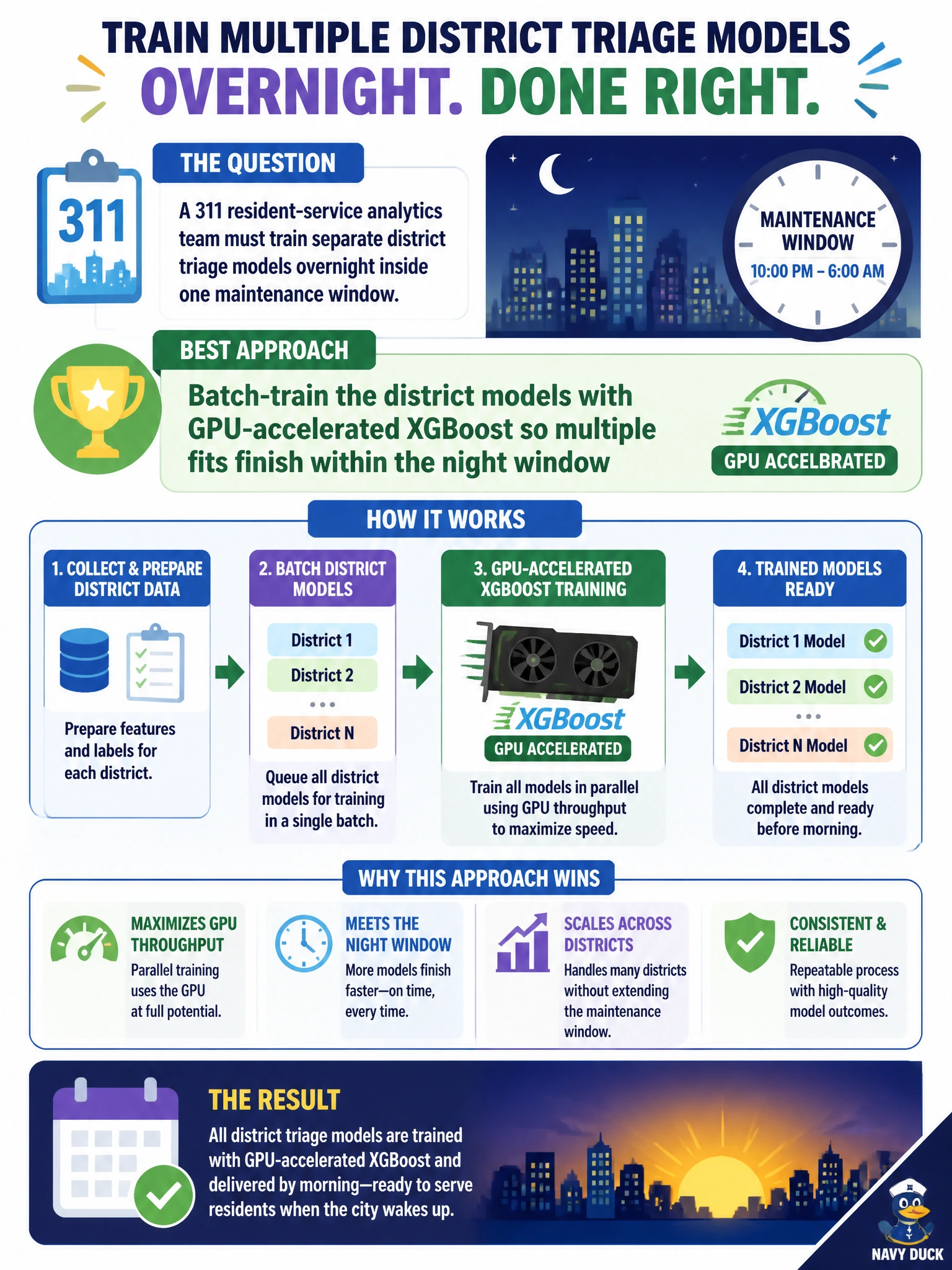
A 311 resident-service analytics team must train separate district triage models overnight inside one maintenance window. What approach best uses GPU training throughput for that multi-model batch?
Select an answer to reveal the explanation.
Short Explanation
Picture a night shift that has to bake many district cakes before sunrise—GPU XGBoost is the big oven that finishes the whole batch while the kitchen is quiet.
Full Explanation
A 311 resident-service analytics team that must train separate district triage models overnight inside one maintenance window needs training throughput, not a single CPU serial path. Batch-training those district models with GPU-accelerated XGBoost best fits: each district fit uses GPU tree boosting, and the night window can complete many district models before morning reopen. That preserves local triage patterns per district while still finishing inside the shared maintenance SLA.
Training each district model sequentially on a single CPU core with no GPU involvement fails by concept for the stated goal—CPU serial training typically cannot deliver multi-model overnight throughput when district counts and feature widths grow. Skipping training and hard-coding one priority rule for every district ignores local ticket patterns and abandons supervised learning entirely, so triage quality cannot adapt. Shipping raw tickets to resident phones and asking callers to score their own priority labels is not a training strategy; it offloads labeling to the public and does not produce validated district models inside the maintenance window.
Exam caveat: GPU XGBoost speeds training but does not automatically make district models fair or calibrated—bad labels, leakage, or uneven district sample sizes still produce weak triage. Operational check: schedule the overnight GPU batch with per-district run logs, verify every district model finishes before the window ends, compare holdout triage metrics by district, and alert if any district fails to train or regresses versus the prior night’s checkpoint.