
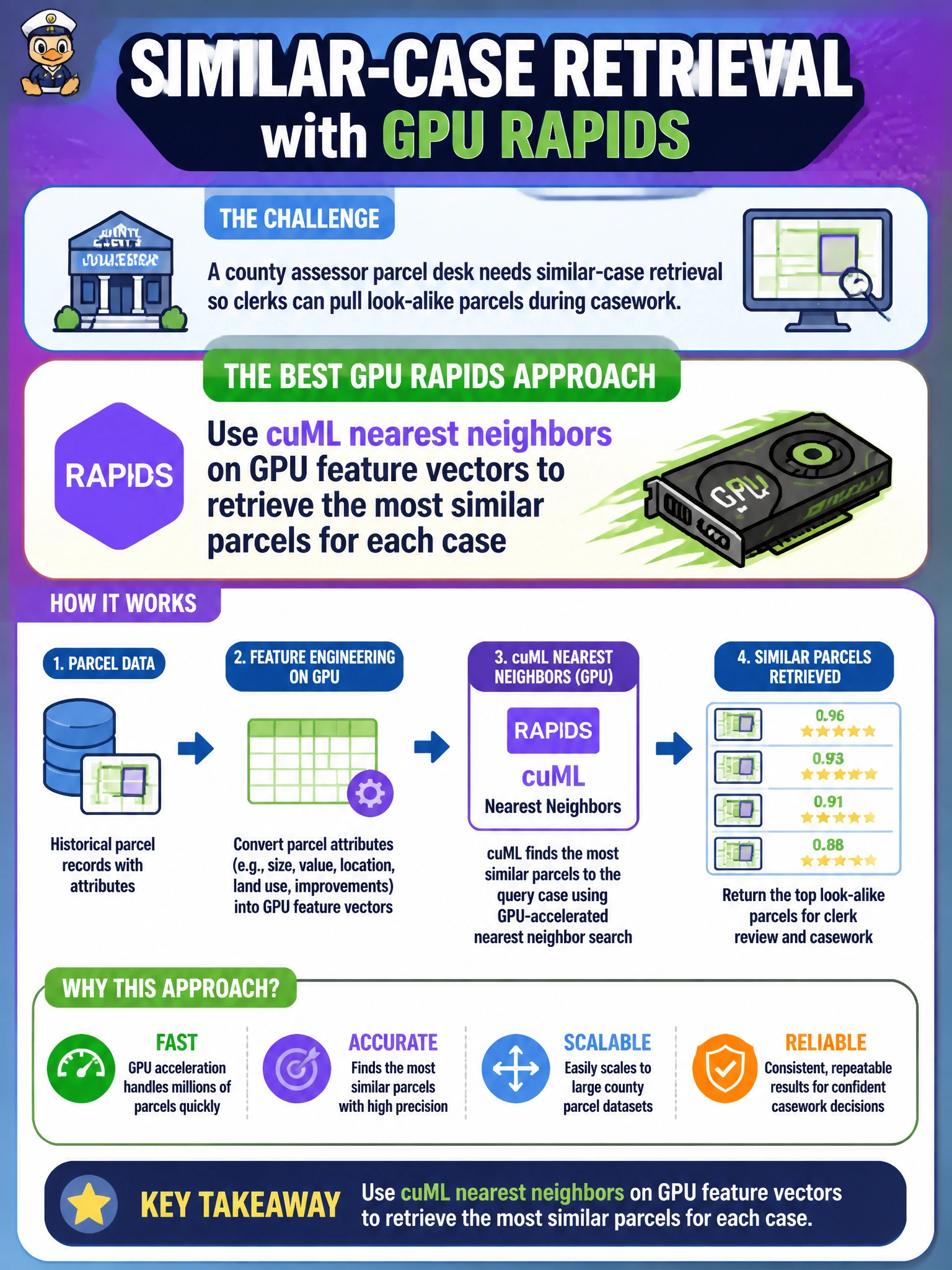
A county assessor parcel desk needs similar-case retrieval so clerks can pull look-alike parcels during casework. Which GPU RAPIDS approach best fits that similarity task?
Select an answer to reveal the explanation.
Short Explanation
Similar parcels are like matching library books by topic shelves—nearest neighbors finds the closest feature neighbors fast on the GPU instead of rereading the whole catalog.
Full Explanation
A county assessor parcel desk that needs look-alike parcels during casework is solving a similarity retrieval problem on tabular feature vectors, not a generative language task. The correct RAPIDS approach is cuML nearest neighbors on GPU feature vectors: encode each parcel’s assessed attributes into a feature space, then retrieve the most similar neighbors for the case under review. That pattern matches how clerks actually work—pull comparable parcels quickly—while GPU nearest-neighbor search keeps latency acceptable for interactive desk queues.
Training only a deep generative language model on parcel narratives and skipping tabular neighbor search fails by concept: narrative generation does not implement deterministic similarity retrieval over structured assessment features, and it abandons the RAPIDS tabular path the stem asks for. Exporting every parcel to handwritten paper binders and matching by eye fails operationally and conceptually—it replaces scalable GPU similarity with unrepeatable manual comparison and cannot support desk throughput. Fitting a single global mean assessment and treating every parcel as identical erases local feature differences that define look-alike neighborhoods, so clerks get no case-specific comparables.
Exam caveat: nearest neighbors retrieves similarity under the features and distance you choose; garbage features, unscaled magnitudes, or the wrong metric still return poor comparables even on GPU. Operational check: build a cuML nearest-neighbors index on the assessor feature frame, query a known parcel with documented look-alikes, confirm returned neighbors share the expected attribute neighborhood, and time a batch of clerk queries under desk-load conditions before promoting the workflow.