
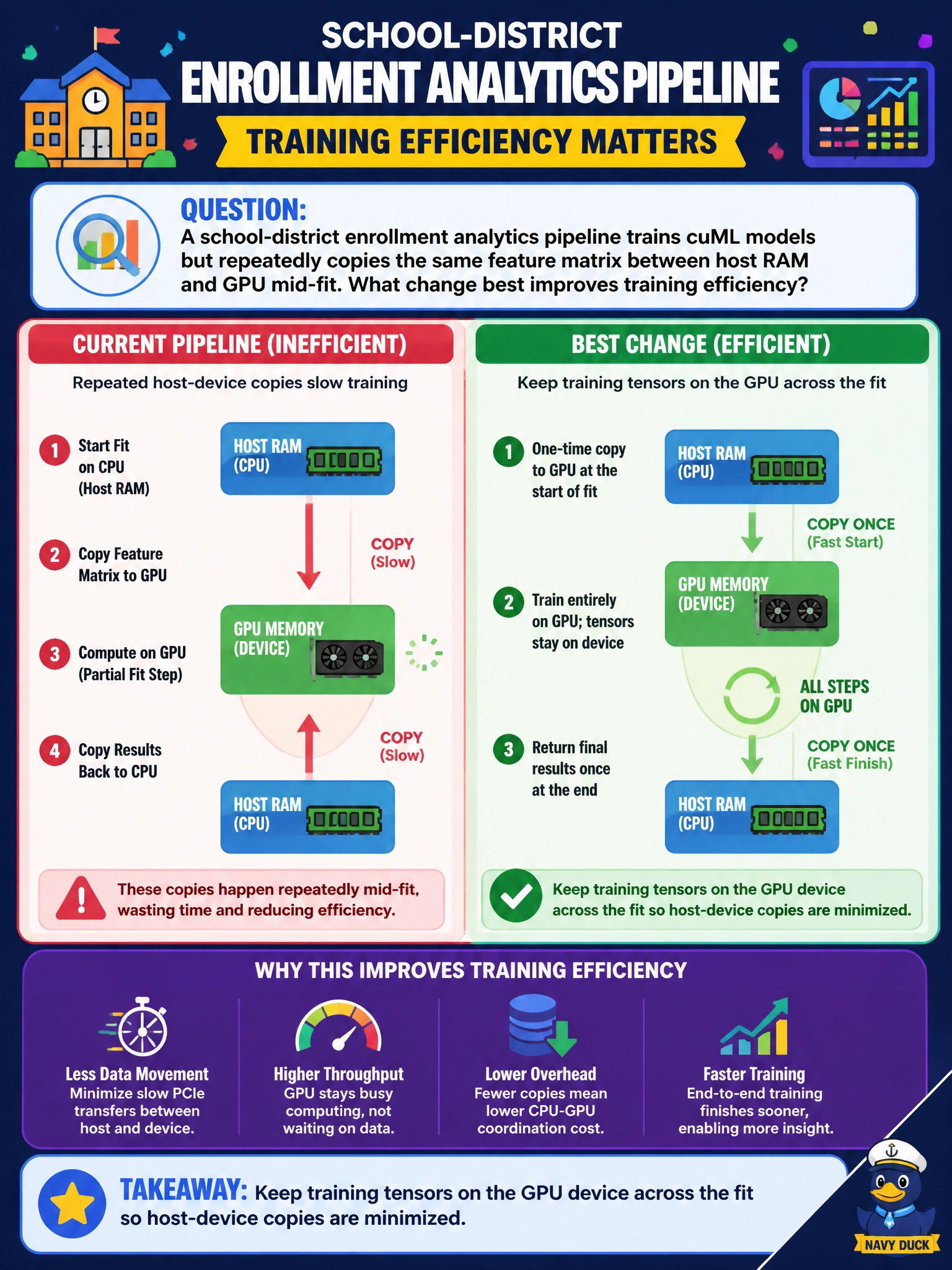
A school-district enrollment analytics pipeline trains cuML models but repeatedly copies the same feature matrix between host RAM and GPU mid-fit. What change best improves training efficiency?
Select an answer to reveal the explanation.
Short Explanation
Shipping the same enrollment matrix back and forth is like ferrying the same busload across town between every class period. Park the training data on the GPU for the fit so PCIe stops being the bottleneck.
Full Explanation
A school-district enrollment analytics pipeline that trains cuML models but repeatedly copies the same feature matrix between host RAM and GPU mid-fit should keep training tensors on the GPU device across the fit so host-device copies are minimized. PCIe round-trips are a common bottleneck in GPU machine learning; once enrollment features are on device, leaving them resident through cuML or GPU boosting iterations improves throughput and stabilizes training time. That change best improves efficiency for civic tabular fits dominated by unnecessary transfers. Inserting extra host round-trips after every tree so the CPU can revalidate each split fails by concept: it adds synchronization and copy cost without being required for a correct cuML fit. Converting features to CSV between each boosting iteration fails by introducing extreme I/O and parse overhead under the guise of “freshness.” Forcing pageable single-row transfers for every sample fails by maximizing PCIe traffic—the opposite of an efficient GPU training path. Exam caveat: device residency helps only while the working set fits in GPU memory; oversize enrollment matrices may still need out-of-core or staged strategies rather than silent host thrashing. Operational check: profile host-device copy time during an enrollment cuML fit, refactor so the feature matrix is transferred once and reused on device, re-profile PCIe and wall-clock metrics, and confirm accuracy parity with the chatty baseline before adopting the change in production.