
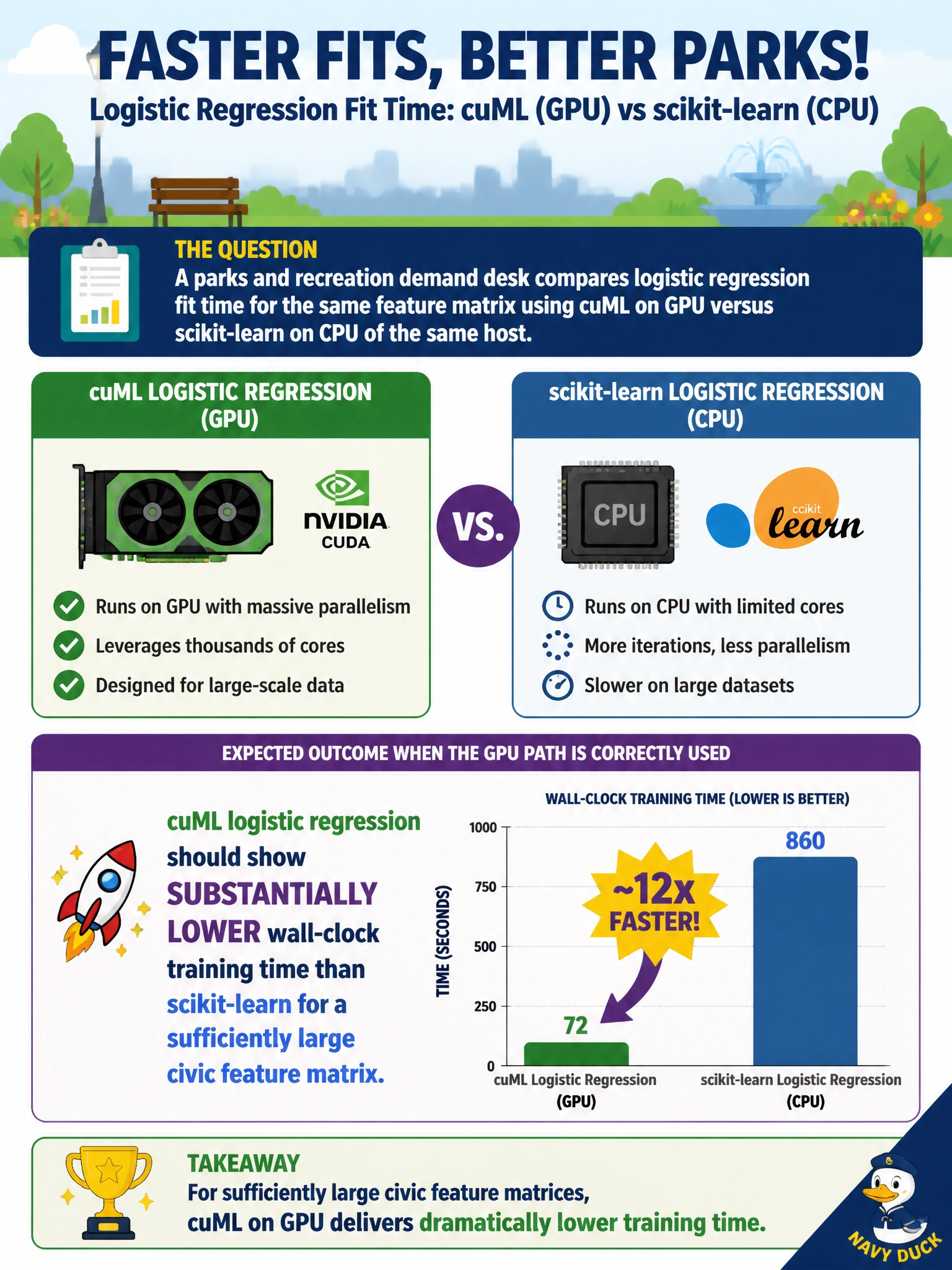
A parks and recreation demand desk compares logistic regression fit time for the same feature matrix using cuML on GPU versus scikit-learn on CPU of the same host. What outcome should they expect when the GPU path is correctly used?
Select an answer to reveal the explanation.
Short Explanation
Same math, different engine: cuML's logistic regression is the GPU twin of the sklearn API. On a big parks demand table, that GPU fit should finish a lot sooner than the CPU sklearn run on the same box.
Full Explanation
A parks and recreation demand desk comparing logistic regression fit time for the same feature matrix on cuML (GPU) versus scikit-learn (CPU) on the same host should expect substantially lower wall-clock training time from cuML when the civic matrix is large enough to justify acceleration. cuML mirrors many scikit-learn estimators while executing on the GPU, so large tabular fits typically see major runtime reductions without changing the conceptual linear model. That is the outcome that correctly used GPU logistic regression is meant to deliver for municipal demand features. Claiming cuML must always be slower because GPUs cannot accelerate linear models fails by concept: cuML specifically accelerates such estimators on GPU. Expecting wall times to match exactly because APIs look similar fails: API familiarity is not runtime equivalence. Assuming scikit-learn automatically moves the same fit onto the GPU without cuML fails because stock sklearn stays on CPU unless you deliberately use a GPU library path. Exam caveat: tiny feature matrices may not beat CPU once PCIe transfer overhead is counted; “substantially lower” assumes a sufficiently large parks demand matrix and a correct device-resident fit path. Operational check: materialize the same feature matrix for cuML and sklearn, time both logistic regression fits on the same host, keep data on GPU for the cuML path, and record wall-clock and utilization to confirm the expected civic-scale speedup.