
A library program attendance analytics team will train an early-warning model on large school-district tabular features overnight. Which training choice best leverages GPU acceleration for that booster workload?
Select an answer to reveal the explanation.
Short Explanation
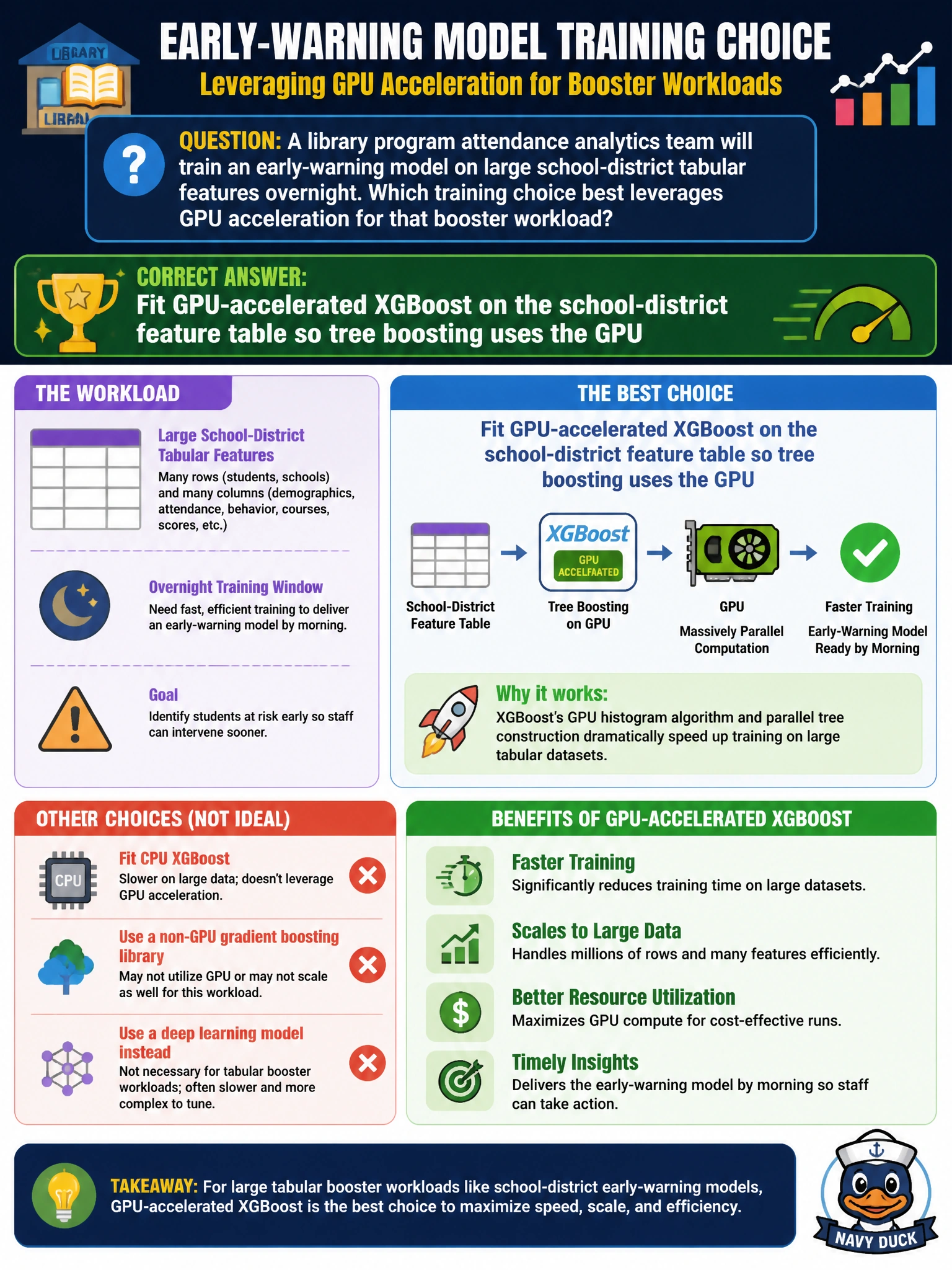
Big district feature tables love gradient-boosted trees, and GPU XGBoost is the turbo version of that night-shift job. Point the booster at the GPU so the early-warning model finishes before morning standup.
Full Explanation
A library program attendance analytics team training an early-warning model on large school-district tabular features overnight should fit GPU-accelerated XGBoost so tree boosting uses the GPU. GPU XGBoost is a core RAPIDS-era tool for large tabular classification and regression and matches NCA-ADS Machine Learning With RAPIDS scope for booster workloads. Pointing the overnight early-warning job at the GPU turns a large district feature table into a timely model instead of a morning-slippage risk. Training a tiny CPU linear model on a hundred random rows fails by concept: it ignores most district data and underfits the early-warning task. Exporting features to slides and estimating risk by visual inspection fails as a substitute for fitting a model on large tabular features. Using only CPU single-threaded XGBoost when a compatible GPU and RAPIDS stack are available fails by leaving acceleration unused for a workload that benefits from it. Exam caveat: GPU XGBoost still needs careful hyperparameters, early stopping, and honest time-aware validation on school-district cohorts; a fast overfit is still an overfit. Operational check: configure XGBoost for GPU training on the district feature table, run the overnight fit, confirm GPU utilization during boosting, and compare validation early-warning metrics and wall time against a CPU-only control before promoting the model.