
A courts and clerk e-filing analytics team needs a tabular permit-approval risk model trained quickly on GPU. Which approach best fits NVIDIA RAPIDS accelerated training for that task?
Select an answer to reveal the explanation.
Short Explanation
Permit risk tables are classic rows-and-columns work—cuML's random forest is like putting that clerk workload on a GPU express lane instead of a single CPU teller window. Fit the forest on device and score approvals faster.
Full Explanation
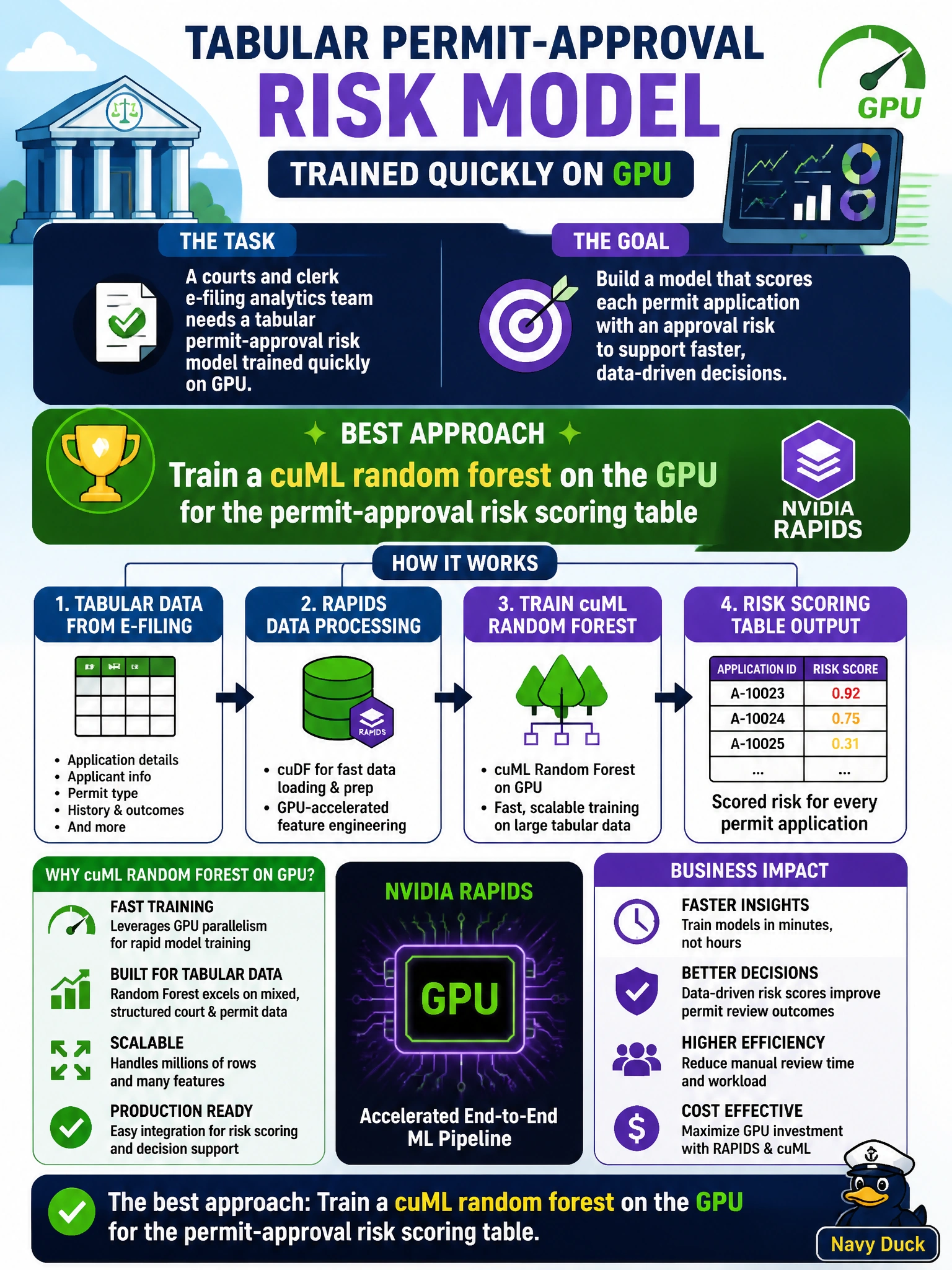
A courts and clerk e-filing analytics team needing a tabular permit-approval risk model trained quickly on GPU should train a cuML random forest on the permit-approval risk scoring table. cuML provides GPU-accelerated classical tabular algorithms that fit RAPIDS-centric NCA-ADS workflows, keeping feature data and training on device for municipal risk tables instead of falling back to slow row-wise CPU loops. For structured civic approval features, that is the approach that best matches NVIDIA RAPIDS accelerated training. Training only a CPU scikit-learn neural net after forcing all features onto host memory for every epoch fails by concept: it abandons GPU acceleration for a tabular problem that cuML already targets. Hand-labeling risk with spreadsheet macros fails by skipping model training entirely and not scaling with e-filing volume. Running an unaccelerated pure-Python decision stump loop over each row on the CPU fails as a performance and engineering pattern for GPU-oriented RAPIDS exams and production desks. Exam caveat: cuML random forests accelerate fitting but still require proper validation, class imbalance handling, and leakage checks on permit timelines; speed alone is not model quality. Operational check: build the permit-approval feature table on RAPIDS, fit cuML RandomForestClassifier on GPU, compare wall-clock time to a CPU baseline, and verify holdout risk metrics before clerk operations consume scores.