
A county social-services case analytics team must downsample dense GPS pings from mobile caseworker routes while keeping peak-hour coverage. Which sampling design best meets that goal?
Select an answer to reveal the explanation.
Short Explanation
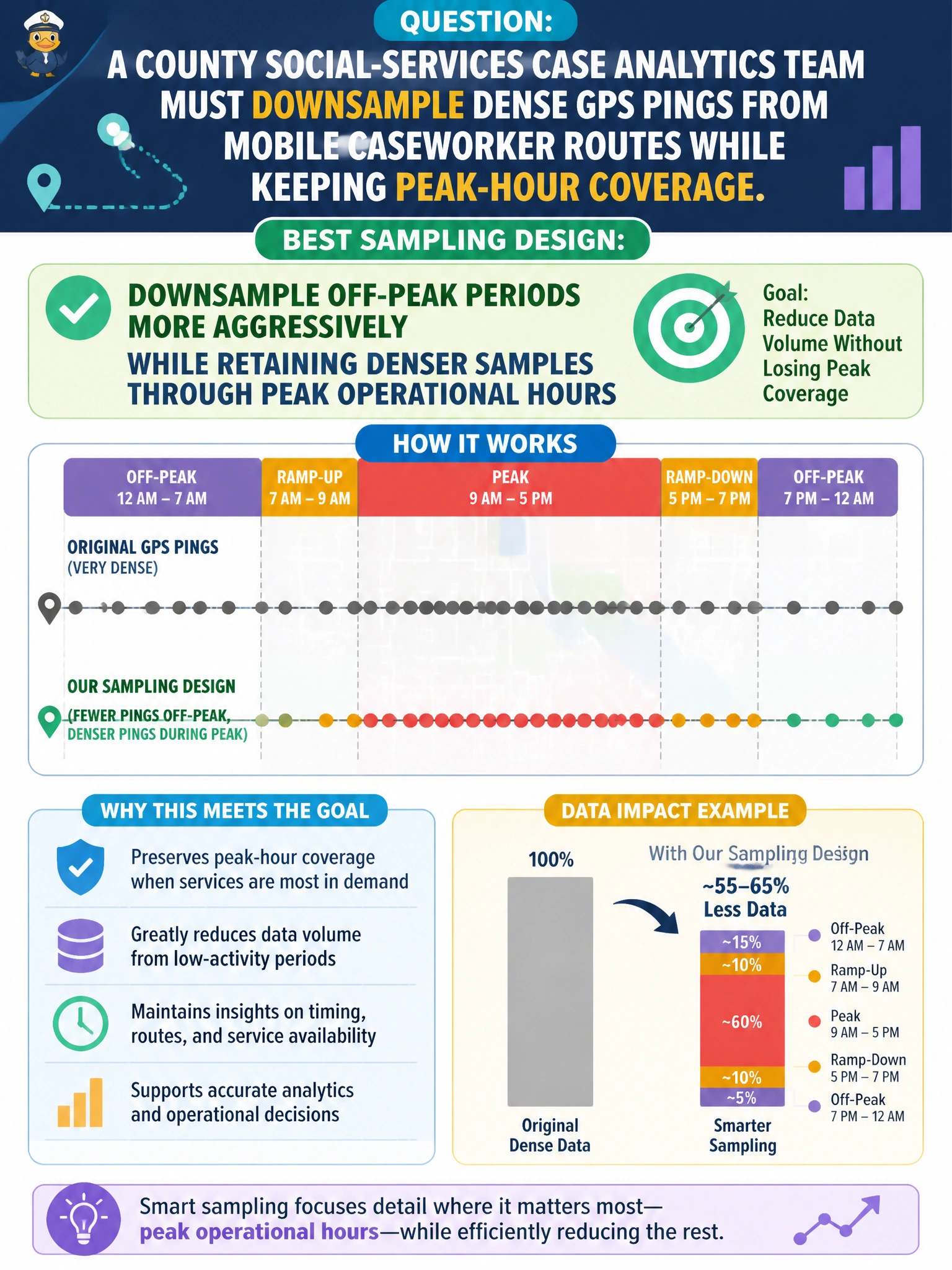
Peak-hour GPS pings are like rush-hour traffic counts—you cannot throw those away just to shrink the file. Thin the quiet overnight stretches harder and keep denser samples when caseworkers are actually moving.
Full Explanation
A county social-services case analytics team downsampling dense GPS pings from mobile caseworker routes must keep peak-hour coverage. Downsampling off-peak periods more aggressively while retaining denser samples through peak operational hours shrinks storage and GPU load without erasing the rush-period trajectory detail that route and workload models need. That design matches civic operations: peak hours carry the decision-critical movement patterns, while overnight idle pings are cheaper to thin. Deleting all peak-hour pings fails by concept: it removes the highest-value coverage the stem requires preserving. Keeping only overnight idle pings fails because idle periods poorly represent caseworker movement and service demand. Uniformly thinning the entire day until peak density falls below overnight density fails by under-sampling the operationally critical window simply to equalize counts. Exam caveat: non-uniform temporal downsampling must still avoid breaking trip continuity badly enough that derived speed or dwell features become biased; validate trajectory metrics after thinning. Operational check: tag peak versus off-peak windows from the social-services schedule, apply heavier downsampling off-peak, confirm peak ping density remains higher, and compare route-duration and dwell statistics before versus after to ensure peak coverage still supports analytics.