
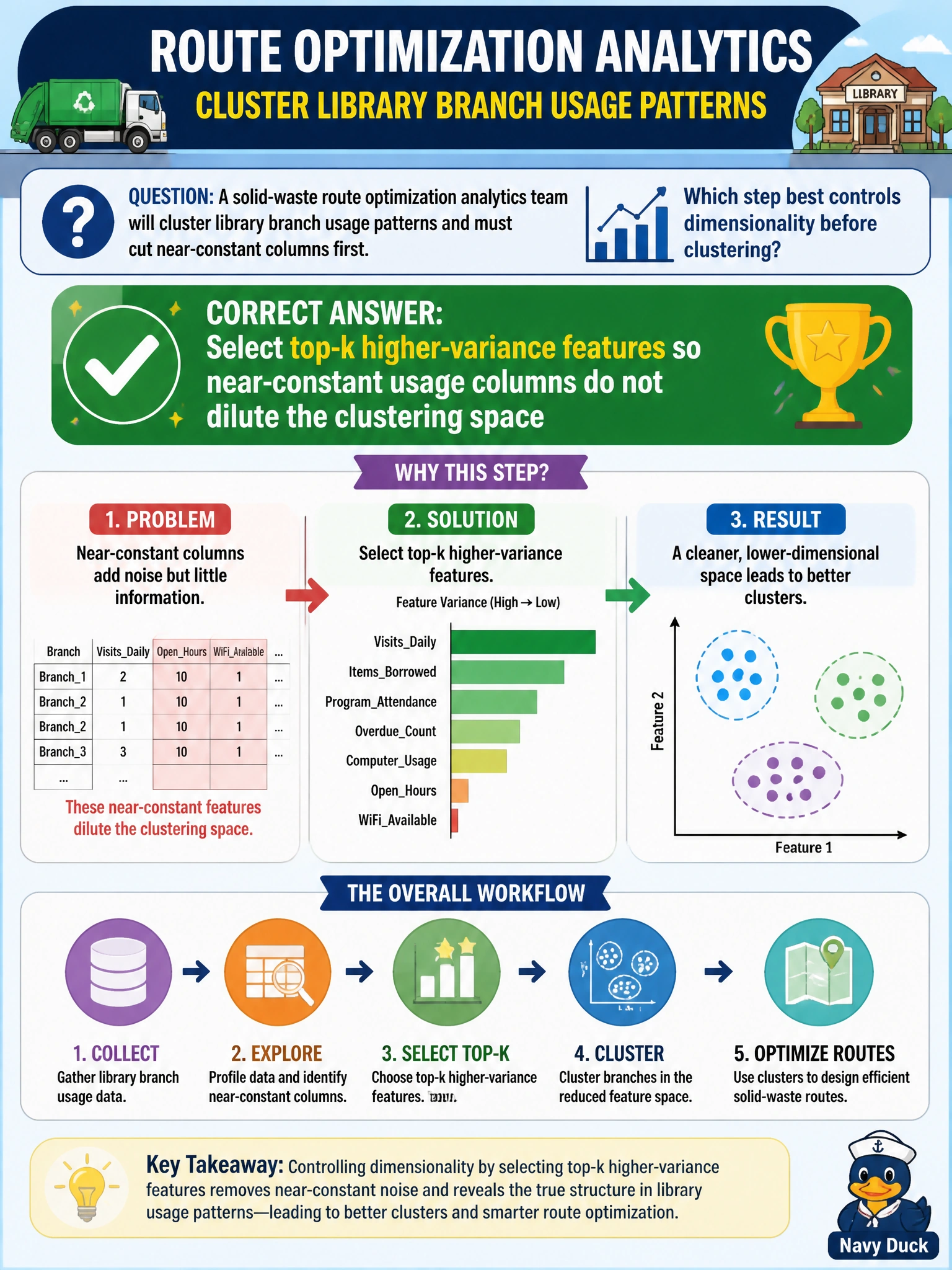
A solid-waste route optimization analytics team will cluster library branch usage patterns and must cut near-constant columns first. Which step best controls dimensionality before clustering?
Select an answer to reveal the explanation.
Short Explanation
A column that barely moves is like a streetlight that is always on—it does not help you tell branches apart. Keep the higher-variance usage features so clustering sees real differences instead of flat noise.
Full Explanation
A solid-waste route optimization analytics team clustering library branch usage patterns should cut near-constant columns before clustering. Selecting top-k higher-variance features keeps dimensions that actually differentiate branches and prevents near-constant usage flags from diluting distances in the clustering space. For civic usage tables, variance screening is a practical dimensionality control that improves cluster separation without requiring a full supervised label set. Retaining only zero-variance columns fails by concept: constants cannot separate branches and collapse the space. Feeding every raw column without screening fails because flat municipal flags and unused counters add noise dimensions that warp distance-based clusters. Converting all numeric usage metrics to binary presence flags fails by discarding magnitude—the difference between light and heavy branch usage disappears even when variance was informative. Exam caveat: high variance does not guarantee business relevance; a noisy sensor or mis-scaled counter can dominate variance and should be reviewed before clustering. Operational check: compute per-column variance on library usage features, drop near-constants, select top-k informative columns, rerun clustering, and compare cluster stability and branch interpretability against the unfiltered feature set.