
A city planning zoning analytics team must shrink a wide feature set for a model that council staff must interpret. When should they prefer feature selection over PCA?
Select an answer to reveal the explanation.
Short Explanation
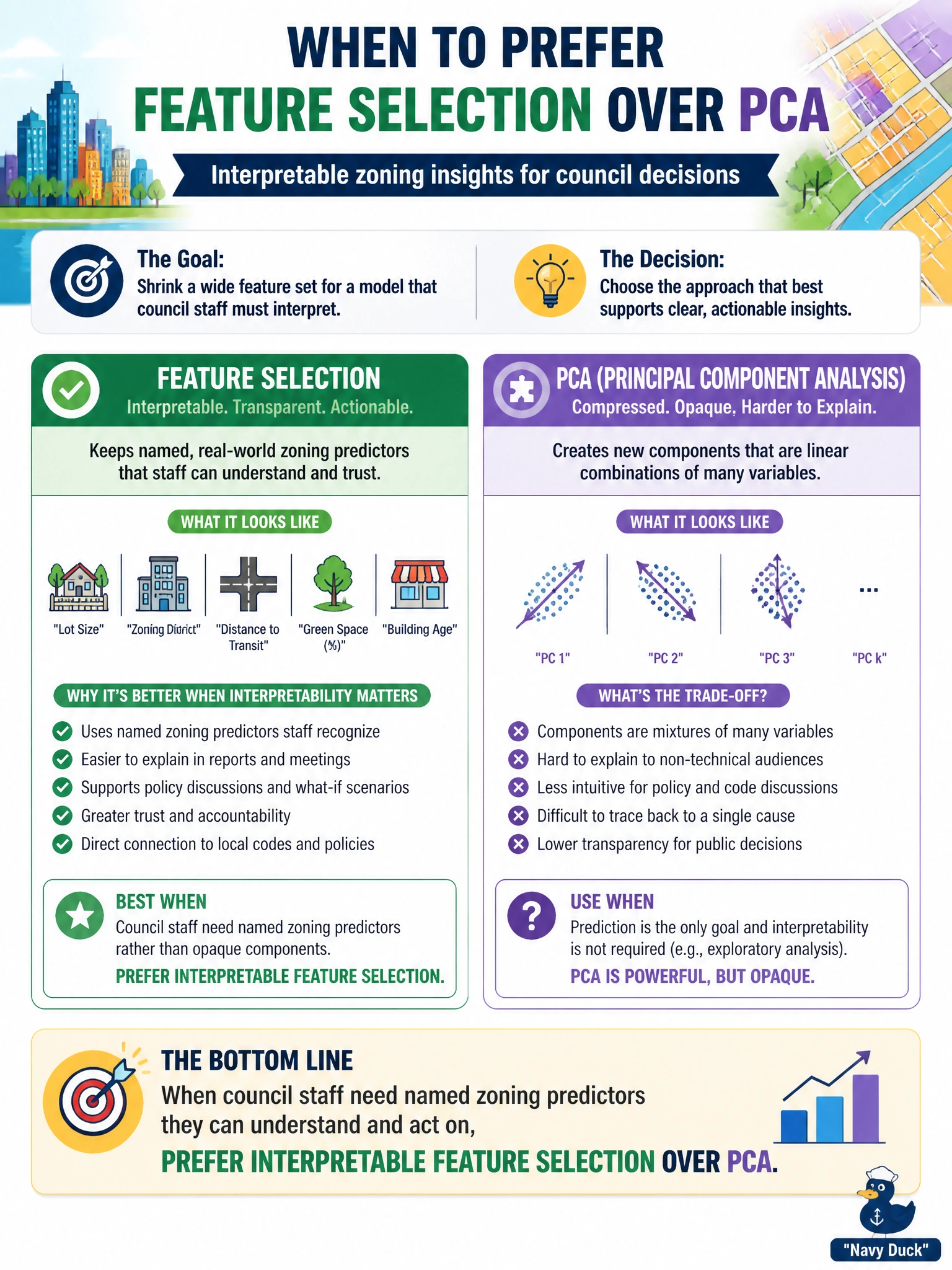
Council staff want to hear about "lot coverage" and "setback variance," not "component three." When explainability matters, pick the named features instead of PCA's blended axes.
Full Explanation
A city planning zoning analytics team shrinking a wide feature set for a model that council staff must interpret should prefer interpretable feature selection when named zoning predictors matter more than opaque components. Selection keeps columns such as lot coverage, setback variance, or use codes that staff already debate in hearings, which makes explanations and policy discussion possible. PCA can compress correlation, but it is the wrong first preference when the consumer of the model needs civic feature names rather than component indexes. Always preferring PCA because loadings are supposedly easier for councils fails by concept: loadings are less intuitive than original zoning field names for non-technical audiences. Dropping both PCA and selection and presenting raw multicollinear columns fails because explanation layers stay unstable and redundant. Using PCA exclusively whenever any two features show nonzero correlation fails by over-triggering compression on weak correlations and sacrificing interpretability without necessity. Exam caveat: feature selection for interpretability can leave residual multicollinearity; you may still need correlation checks or regularization even after choosing named zoning predictors. Operational check: run an interpretable selection method on the zoning table, present the retained named features to planning staff, confirm they can explain a sample prediction in council language, and reserve PCA for internal compression experiments that are not the staff-facing explanation path.