
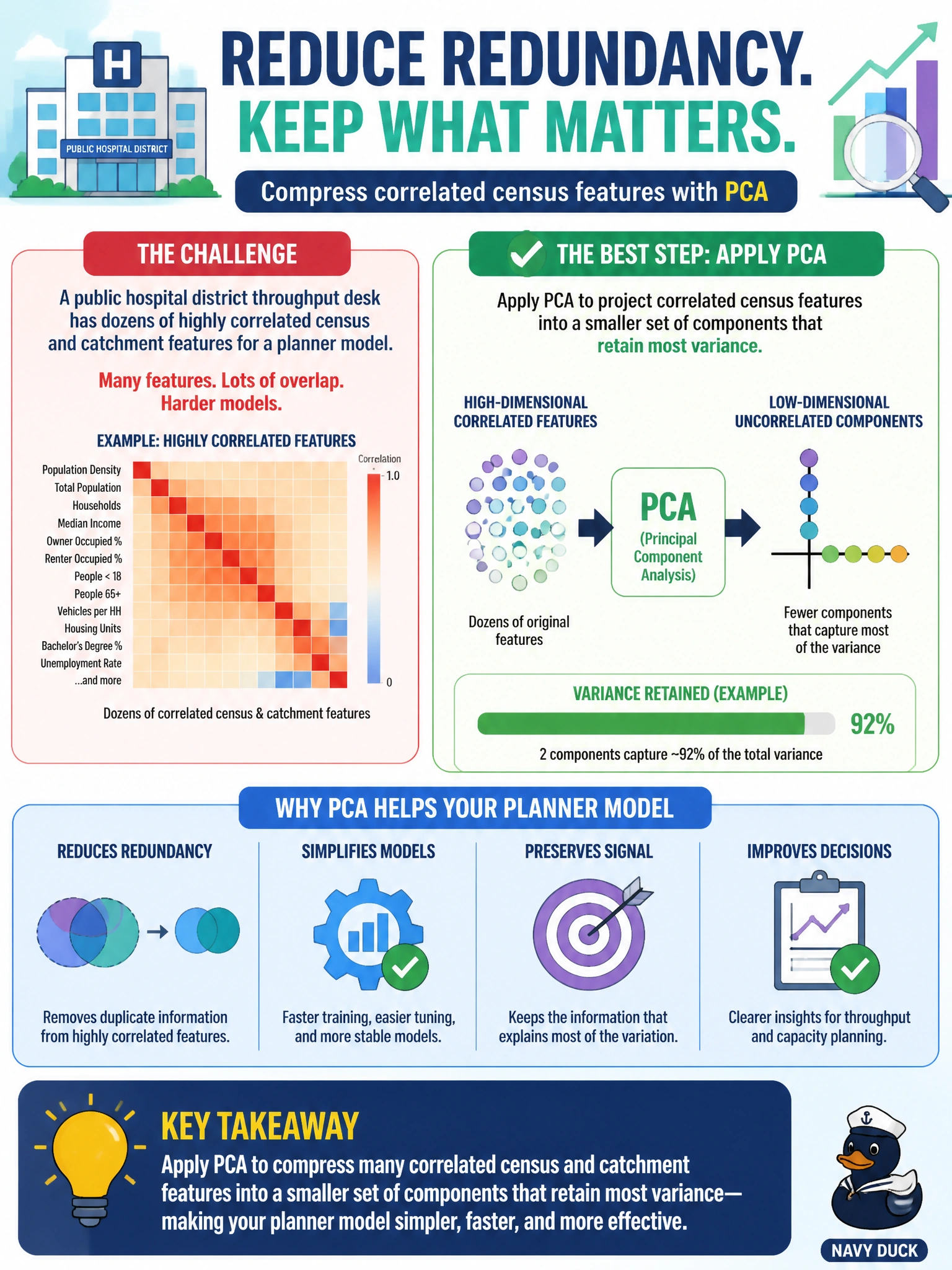
A public hospital district throughput desk has dozens of highly correlated census and catchment features for a planner model. Which dimensionality reduction step best compresses that redundancy?
Select an answer to reveal the explanation.
Short Explanation
Correlated census columns are like three thermometers all reading the same waiting-room temperature—you do not need every dial. PCA folds that shared signal into fewer components so the planner model travels lighter.
Full Explanation
A public hospital district throughput desk with dozens of highly correlated census and catchment features should compress that redundancy with PCA, projecting correlated columns into a smaller set of components that retain most variance. PCA is the dimensionality-reduction step that turns overlapping civic census signals into compact orthogonal components, cutting width for GPU planners without arbitrarily discarding shared catchment information. When many hospital-area demographics move together, components capture the dominant shared structure more efficiently than training on the full collinear width. Keeping every correlated census column unchanged fails by concept: it leaves multicollinearity and unnecessary width that inflate memory and can destabilize linear planners. Duplicating correlated columns fails because repetition amplifies redundancy rather than compressing it. Replacing numeric census fields with random noise fails by destroying real catchment signal and making the planner model learn nonsense. Exam caveat: PCA components are not named census fields; if clinicians or board staff need interpretable predictors, prefer explicit feature selection or be prepared to interpret loadings. Operational check: standardize census features, fit PCA on the training catchment table, choose component count by explained variance, confirm downstream GPU planner metrics hold, and document that production inputs must follow the same scaling and projection pipeline.