
A fire and EMS response-time analytics team applied an imbalance remedy to a fire-risk classifier. How should they judge whether the fix actually helped for rare risk cases?
Select an answer to reveal the explanation.
Short Explanation
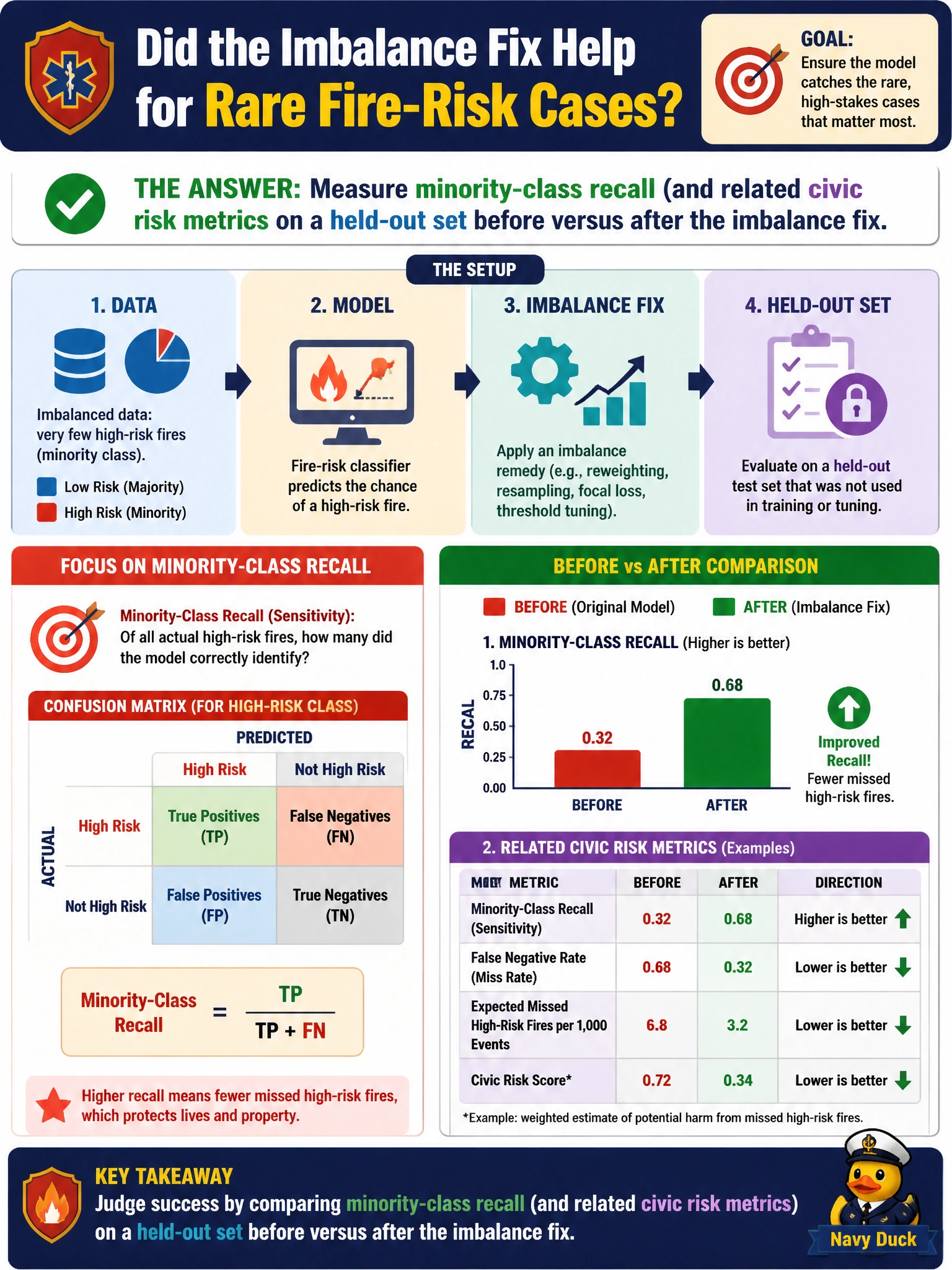
Fixing imbalance is like adjusting a smoke alarm—you care whether it still catches real smoke, not whether the hallway lights look brighter. Check minority recall on held-out fire-risk cases before and after the fix.
Full Explanation
A fire and EMS response-time analytics team that applied an imbalance remedy to a fire-risk classifier should judge success by minority-class outcomes, not vanity metrics. Measuring minority-class recall (and related civic risk metrics) on a held-out set before versus after the fix shows whether rare high-risk cases are actually caught more often. For public-safety scoring, that is the operational meaning of an imbalance fix: fewer missed rare risks under realistic prevalence, with companion metrics for precision or alert burden as needed. Reporting only overall accuracy on the imbalanced test mix fails by concept: accuracy can rise while minority recall stays flat or worsens when the majority class dominates. Comparing training loss curves alone fails because loss may improve from majority fit without any minority gain on held-out fire-risk cases. Declaring success from GPU utilization above ninety percent fails because hardware busyness is unrelated to whether rare risk detection improved. Exam caveat: minority recall gains can be wiped out by threshold changes or distribution shift between training districts and deployment districts; always pair recall with a policy-relevant false-alarm view. Operational check: freeze a held-out fire-risk extract, record pre-fix minority recall and alert volume, apply the imbalance remedy only on training data, re-evaluate on the same holdout, and promote the change only if rare-risk detection improves within acceptable EMS review load.