
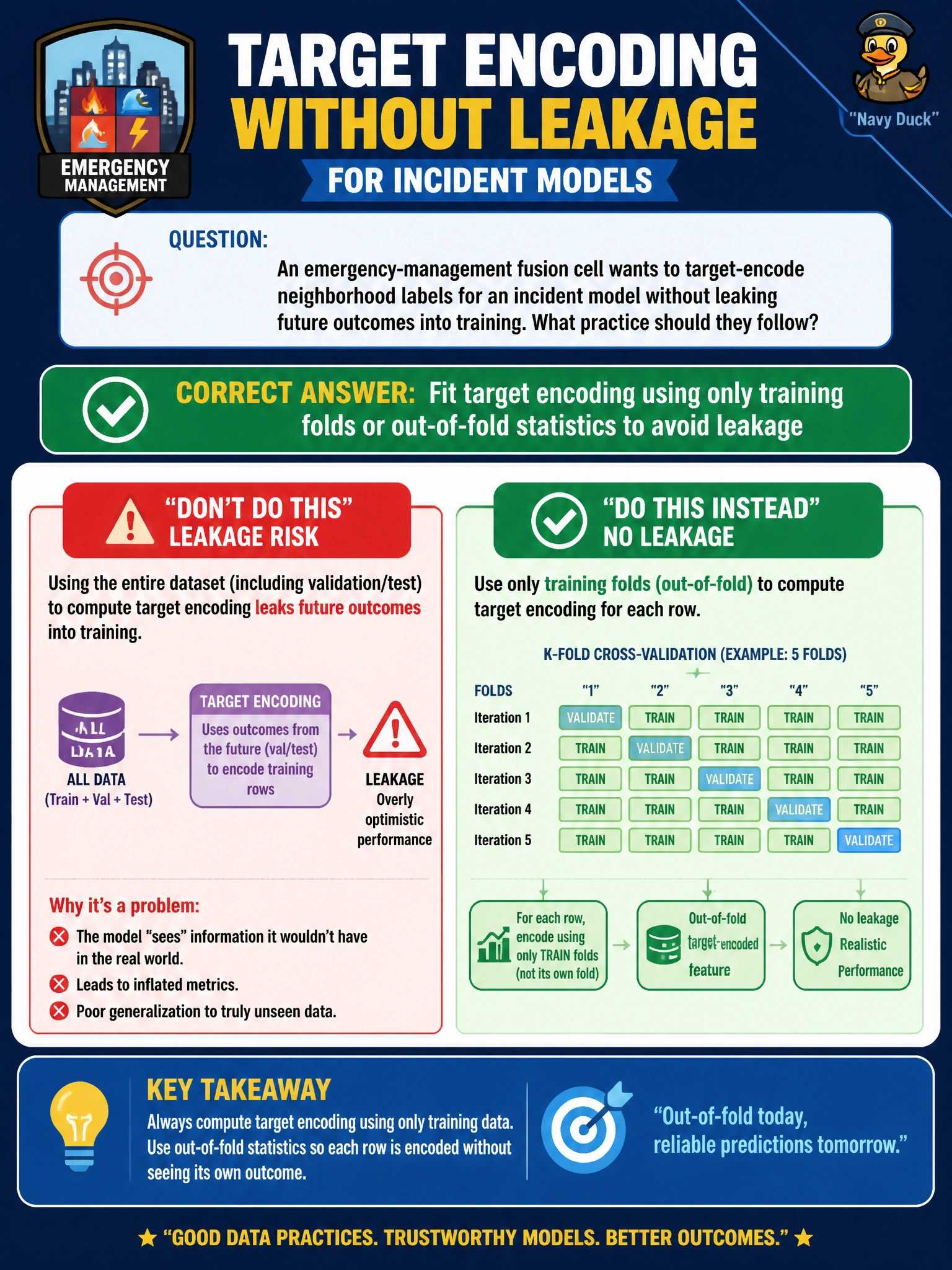
An emergency-management fusion cell wants to target-encode neighborhood labels for an incident model without leaking future outcomes into training. What practice should they follow?
Select an answer to reveal the explanation.
Short Explanation
Target encoding is like grading a neighborhood with its own incident rate—you must not peek at the final exam while writing the study guide. Fit encodings on training folds (or out-of-fold stats) only. Cooking the code with holdout labels is classic leakage.
Full Explanation
Target encoding maps neighborhood categories to statistics of the label (for example, historical incident rate). To avoid leakage in an emergency-management incident model, fit those statistics using only training folds or out-of-fold schemes—never using validation or test rows when computing the encodings applied during training. Out-of-fold or nested approaches give every training row an encoding that does not peek at its own holdout outcome, which keeps offline metrics honest for fusion-cell decisioning and deployment gates.
Computing target statistics on the full labeled dataset including the holdout before splitting leaks future outcomes into features and inflates reported performance. Replacing every neighborhood with the global mean of the test labels is direct test leakage and invents an encoding you would not have at train time. Shuffling labels randomly after encoding to make metrics look optimistic is evaluation fraud and destroys the meaning of the incident target itself.
Exam caveat: production serving must use encodings computed from approved historical windows only; refresh schedules and unseen-neighborhood defaults (global prior, null bucket) need an explicit municipal policy. Operational check: implement out-of-fold target encoding, compare AUC or log-loss against a leaked full-data encoding on the same split, confirm the leaked version looks unrealistically good, and ship only the non-leaking pipeline with documented unseen-key behavior.