
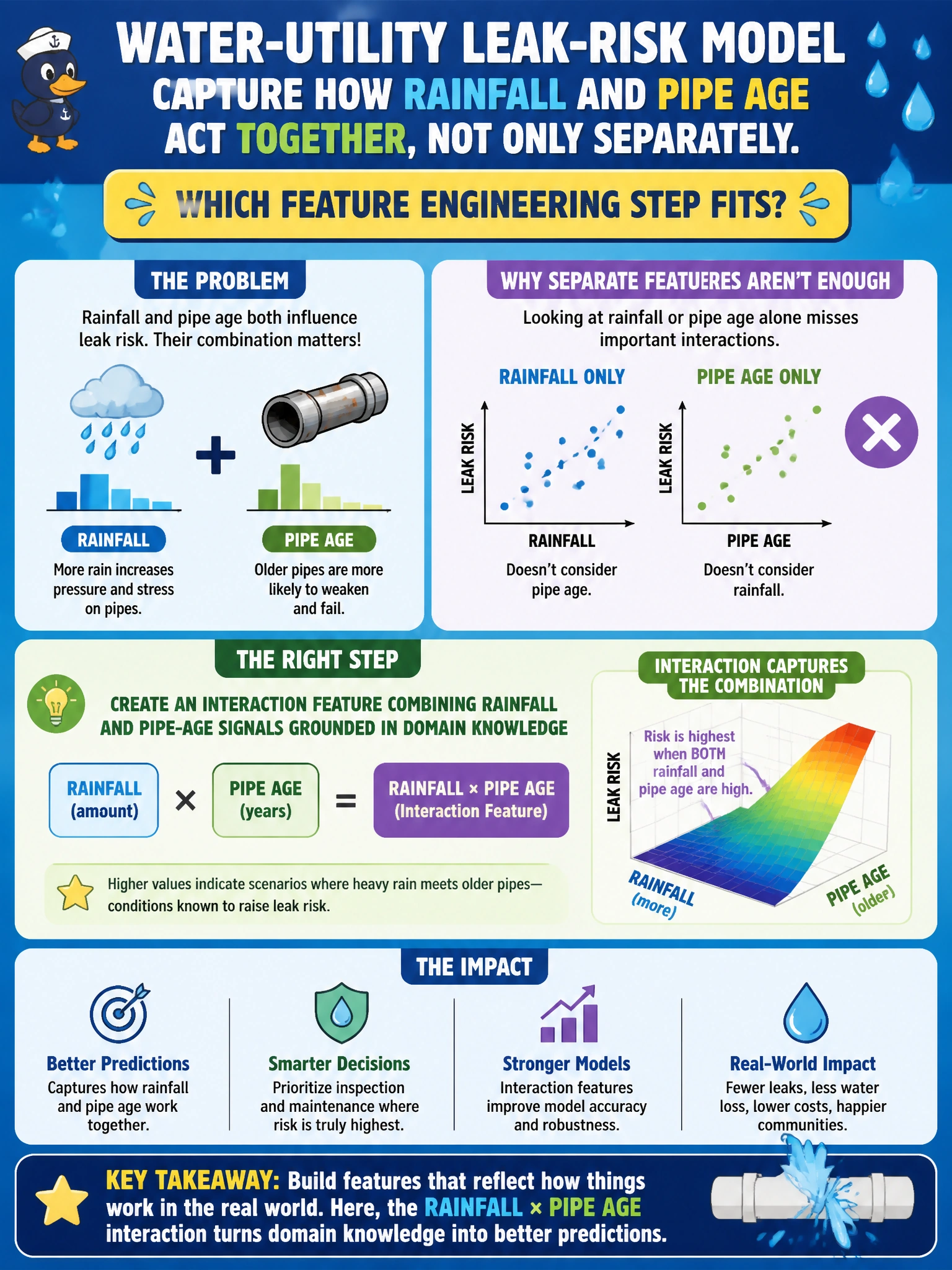
A water-utility leak-risk model should capture how rainfall and pipe age act together, not only separately. Which feature engineering step fits?
Select an answer to reveal the explanation.
Short Explanation
Old pipes in a rainstorm fail differently than new pipes in a drizzle—the combo matters. Build an interaction feature from rainfall and pipe age so the model can see that joint effect. Dropping one signal or using row numbers throws away the physics ops already knows.
Full Explanation
Leak-risk models often need joint effects that single columns miss. Creating an interaction feature that combines rainfall and pipe-age signals—grounded in hydrology and asset-management domain knowledge—lets the model represent how wet weather amplifies failure risk in aging water mains. Numerical interactions (products, ratios, or policy-defined composite scores) are standard feature engineering when utility SMEs already describe the combination verbally in incident reviews and capital planning.
Deleting rainfall whenever pipe age is present throws away half of the joint mechanism and forces the model to ignore storm loading. Encoding pipe age as a random password string unrelated to years destroys numeric meaning and blocks both main effects and interactions. Ignoring domain hydrology and using only the row index as a feature supplies an arbitrary identifier with no physical content and can introduce ordering artifacts if index correlates with collection batches.
Exam caveat: interactions increase feature space and collinearity; document the formula, watch scaling differences between rainfall and age, and validate that the interaction improves holdout metrics rather than only training fit. Operational check: engineer the interaction in RAPIDS, compare models with and without it on a held-out storm period, and review top drivers with utility engineers to ensure the signal matches field experience on leak crews.