
A transit ridership desk wants model features that reflect municipal response-time SLAs such as under 10 minutes, 10–20, and over 20. What should they engineer?
Select an answer to reveal the explanation.
Short Explanation
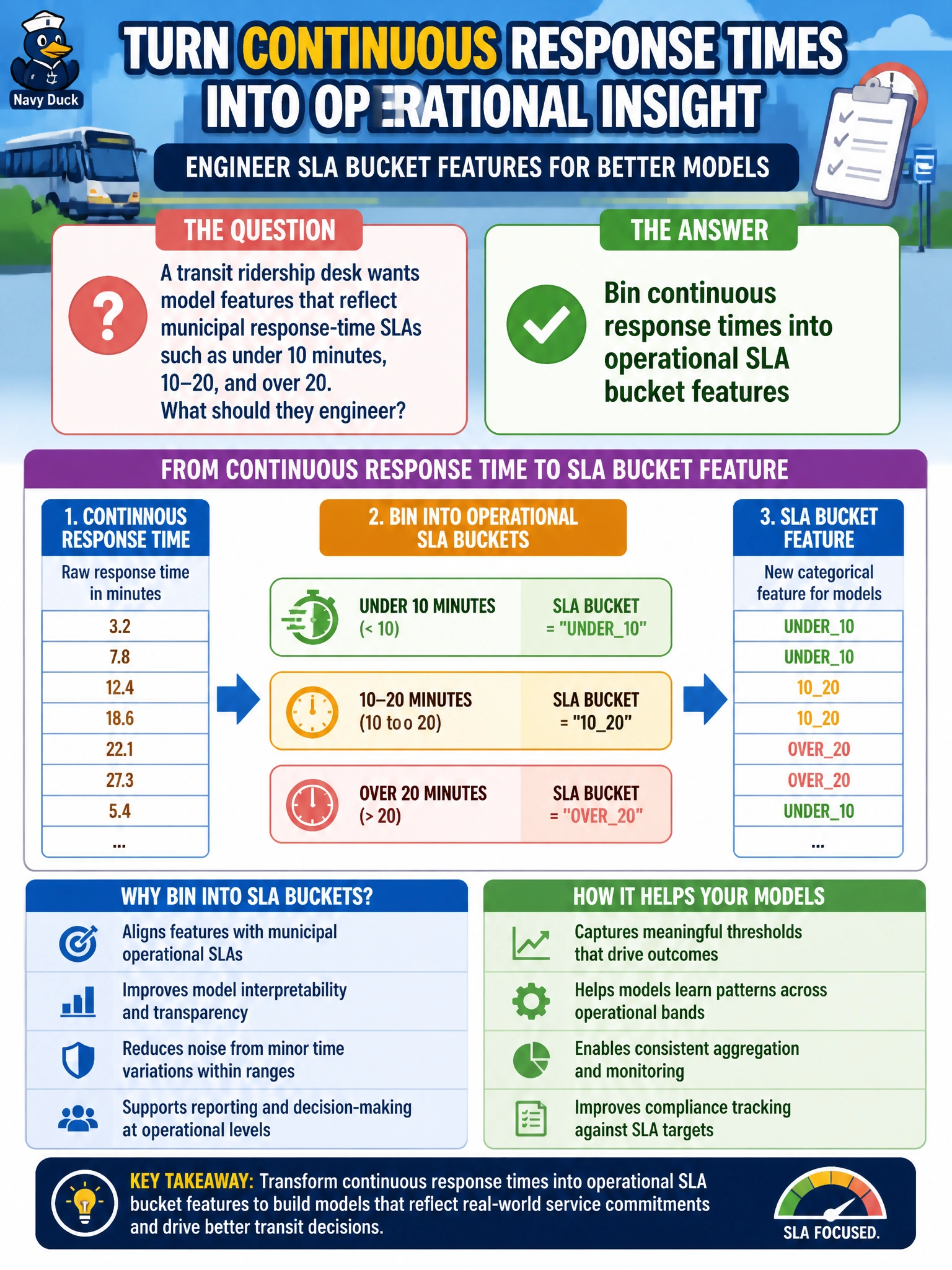
Ops boards already think in SLA buckets—under ten, ten to twenty, over twenty—not raw milliseconds. Bin the continuous times into those municipal bands so the model speaks the same language. Smashing everything to one average erases the SLA story.
Full Explanation
When municipal response-time SLAs are defined as bands such as under 10 minutes, 10–20, and over 20, feature engineering should bin continuous response times into those operational SLA bucket features. Binning aligns model inputs with how transit and emergency ops already manage performance, improves interpretability for stakeholders, and can stabilize learning when raw second-level noise is less actionable than threshold breaches on ridership and response boards.
Leaving only raw continuous seconds and forbidding any bin labels ignores the SLA taxonomy the desk must report to leadership. Replacing all response times with a single citywide average erases variation and makes every row identical on that signal, destroying discriminatory power. Predicting SLA bins with a language model and discarding measured times replaces telemetry with generative guesses—inappropriate when CAD clocks already provide ground-truth durations.
Exam caveat: keep raw duration as well if models or audits need exact seconds; bins complement rather than always replace continuous features, and bin edges should match published SLA policy exactly including inclusive/exclusive boundaries. Operational check: compute bins from policy cut points on a labeled CAD sample, assert counts per bucket match a hand spreadsheet, and confirm dashboard filters on the same bins reconcile with the feature store.