
An elections operations (non-partisan) data team runs countywide property-tax extract transforms that already live in a multi-node Spark estate. When is Spark GPU acceleration a fitting choice?
Select an answer to reveal the explanation.
Short Explanation
If the county already runs tax extracts on a Spark cluster, plugging GPU acceleration into those stages is like putting a turbo on the same assembly line. Keep the multi-node flow; accelerate the heavy transforms. Dumping Spark for a word processor is not an ETL upgrade.
Full Explanation
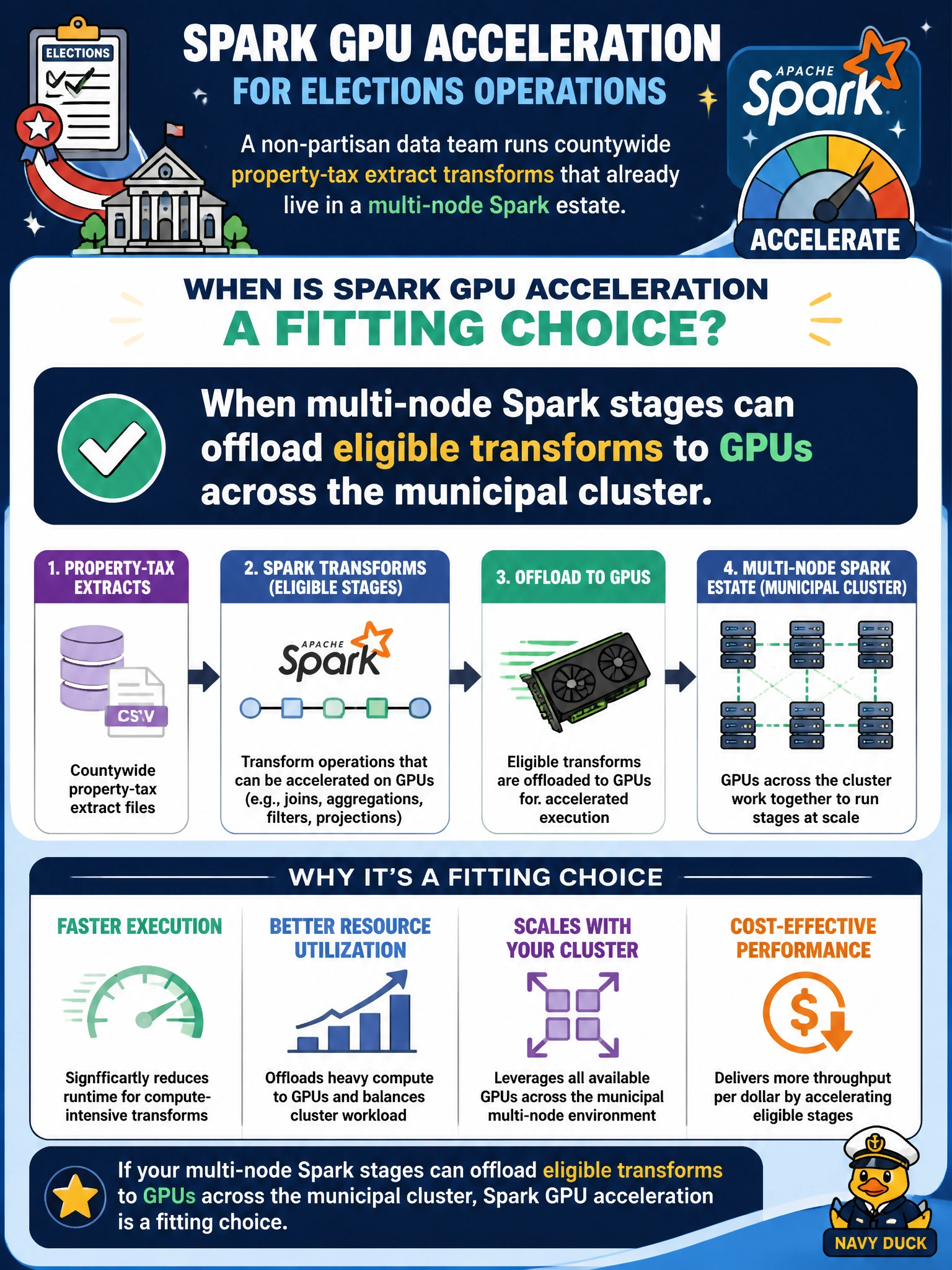
Spark-RAPIDS (or equivalent Spark GPU acceleration) fits when municipal tax ETL already runs as multi-node Spark and eligible transform stages can offload to GPUs across the cluster. That choice preserves the county’s distributed orchestration, fault tolerance, and catalog integrations while accelerating heavy columnar transforms on large tax extracts. It is an acceleration of an existing Spark path, not a demand to abandon the platform.
Abandoning Spark to retype every tax row into a word processor is not an ETL strategy and destroys automation. Restricting GPU use to single-row debugging on a laptop without a cluster misses the scale problem Spark exists to solve. Removing all data validation from the tax extract to "go faster" trades speed for silent fiscal errors—unacceptable in assessor and treasury pipelines.
Exam caveat: not every Spark operator is GPU-accelerated; unsupported stages fall back to CPU, so teams must profile which tax transforms actually benefit and avoid assuming blanket speedups. Operational check: enable GPU acceleration on a staging cluster, compare stage metrics for eligible versus fallback operators on a full tax extract, and keep validation gates (schema, totals, null rates) identical to the CPU baseline before production cutover.