
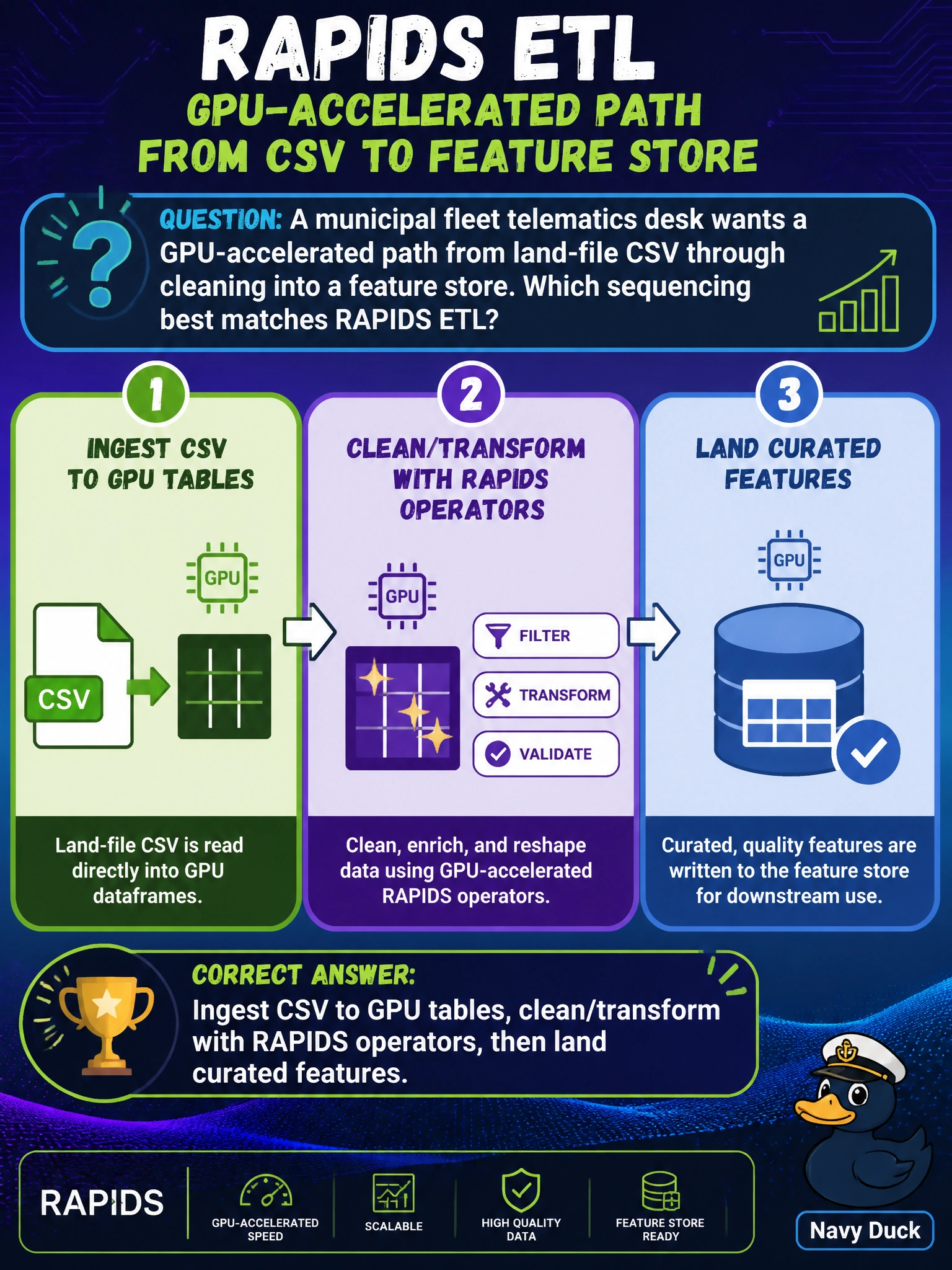
A municipal fleet telematics desk wants a GPU-accelerated path from land-file CSV through cleaning into a feature store. Which sequencing best matches RAPIDS ETL?
Select an answer to reveal the explanation.
Short Explanation
You can think of fleet CSV like a dirty truck at the wash bay: bring it in, clean and transform it, then park the curated features in the feature store. That RAPIDS sequence keeps raw GPS noise out of the finished data; training on raw CSV or skipping cleaning spreads defects instead.
Full Explanation
For municipal fleet telematics, the RAPIDS ETL sequence is to ingest CSV into GPU tables, clean and transform the data with RAPIDS operators, then land curated features in the feature store. This keeps raw GPS noise out of production serving paths and gives models governed, reproducible columns to use. RAPIDS supports the middle stages, including filters, joins, aggregations, and string or time cleanups, before a durable curated landing. Training models first on raw CSV and cleaning labels only after deployment reverses the sequence, allowing avoidable data defects to influence production decisions. Skipping cleaning and writing raw GPS noise directly into the production feature store pollutes data for downstream trainers and online consumers. Printing paper reports and manually entering features into a spreadsheet cannot keep pace with fleet volume and breaks lineage. Exam caveat: “land curated features” implies schema contracts, null policies, and freshness SLAs; a temporary GPU DataFrame left in notebook memory is not a durable landing. Practical check: run ingest, clean, and land on a known telematics fixture, assert feature-store row counts and ranges, and confirm training jobs read only the curated path, with no silent fallback to raw CSV.