
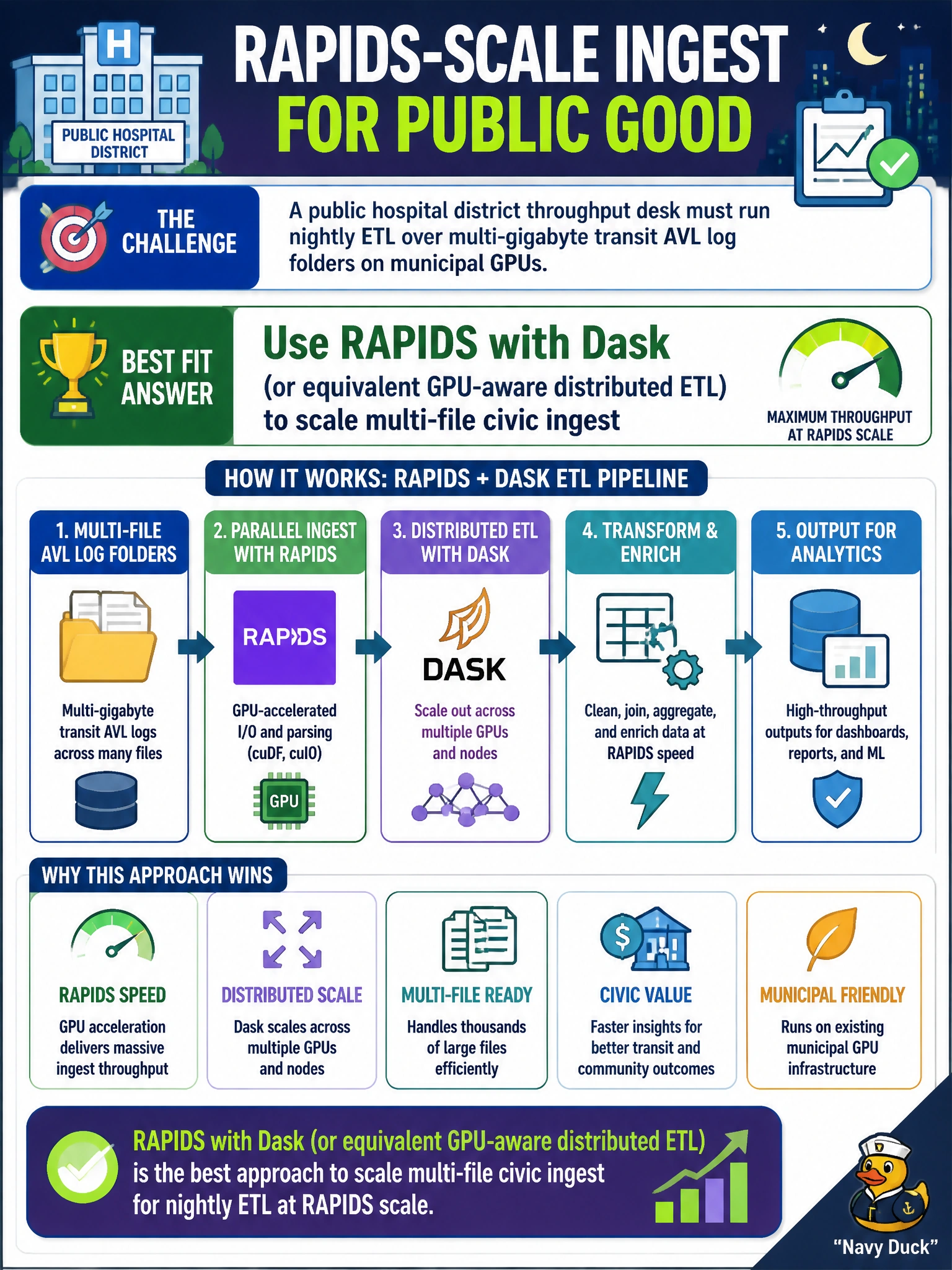
A public hospital district throughput desk must run nightly ETL over multi-gigabyte transit AVL log folders on municipal GPUs. Which approach best fits RAPIDS-scale ingest?
Select an answer to reveal the explanation.
Short Explanation
Nightly AVL dumps are a firehose, not a sticky note. RAPIDS plus Dask (or similar GPU-aware distributed ETL) spreads the clean-and-load work across municipal GPUs. Desktop editors and email merges will not finish before morning rounds.
Full Explanation
Nightly multi-gigabyte transit AVL log folders on municipal GPUs call for GPU-aware distributed ETL. Using RAPIDS with Dask (or an equivalent GPU-aware distributed approach) scales multi-file civic ingest across workers so cleaning and load finish inside operational windows. That pattern matches hospital-district and transit throughput desks that must land large AVL histories before morning analytics, rather than fitting everything into a single fragile laptop process.
Opening each log in a desktop text editor and copying rows into a spreadsheet cannot ingest multi-gigabyte folders and is not an ETL architecture. Processing strictly one CPU core at a time with no GPU libraries leaves both parallelism and accelerator throughput unused against a firehose of AVL files. Emailing CSV attachments overnight for analysts to merge manually is slow, error-prone, and cannot meet nightly SLA or chain-of-custody expectations.
Exam caveat: Dask scheduling and partition sizing matter; too-large partitions still OOM a GPU worker even when the cluster is "distributed." Operational check: partition AVL inputs by time or file groups, run a RAPIDS+Dask ingest on a representative night folder, verify row counts against source file totals, and confirm wall-clock time beats the single-process baseline under the same cleaning rules.