
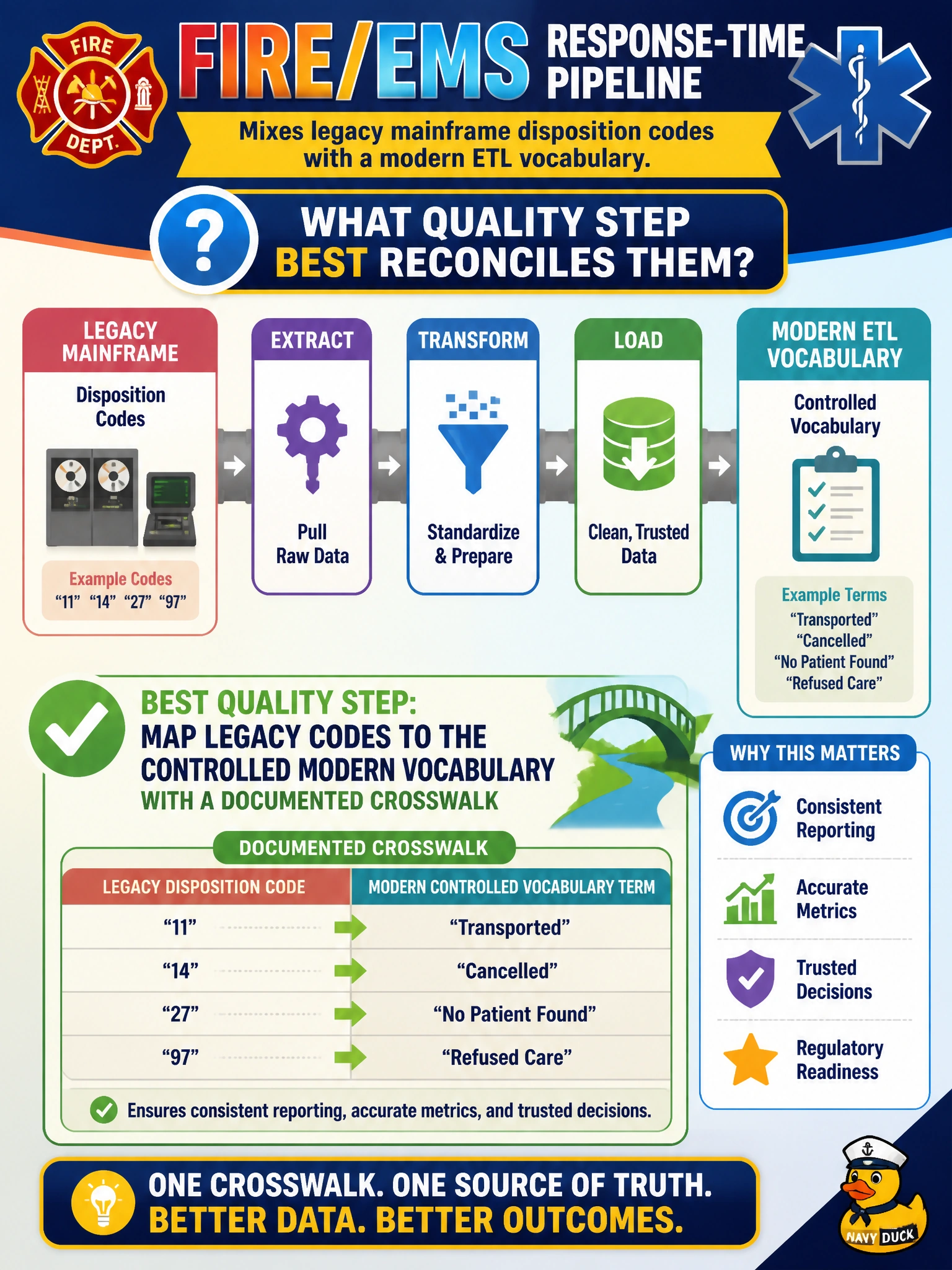
A fire/EMS response-time pipeline mixes legacy mainframe disposition codes with a modern ETL vocabulary. What quality step best reconciles them?
Select an answer to reveal the explanation.
Short Explanation
Two radio codebooks for the same fire run is chaos—dispatchers need one legend. Build a documented crosswalk from legacy codes into the modern controlled list. Hoping dashboards guess, or tossing the codes, leaves response analytics incoherent.
Full Explanation
Cross-system quality compliance for fire/EMS disposition codes requires an explicit, documented crosswalk from legacy mainframe values to the modern controlled vocabulary. Mapping legacy codes into the ETL’s governed list makes joins, groupbys, and response-time metrics coherent across eras of CAD data. The crosswalk itself becomes an auditable civic artifact: reviewers can see how old radio codes land in the current analytics schema.
Keeping both code lists forever without mapping forces dashboards to guess equivalence and yields fragmented KPIs. Overwriting modern codes with random integers to shorten labels destroys semantics and breaks compatibility with reporting standards. Dropping disposition codes from model features entirely throws away operationally meaningful categories (transport, cancel, false alarm, and so on) that response analytics usually need.
Exam caveat: many-to-one and one-to-many legacy mappings happen; document collisions and prefer conservative many-to-one into the controlled list with an "unmapped" bucket for leftovers. Operational check: cover the top N legacy codes by volume with SME-approved targets, measure residual unmapped rate nightly, and fail the pipeline if unmapped volume exceeds a governance threshold.