
Which four of the following technological developments have been most instrumental in allowing organizations to successfully deploy, scale, and run deep learning models in production environments?
Select all correct answers, then click Submit.
Short Explanation and Infographic
Let's dive in. Getting a model to work in a Jupyter notebook is one thing, but deploying it to millions of users in the real world is a whole different ball game. To do that, we needed some major breakthroughs. First, quantization and compression let us shrink models so they run fast on everyday devices. Second, containerization (think Docker) solved the 'it works on my machine' headache, making deployments consistent. Third, the cloud gave us instant, elastic GPU scaling. And finally, edge devices with dedicated AI hardware (like TPUs or NVIDIA Jetson) let us run inference locally without relying on the cloud. What we didn't need was going back to manual feature engineering or locking down code with proprietary libraries. The open-source community and automated learning are what pushed us forward. Got it? Sweet.
Full explanation below image
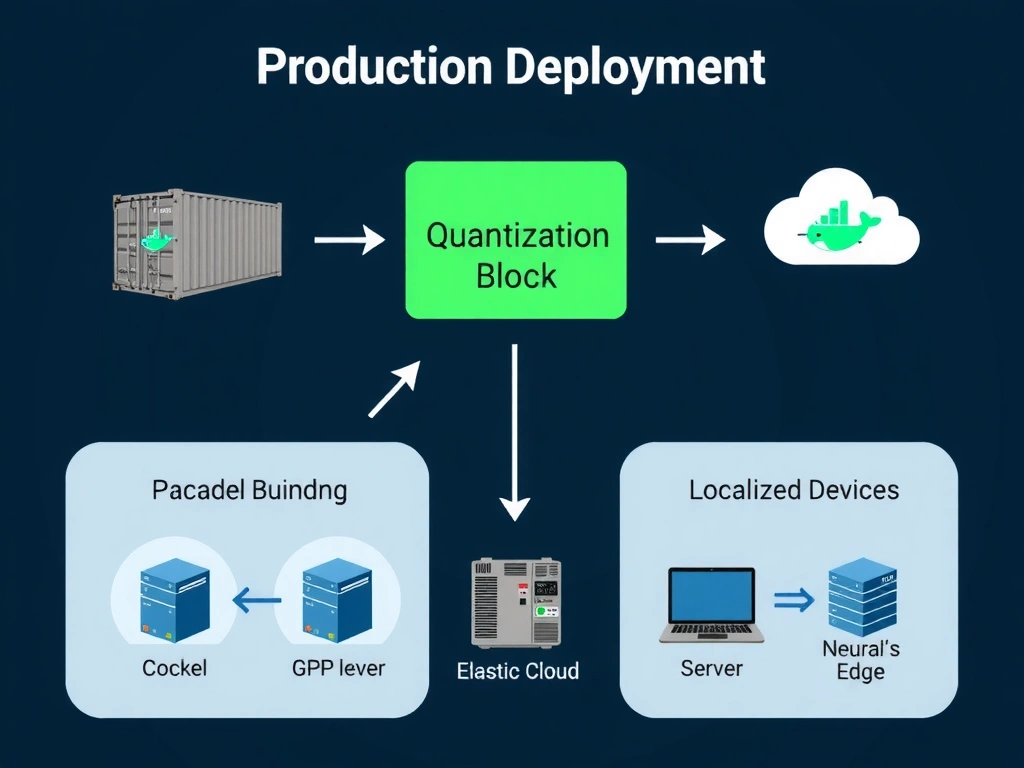
Full Explanation
Scaling and deploying deep learning models in production environments requires overcoming challenges related to hardware constraints, software environment consistency, infrastructure scalability, and network latency. Four distinct advancements have addressed these challenges: 1. Model Quantization and Compression (Option A): Techniques like FP16, INT8, or INT4 quantization, along with pruning, reduce the memory footprint and computational requirements of deep learning models. This allows complex models to be deployed on mobile phones, IoT devices, and local embedded systems. 2. Containerization (Option B): Tools like Docker isolate the model, its runtime dependencies, and CUDA library versions into a single package. This guarantees that the model runs identically across development, staging, on-premise, and cloud production environments. 3. Cloud Infrastructure (Option C): Cloud providers offer elastic access to GPU clusters and managed machine learning endpoints. This allows organizations to scale computing resources dynamically to handle spikes in request traffic without massive capital investments in local servers. 4. AI-Enabled Edge Devices (Option E): Hardware accelerators deployed at the network edge (such as smart cameras and robotics controllers) enable local, low-latency inference without requiring round-trip network connectivity to a central cloud.
Let's look at the incorrect options: - Option D is incorrect because the AI revolution has been fueled by open-source collaboration (e.g., PyTorch, TensorFlow, Hugging Face), not proprietary, closed-source restrictions. - Option F is incorrect because deep learning's primary strength is automated feature extraction; reverting to manual feature engineering would undermine the efficiency and accuracy of modern AI architectures.