
Deploying and scaling complex deep learning models in production environments presents major challenges in terms of latency, portability, and resource constraints. Which four of the following technological advancements have been most critical in overcoming these challenges to enable real-world deployment? (Choose four)
Select all correct answers, then click Submit.
Short Explanation and Infographic
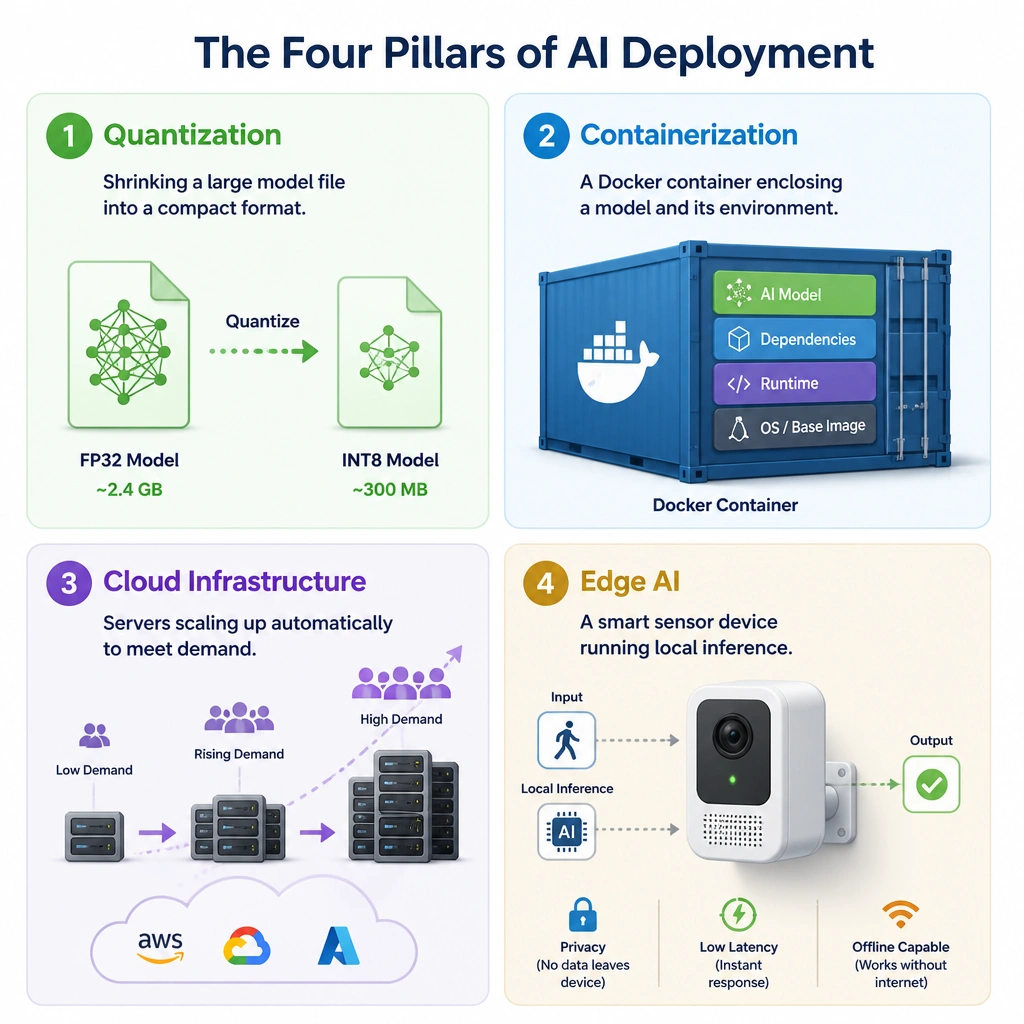
Okay, let's look at what it actually takes to push a deep learning model out of the lab and into the real world. First, models are huge, so we need to shrink them without losing accuracy. That's where quantization and model compression come in. Second, we need our models to run the same way on a developer's laptop as they do in production. Containerization with Docker solves that portability headache. Third, we need massive, scalable computing power, which we get from cloud platforms. And finally, we want AI running locally on small devices—like smart cameras or self-driving cars—so we need specialized edge hardware with built-in AI processors. These four pieces are what make modern AI deployment possible. Avoid options D and E—they are backward steps!
Full explanation below image
Full Explanation
Taking deep learning models from experimental environments and scaling them in production requires solving problems of hardware efficiency, environmental consistency, scalability, and latency. Four advancements have been key to this transition: 1. Model Compression and Quantization: Techniques like post-training quantization (PTQ) and weight pruning reduce model size and memory requirements (e.g., converting FP32 parameters to INT8), allowing them to run faster and fit on lower-power hardware. 2. Standardization of Containerization: Technologies like Docker allow developers to bundle models, libraries, and dependencies into a single container. This ensures that the model runs identically across development, testing, and production environments, simplifying CI/CD pipelines. 3. Cloud Computing Platforms: Cloud hyperscalers provide instant access to scalable GPU, TPU, and CPU clusters, allowing organizations to scale inference and training services dynamically according to demand. 4. Dedicated Edge-Computing Hardware: The emergence of system-on-chips (SoCs) and edge devices equipped with dedicated AI accelerators (such as NPU cores or edge GPUs) allows low-latency inference directly on-device, removing the need for a constant network connection. Option D is incorrect because closed-source restrictions hinder integration and scaling. Option E is incorrect because manual feature engineering represents a step backward from the automated feature learning that defines deep learning's success.